Durst has produced its biggest, fastest dye-sublimation roll printer yet, able to print and fix internally, or print to transfer paper, to tackle the biggest jobs. Michael Walker draws back the curtain
Michael Walker
November 10, 2025
If you want to print on textiles for soft signage or décor, most options run out after you get to around 3.3m wide. Big enough, you say? But what if you need to wrap a building, make a stage backdrop, or dress a two-storey tradeshow stand? Here you might find a machine that can output a roll of 5m width or more, though previously you wouldn’t have been spoilt for choice in this segment.
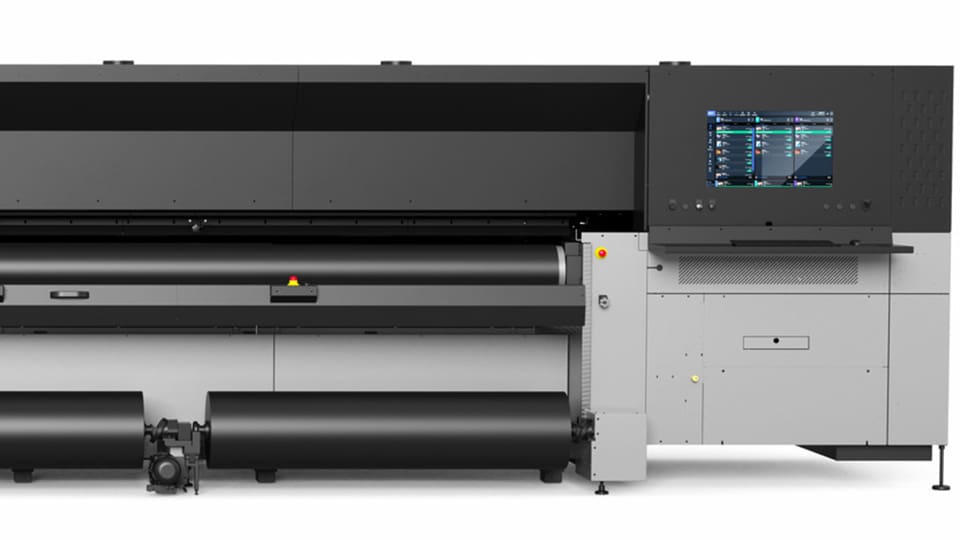
Aiming to broaden the field – in all senses – is the most recent addition from the Durst stable, the P5 500 TEX iSUB, which was launched at FESPA 2025 in Berlin. Breaking down the alphanumeric naming, ‘P5’ tells us it’s built on the P5 platform that Durst introduced in 2018, initially for its hybrid line of UV printers, while the 500 represents the approximate roll width in centimetres (it’s actually a 5.2m machine). TEX is obviously for textile and iSUB relates to Durst’s internal dye sublimation fixing technology that means you don’t need a separate calender if you’re printing directly to the polyester-based fabric.
Can We Fix It?
Apart from the printer’s size, the iSUB system is one of the top features of the P5 500 TEX iSUB. Introduced in 2021 with the original 3.3m P5 TEX iSUB, this technology uses Durst’s Sublifix inks to print directly to fabric for internal fixing using a novel and probably unique non-contact fixing process, while also being able to print to thermal transfer paper for conventional calendering onto stretchy or non-pretreated fabrics.
The Press can be used to make a variety of retail and event graphics
Durst is coy about how iSUB works in terms of technical details but says the advantages of its approach are multiple, avoiding ink bleed, dust contamination, or fabric discolouration, resulting in improved colour consistency and sharp reproduction of text or other fine graphic details, even on thin fabrics or ‘difficult’ materials like blackback, backlit, and flag fabrics. It’s also claimed to maintain the soft-touch feel of fabric.
Durst is coy about how iSUB works in terms of technical details but says the advantages of its approach are multiple, avoiding ink bleed, dust contamination, or fabric discolouration
Carrying out the fixing process inside the same machine saves both time, thanks to not needing a subsequent process, and space, as a separate calender isn’t needed for most applications. As well as reducing handling and potential marking or damage, the shortened process brings faster turnaround and lower costs, not least because the whole machine can be operated by one person. Durst claims a 60% reduction in energy costs compared to a two-step process using a separate calender and a 40% saving in production time.
Go Big or Go Home
The new machine essentially expands this all-in-one production of printed fabric ready for cutting, sewing, mounting, or otherwise finishing to the 5.2m width, reducing or eliminating the need to sew together narrower panels in the bigger applications. While the 3.3m model had a facility to print independently on two rolls of up to 1.6m width, the P5 500 doesn’t offer this (it could potentially handle three rolls at that width), so it really is only for jobs that need more than the 3.3m width.
As well as handling the bigger rolls of fabric, it goes faster than the 3.3m, though perhaps by less than you might expect. While both models can hit an impressive sounding 422 m2/hr on transfer paper (which is limited to 3.3m rolls, hence no speed improvement for the 5m model), printing direct and fixing using the iSUB drying process slows them down, with the original machine producing up to around 130 m2/hr and the new one 152 m2/hr. While that’s not to be sniffed at – bearing in mind that this is printed fabric that can go straight into finishing – it doesn’t scale in proportion with the extra width of the 5.2m roll. Durst says this is because ‘the primary goal was not maximum speed but delivering exceptional image quality and colour uniformity at ultra-wide widths.’
The Durst P5 500 was launched in 2022 as a five-meter large-format printer with LED curing technology
To that end, both models use the same number of Ricoh Gen 5 printheads – 16 – for CMYK print, but there are options for additional colours within that which include light cyan, light magenta, and light black for smoother gradients in things like skin tones, plus a gamut-expanding orange and a dedicated Permeo agent to help with ink penetration into double-sided materials such as flags so that both sides match visually. Up to eight channels are supported, so you can’t quite have all of these at once.
The Ricoh printheads offer resolutions of 400 x 600dpi in greyscale mode and 800 x 600dpi in binary. The drop size options in the former mode are 7, 14, and 21pl, while the latter uses 7pl only, hence the higher resolution. The choice of which to use will depend on the type of material, application, and the graphical content; fine details and smallish text would call for the higher resolution while large photographic images with subtle colour gradation will benefit from the greyscale mode.
The P5 500 TEX iSUB can handle media rolls weighing up to 200kg and up to 350mm in diameter; like its smaller sibling incorporates a roll sewing device that allows rolls to be joined on the machine to minimise wastage when switching. A ‘smart’ exhaust system deals with fumes. Printing to transfer paper requires the installation of light vacuum plates inside the printer, a simple task that the user can perform in a few minutes. These provide the necessary drawdown to hold thin transfer paper sufficiently flat as the printhead carriage passes over it without applying the kind of tension that could cause it to tear.
Statistics
Width: 5.2m
Speed: Up to 152m2/hr including iSUB fixing; up to 422m2/hr to transfer paper
Print Heads: 16 x Ricoh Gen 5
Resolution: Up to 800 x 400dpi
Colours: CMYK standard – eight channels
On the software side, the P5 500 TEX iSUB is driven by Durst’s existing workflow offering that runs all its machines, providing RIP and substrate/setting-specific colour management functions, and production monitoring via a dashboard. This can be expanded with the company’s Analytics and Lift ERP offerings for larger multi-machine sites.
The big beast has had a positive reception since its introduction in the late spring, with more than 20 units sold at the time of writing in early August. Durst comments: “The launch has generated tremendous interest, affirming the market’s need for a high-quality ultra-wide dye-sub solution.” Given that there are few alternatives at this size – EFI’s Matan 5 perhaps being the only one from a ‘big name’ printer manufacturer and still requiring an external calender – it looks like Durst has a strong offering here.
Michael Walker is a trade journalist, technical writer, and editor with over 37 years’ experience in the print, prepress, photography, and digital imaging sectors, with a particular interest in the digital transformation of processes. In addition to editing Desktop Publishing Today and Digital Printer magazines, he is co-author with Neil Barstow of Getting Colour Right (Ilex Press, 2004) and Practical Colour Management for Photographers and Digital Image Makers (2009, self-published e-book) and winner of a Communicators in Business Gold Award.
HP is looking to boost the life and appeal of its R-series hybrid Latex printers in rigid media applications with the introduction of an automated feeder/stacker that aims to improve overall productivity from loading to output. Michael Walker joins the queue
SwissQprint has added a lower production variant to its established 3.2 x 2m UV flatbed printer platform, offering the same features and fifth-generation engineering base as the established Nyala and Kudu models. Michael Walker looks at what’s on the table
Kongsberg set its sights on the corrugated market with the 2024 launch of the Ultimate line of digital cutting tables. Michael Walker looks at the smallest member of the family
Watch our latest video of the week
SignLink gives you the latest video coverage of companies, people, and events from within the signage, graphics, and wide-format print industries.