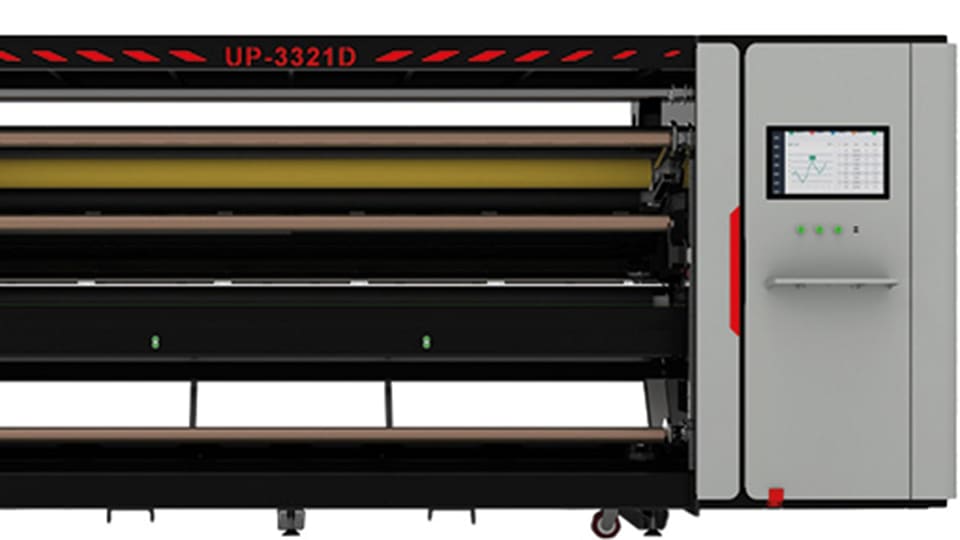
If you ever need to print double-sided UV graphics, the Hapond UP-3321D from CPS might be just the timesaver you need, while giving you plenty of single-sided firepower for the rest of your work. Michael Walker looks at how this Chinese offering flips the script
Michael Walker
February 25, 2026
When is a 3.2m UV printer not a 3.2m UV printer? When it’s two 3.2m UV printers in one! Ok, so that’s not even up to the standard of the worst Christmas cracker jokes, but it is an accurate description of the Hapond UP-3321D, a novel Chinese-made printer now available in the UK through China Print Supplies (CPS), which made its UK debut at The Print Show in September 2025.
The product is a single printer that has two printhead carriages which can be run simultaneously but independently on different media, or configured to print double-sided on one roll in a single operation, thus avoiding the delay, complexity, and scope for error of reloading, reversing, registering, and printing via a conventional single-sided printer. It doesn’t do anything you can’t do another way, but it makes the double-sided option very much simpler and faster to execute, while acting as two separate printers in the same footprint (about 5.8m wide by under 1.8m deep, and nearly 2.2m high) the rest of the time. One ‘printer’ or roll has a low loading position while the other has a built-in winch to load rolls of media above head height without difficulty.
Performance is up to 75m2/hr for each printhead carriage, so with both in play that’s up to 150 m2/hr, whether that’s on two separate rolls or on both sides of one. Switching between modes is said to be a two-minute job according to CPS managing director, Scott Clutton, making it very practical to mix in double-sided work with regular single-sided jobs, subject to always having the right media for the right job. When switching to double-sided, media already loaded on the ‘spare’ roller can be wound back, ready to be fed back in when single-sided working resumes.
Performance is up to 75m2/hr for each printhead carriage, so with both in play that’s up to 150 m2/hr, whether that’s on two separate rolls or on both sides of one
Print resolutions range from 508 x 1080dpi via three passes to 508 x 2160dpi with six passes, with the usual trade-off between speed and quality. This is delivered by Konica Minolta printheads, arranged in rows of four or six. There is a choice of 6 or 13pl heads, with the former giving finer quality and the production speeds quoted above, while the latter add some 15% extra throughput but at the expense of the better quality. Clutton recommends the 6pl option as it allows for greater versatility in the type of work that can be handled. The colour options are standard CMYK or in six-colour configurations, light cyan and light magenta can be added for improved rendering of subtle graduations as found in skin tones. Clutton says that a seven-colour version could be built, allowing light black to complement the other light inks. There is also an option for white ink, so there’s considerable flexibility to play with when configuring the printer. Curing is via LED, as is pretty much standard for UV these days.
The device uses Konica Minolta printheads
On the software/RIP side, either Caldera or Print Factory can be supplied, bringing with them their respective workflow, production, and colour management capabilities. Clutton says that when printing on two rolls, each can operate entirely independently of the other, allowing maximum flexibility in loading, printing, and collecting work from each. With a weight of around five tonnes, he says vibration from the differing movements of the printhead carriages, whatever their respective positions and direction, isn’t an issue.
Registering No Concern
A key factor in double-sided printing is front-to-back registration. While the dual-sided printing mode should inherently avoid any of the material stretch or contraction issues that may arise with single-sided print-roll-reverse working, the Hapond machine goes further. Mr Clutton explains: “It’s very accurate, as it prints a small calibration at the start of a run and continuously along the sides, so you can adjust not only for position left-to-right and front-to-back but also [for] any media stretch. For instance, if it pulls a little more in the middle you can adjust at five points along the length.”
The biggest benefit is of course the labour saving in double-sided printing, which becomes more important for users who don’t need to do much of it, or who are keen to expand their portfolio of services but without significantly impacting their regular single-sided print operations in order to add it. As already pointed out, it doesn’t make possible anything that you can’t do with a single sided printer, but it could make a lot of mixed work a great deal more practical.
Customers can choose between a four or six colour configuration setup when purchasing
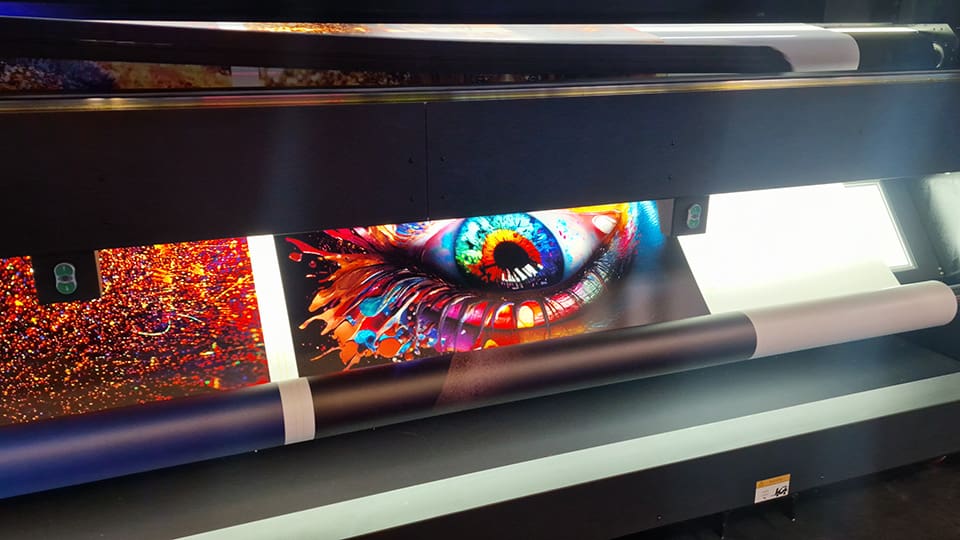
So, what are the types of double-sided work that might entice you to think about investing in one these printers? Simple light box signage is one, where normal single-sided printing for backlit use would put all the ink on one side, producing a result that could look dull in daylight or other external light, and possibly causing problems with the media ‘bruising’, depending on the total ink coverage needed. By printing a normal ink level for reflective daytime illumination on one side and the additional colour needed for backlit density on the other, you can have a result that doesn’t need constant backlighting, saving energy, but which looks good in both ambient and backlit modes. It also avoids the need in day and night printing where a white layer is required between the day and night ink layers, simplifying production and saving ink.
Clutton says: “The printer also produces colours to rival any sublimation or textile printed backlit without needing masses of heat and a separate calender etc. So again, [it’s] an environmentally and cost-effective solution.” Another application that requires double-sided printing is partition curtains, which can be imaged separately on each side using suitably opaque material, though potentially needing white ink.
CPS is the exclusive UK reseller for the Hapond printer and is responsible for UK service and support. While it’s early days in terms of local market uptake, Clutton reports that visitors to The Print Show who saw the printer were “blown away” by the colour and quality. He notes that with prices for 3.2m single-roll printers starting from upwards of £60,000, he feels that the Hapond’s offering of what is effectively two 3.2m printers with “real world” production speeds of 50m2/hr – and faster on banner material – for around £135,000 is “pretty good value”.
With prospective customer demonstrations scheduled to begin in early 2026, it won’t be long before we see if UK printers are up for a bit of Chinese innovation.
Statistics
Print Heads: Up to 36 in six-colour version, 24 in four-colour version Ink Type: UV curable ink Ink Colours: CMYK with optional white, and light cyan and light magenta Print Speed: Up to 150m2/hour Max Print Width 3,200mm
Michael Walker is a trade journalist, technical writer, and editor with over 37 years’ experience in the print, prepress, photography, and digital imaging sectors, with a particular interest in the digital transformation of processes. In addition to editing Desktop Publishing Today and Digital Printer magazines, he is co-author with Neil Barstow of Getting Colour Right (Ilex Press, 2004) and Practical Colour Management for Photographers and Digital Image Makers (2009, self-published e-book) and winner of a Communicators in Business Gold Award.
HP is looking to boost the life and appeal of its R-series hybrid Latex printers in rigid media applications with the introduction of an automated feeder/stacker that aims to improve overall productivity from loading to output. Michael Walker joins the queue
SwissQprint has added a lower production variant to its established 3.2 x 2m UV flatbed printer platform, offering the same features and fifth-generation engineering base as the established Nyala and Kudu models. Michael Walker looks at what’s on the table
Kongsberg set its sights on the corrugated market with the 2024 launch of the Ultimate line of digital cutting tables. Michael Walker looks at the smallest member of the family
Watch our latest video of the week
SignLink gives you the latest video coverage of companies, people, and events from within the signage, graphics, and wide-format print industries.