Finding the Best Cut with the Kongsberg Ultimate 24
Kongsberg set its sights on the corrugated market with the 2024 launch of the Ultimate line of digital cutting tables. Michael Walker looks at the smallest member of the family
Michael Walker
April 22, 2026
For any sign-maker already handling rigid materials, the move into printing onto corrugated looks like a fairly natural progression and opens up new applications in point-of-sale (POS) display and constructional materials for exhibitions, as well as customised short-run or sample packaging production. But the material has its own particular characteristics and existing finishing gear might not be suitable for the combination of cutting, creasing, and perforation that’s needed.
That’s what Kongsberg’s Ultimate line of cutting tables is designed for. Previewed at a customer event at the end of 2023 and launched to the wider world at drupa 2024, the new family was designed to provide a significant hike in performance for the requirements of complex corrugated finishing, particularly in the light of continuing trends for shorter runs, more custom and complex shapes, plus pressure for both increased sustainability and profitability as printing systems get faster and finishing needs to keep up.
The Cut of a Thousand Lifts
To do what was needed, Kongsberg studied a range of typical jobs in detail and worked out how best to optimise performance and accuracy with some engineering innovations. Research director, Simon Kvanvik, notes that some POS /Free Standing Display Unit (FSDU) jobs could have up to a thousand cutting tool lifts in addition to the various cuts or creases that are made in the substrate, and that increasing cutting speed alone isn’t necessarily the answer.
“We built an analysis of how increased speed or acceleration would affect performance in typical jobs. We found that increased acceleration has four to five times the impact of increased [maximum] speed,” he explains, “but you need both for the best performance.”
Therefore, a key design objective for the Ultimate range is how fast the cutting head assembly can be accelerated (and decelerated), in not just the usual x and y directions but also including the raising and lowering of the cutting head. The result uses a variant on the linear direct drive motor that Kongsberg calls PrecisionDrive, to achieve acceleration of up to 2.7G (G being the acceleration due to gravity at sea level, just under 10m/s2); for comparison Kongsberg’s C-series tables manage up to about 1.7G and the X series up to about 0.56G. Linear speed tops out at just over 167m per min, compared to 100m per min in the C-series and half that in the X series.
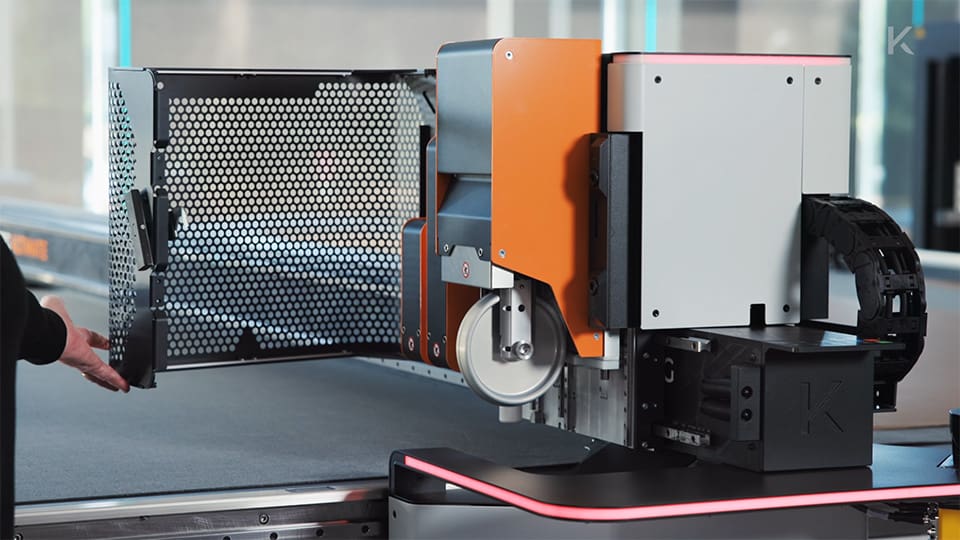
The Ultimate range features three tool positions
The increase in productivity in real world use is harder to quantify as it depends very much on the nature of the job. Long straight cuts, as might be found in cutting out banners for soft signage, benefit more from the speed boost, while complex POS/point-of-purchase (POP) cut-outs or folding carton production will gain more from the greater acceleration across a multitude of short cuts or creases.
Kvanvik points out that the performance boost doesn’t come at the cost of a trade-off against precision and repeatability, saying the Ultimate line was “built for top-notch precision at top speed”. Konsgberg doesn’t quote figures for either precision or repeatability for the Ultimate tables, but Kvanvik says that they match or exceed previous models, while running faster. He advises customers to bring samples of the material they want to cut when attending demonstrations.
Clean-Cut
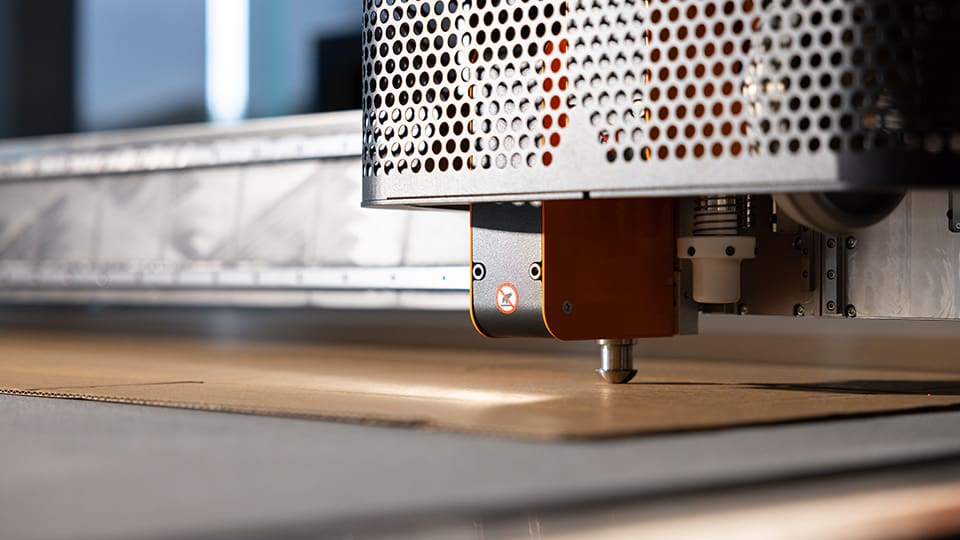
The quality of the cut matters too, especially in corrugated, where die-cutting is accepted as the benchmark. Kongsberg’s design in the Ultimate range exerts the same 50kg equivalent downforce as in previous models, but in the larger two tables in the Ultimate range, this is helped by a novel carbon fibre gantry beam, designed for minimal weight and maximum stiffness. In the smaller models, of which the Ultimate 24 is the smallest, at 1680 x 3200mm work area, an extruded aluminium beam is sufficient and helps yield the highest acceleration figure of the range, at 2.74G.
Kongsberg’s CorruSpeed tool provides static knives to yield clean edges without burrs on cuts, and there’s an oscillating option for the thicker materials used in exhibition stand and furniture construction. 150mm diameter creasing and perforation wheels apply the necessary force without tearing the fibres of the substrate. There’s no router option for the Ultimate series but other than resistant materials like acrylic, metal, or wood which require that, the new tables can cut the vast majority of printable rigid media used in signage work.
The system has a infinite linear motor drive for higher cutting speeds
The quality of cut achieved means that results in packaging sample-making should very much look like what conventional die cutting in volume production would, while also giving crisp edges to complex cut-out shapes increasingly being used to make POS/POP displays stand out in the retail environment.
The Ultimate tables can be used in multi-zone mode in which one board can be loaded or removed while the table is working on another, to maximise throughput. It can also be fed automatically by Kongsberg’s Smart Materials Handler, which was introduced late in 2025, and robotic handling options are available for the highest levels of productivity. This is all complemented by a two-stage sensor-based SmartZone safety system which will first slow the cutting head if it detects movement nearby or stop it altogether if anything gets too close. As well as generally keeping work moving, this also avoids some of the potential quality problems with stopping mid-cut.
Kongsberg supplies software to drive the tables but can increasingly integrate with prepress and CAD workflows (not least Esko’s, of which Kongsberg used to be a part of), reading cut/crease information from PDF layers or DXF files, as well as some proprietary file types. Kvanvik notes some customers with the most integrated and automated end-to-end installations are using JDF as the backbone but says that “you can do a lot with PDF”.
The company also has an Adobe Illustrator plug-in which is about to gain additional metadata capabilities, as part of a ‘material is key’ concept in which including the name of the substrate in metadata can help set the right parameters for cutting it; job details can also be called up automatically from QR or barcodes printed on the edge of the media.
If corrugated production is already part of your repertoire, the Ultimate 24 or its larger siblings may help give you a productivity boost. However, if you’re new to this work, but like the idea of expanding into new materials applications in packaging, whether prototyping or small scale custom production, it might be just the ticket.
Statistics
Working Area: 1680 x 3200mm (MultiZone two 1680 x 1450mm areas) Cut Type: Through-cut, perforate, and crease via choice of knives and wheels Media: All rigid/semi rigid types, especially corrugated, up to 30mm thick, but no routing Max Cut Speed: 167.5m/min Max Acceleration: 2.74G
HP is looking to boost the life and appeal of its R-series hybrid Latex printers in rigid media applications with the introduction of an automated feeder/stacker that aims to improve overall productivity from loading to output. Michael Walker joins the queue
SwissQprint has added a lower production variant to its established 3.2 x 2m UV flatbed printer platform, offering the same features and fifth-generation engineering base as the established Nyala and Kudu models. Michael Walker looks at what’s on the table
If you ever need to print double-sided UV graphics, the Hapond UP-3321D from CPS might be just the timesaver you need, while giving you plenty of single-sided firepower for the rest of your work. Michael Walker looks at how this Chinese offering flips the script
Watch our latest video of the week
SignLink gives you the latest video coverage of companies, people, and events from within the signage, graphics, and wide-format print industries.