Able to print with raised textures up to 2mm high underneath CMYK print, Roland’s revamped version of the DIMENSE printer offers a range of application possibilities beyond the obvious wallpaper. Michael Walker peels back the edges to take a peek beneath
Michael Walker
January 12, 2026
Digital printing of wallpaper isn’t such a radical idea. Various systems have been promoted over recent years, based around roll-fed printers using media and inks suitable for domestic and hospitality applications. But the idea of being able to also print a fully variable texture onto a wallcovering is novel and has so far been the sole province of the DIMENSE range of printers originally developed by Lithuanian company, Vieka.
The underlying technology involves a coating on the media that foams and expands when heated after printing, plus a jettable ‘structural’ ink that suppresses the expansion reaction at any desired location. The original Vieka machine, shown at FESPA 2017 could achieve a 1mm relief this way, which enabled plenty of textured effects to be achieved on supported media, which was – and still is – manufactured by the DIMENSE operation in Lithuania.
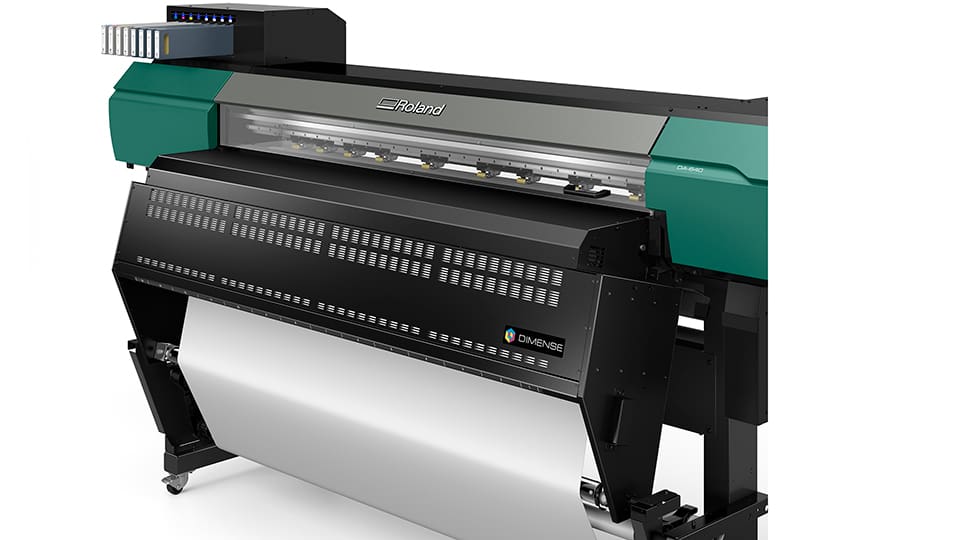
When Roland took a controlling stake in the DIMENSE business in August 2023, it took on distribution and support of the existing machines, but with a clear intention to combine the technology with its own manufacturing expertise. This led to the announcement in June 2025 of the Roland DIMENSE DA-640, a brand-new machine that combines a familiar Roland 1.6m roll-fed printer chassis with the DIMENSE ink and media.
The DA-640 made its UK public debut at The Sign Show in September 2025
The DA-640 made its UK public debut at The Sign Show in September 2025. The most obvious physical difference is that the printer is a lot smaller, especially in terms of its footprint. However, that is perhaps one of the less significant changes compared to what’s going on inside.
Two Heads are Better Than One
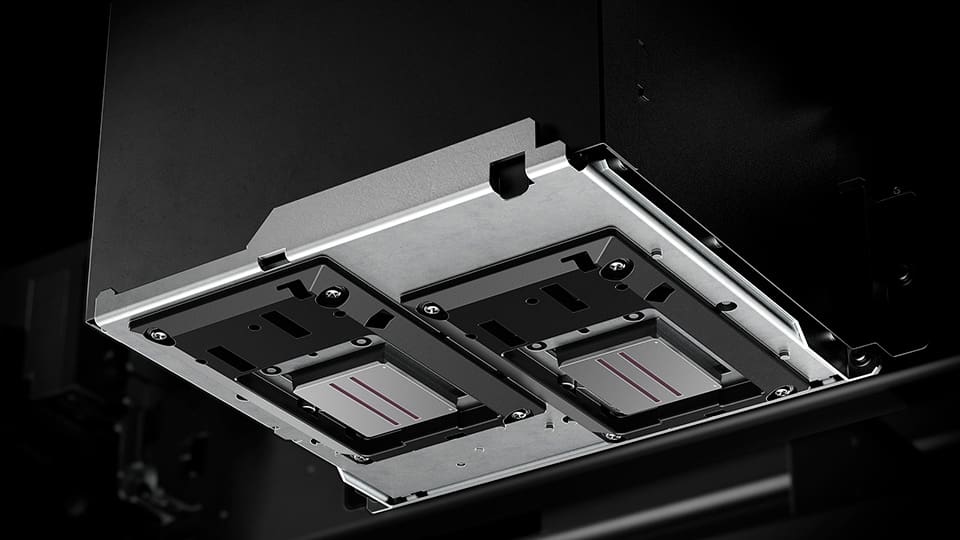
The new model uses two Epson printheads to offer resolutions for both CMYK and structural ink of 900 x 1200dpi, though it’s important to note that the nature of the foam expansion in the coating limits the level of fine detail that can be achieved in the ‘embossing’ effect. Head of DIMENSE sales for EMEA at Roland, Geert Van den hole, says that tests have been done that produced suitable levels of detail for wine labels, though the machine can’t be used with self-adhesive label stocks because of the heat required.
The press features two Epson printheads
The CMYK inks are water-based and the structural ink, which is jetted first, is a type of eco-solvent. Both come in 500ml cartridges, and the inks are dried as part of the heating process needed to activate the foam expansion, which depending on the media can require temperatures of between up to 380°C.
At the time of writing, there are 17 media types available, supporting expansion height of up to 2mm, with plans afoot to further increase this to 3mm. They all come with the necessary certifications for use in domestic environments, including fire retardant characteristics. The newer media types are backwardly compatible with existing DIMENSE printers, and, more usefully for prospective new customers, various standard substrates suitable for use with aqueous can be used for CMYK-only printing in the DA-640, so the machine can still be productive even when not producing jobs which require the raised relief effect.
In terms of productivity, the DA-640’s standard mode for ‘dimensional’ jobs runs at about 8m2/hr, dropping to 4 to 5m2/hr in highest quality, which uses up to 16 passes. There is also a ‘fast’ mode that uses nine passes. The baked or cured material is cool enough and dry enough as it emerges from the printer to go straight into cutting or any other finishing process.
The DIMENSE printers were originally developed by Lithuanian company, Vieka
The current media range includes nonwoven textiles, PVC-free rolls, and some thicker substrates up to 2mm (before the expansion). There are silver and gold metallics included, and it was interesting to note from samples that the metallic effect stays on the surface of the expanded layer, doing a fair substitute for metallic ink. Van den hole also notes that CMYK colours can be mixed on the silver substrate to achieve gold or other metallic colours.
A feature of the new unit is that separate printheads are used for the CMYK and structural inks. This is said to overcome maintenance issues with cross-contamination of inks, in which both were jetted from the same head, and makes printhead cleaning a simple matter of wiping. The heating system, which uses ceramic plates automatically controlled across 14 zones, has also been improved for consistency, simultaneously reducing warm-up time from around 40 minutes to 15 or less – while also reducing power consumption by around 50%.
Feel the Workflow
A key aspect of using the texture printing capability is preparing the artwork for it. The DIMENSE DA-640 ships with a version of Roland’s VersaWorks RIP software that contains dedicated functionality for this. The raised texture effect is essentially binary – it’s either on or off, no intermediate options – so it can be controlled via a one-bit TIFF file or equivalent contained within an artwork PDF. While creating these might be something that could be done in the prepress studio, many prospective customers for what the printer can produce won’t be skilled in this, so Roland has included a variety of tools that enable multiple textures to be applied within the artwork, based on simple predefined repeating patterns or generated automatically from the underlying image content according to its colours. A 3D previewing capability is also included, which can also represent how the textures would appear using the gold or silver substrates.
Statistics
Print Width: 1615mm on 1625mm rolls
Raised Texture Depth: Up to 2mm fixing
Ink Set: Aqueous CMYK plus eco-solvent ‘structural’ ink. Suitable for internal décor use
Print Resolution: From 600 x 900dpi to 900 x 1200dpi
Print Speed: From 4 to 5 m2/hr in high quality mode, including foam expansion and drying
In terms of applications, Roland is thinking wider than just conventional wallcoverings, extending the texture printing capability to shorter-lived purposes like exhibition and event graphics, or consumer items like canvas prints with texture effects. Van den hole comments: “Everyone who sees the samples wants to touch them”, he suggests that the combination of samples and the RIP’s 3D preview capability could be used to create a walk-in kiosk-type service for consumer sales.
The DA-640 sells for €51,000 (£44,763) which includes the VersaWorks RIP and a Bofa air filter. Any fumes released during the media heating and expansion process are not harmful, according to Roland, but the filtration system is built in anyway. Van den hole says the printer was the “eye catcher” at FESPA 2025 and the company hopes to sell 25 units by the end of 2025, and “many more” in 2026.
Given the novel creative opportunities that the DIMENSE technology offers and the more robust and easy to operate package that Roland has wrapped it up in, it’s not hard to predict that this will help inventive printers exceed their targets.
Michael Walker is a trade journalist, technical writer, and editor with over 37 years’ experience in the print, prepress, photography, and digital imaging sectors, with a particular interest in the digital transformation of processes. In addition to editing Desktop Publishing Today and Digital Printer magazines, he is co-author with Neil Barstow of Getting Colour Right (Ilex Press, 2004) and Practical Colour Management for Photographers and Digital Image Makers (2009, self-published e-book) and winner of a Communicators in Business Gold Award.
HP is looking to boost the life and appeal of its R-series hybrid Latex printers in rigid media applications with the introduction of an automated feeder/stacker that aims to improve overall productivity from loading to output. Michael Walker joins the queue
SwissQprint has added a lower production variant to its established 3.2 x 2m UV flatbed printer platform, offering the same features and fifth-generation engineering base as the established Nyala and Kudu models. Michael Walker looks at what’s on the table
Kongsberg set its sights on the corrugated market with the 2024 launch of the Ultimate line of digital cutting tables. Michael Walker looks at the smallest member of the family
Watch our latest video of the week
SignLink gives you the latest video coverage of companies, people, and events from within the signage, graphics, and wide-format print industries.