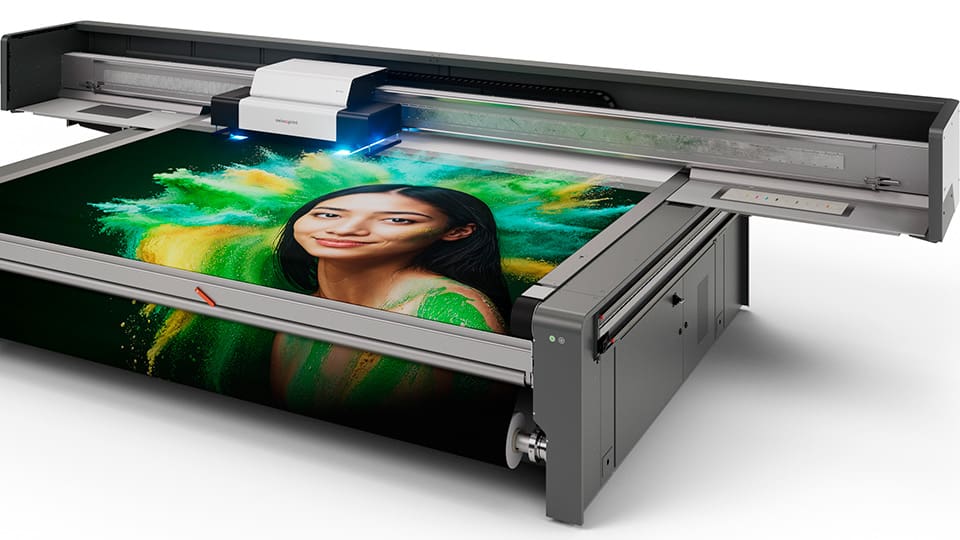
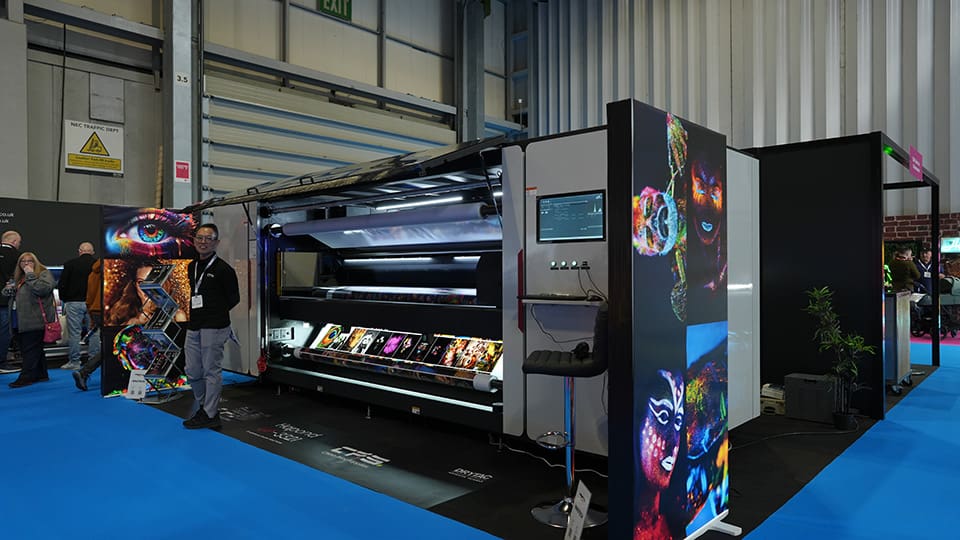
SwissQprint has added a lower production variant to its established 3.2 x 2m UV flatbed printer platform, offering the same features and fifth-generation engineering base as the established Nyala and Kudu models. Michael Walker looks at what’s on the table
Michael Walker
June 30, 2026
Trading on its home country’s reputation for engineering excellence, swissQprint has long been seen as a desirable high-end choice in flatbed digital printers, offering precision and reliability but with a price tag to match. Now the company is extending its offering into the mid-market, with a lower productivity variant of the Nyala and Kudu line of 3.2 x 2m of UV flatbeds that aims to being the same virtues at a more entry-level price.
The new arrival is the Topi 5, also named after a species of African antelope. It’s based on the same engineering platform as the faster Nyala 5 (which was profiled in the June/July 2025 issue of SignLink) and the Kudu, which was the forerunner of the current generation.
The Topi offers speeds of up to 126sqm/hr and resolutions of up to 1350dpi which comes from a single row of Konica Minolta Q1280i printheads. Like its faster siblings it can be configured with up to ten channels, allowing a wide range of speciality inks in addition to standard CMYK and ‘lights’. These include white, orange, clear varnish, and still unique among wide-format printers, neon yellow, and pink. All of them are Greenguard Gold certified.
Like its faster siblings it can be configured with up to ten channels, allowing a wide range of speciality inks in addition to standard CMYK and ‘lights’
While the printhead carriage is naturally smaller than those of the Nyala (one or two rows of heads) and especially the Kudu (two or three rows), the same improved rigidity beam and drive system is still used. UK managing director for swissQprint, Erskine Stewart, explains that standardising this construction across the models, even the Topi which arguably doesn’t need it, not only simplifies the company’s manufacturing and supply chain but also makes customer service better: the experience from an installed base of over 300 Kudu and other generation 5 models means that service engineers have a deep knowledge of the fundamentals of the new machine even as the first units are installed.
So, the Topi should have the same accuracy, repeatability, and reliability that’s already been shown with the faster models, plus the ability to print on all the same media. It also has the same roll-feed and table extension options, namely the ability to print on a single 3.2m roll or two 1550mm rolls simultaneously, plus extension tables that allow printing on boards up to 4m in length. The tandem print zones capability allows one or more boards to be placed on or retrieved from one half of the table while another set is being printed. The printer also has the same safety features, including the light curtain to detect anyone moving too close to the machine and a head crash sensor for its own protection.
With its ink channel choices, the Topi follows the path of the faster models with no double-CMYK option for maximising productivity in ‘regular’ work. Stewart says that the company focuses instead on the application flexibility that the additional inks give, reporting that around 90% of customers take the white ink option, and some 70% the clear varnish. One UK customer with a particular need for white ink has a Kudu with two white channels – six print heads – used for it, he notes.
He also says that the neon options have been more popular than he first thought they might be and have been taken up by 15 UK customers so far, with some offering the capability as a trade service for other wide-format print service providers (PSPs). He also notes that their usage is becoming more sophisticated, with customers mixing the neon inks with the other colours to achieve an expanded colour gamut rather than just printing solid neon – this has been used to good effect by one UK customer producing work for the video game industry, where the extra vivid colours are part of the end-customer appeal.
The Topi is driven by swissQprint’s Lory control software, which handles the set-up for multi-layer and special effects printing and integrates with the Caldera or PrintFactory RIPs. At the time of writing PrintFactory has just been acquired by high-end direct-to-garment printer specialist, Kornit Digital, but swissQprint says it does not expect any changes. File setup for making use of the additional colours via layers in artwork files will for the time being need to be done in Adobe Creative Suite tools or similar.
There Can Be Only One
If you want to do straighter CMYK-only work faster, Stewart says swissQprint will sell you a faster printer that still has all the extra colour options, and it’s here that a key difference between the Topi and the other models emerges. The Topi cannot be upgraded beyond its single row of printheads, so if you think you might need more productivity later on, you might do better to look at the Nyala, which can be factory configured with one or two rows of printheads or have the second row added as a field upgrade. The Kudu can also be upgraded from two to three rows, so both of the faster models offer this upgrade path.
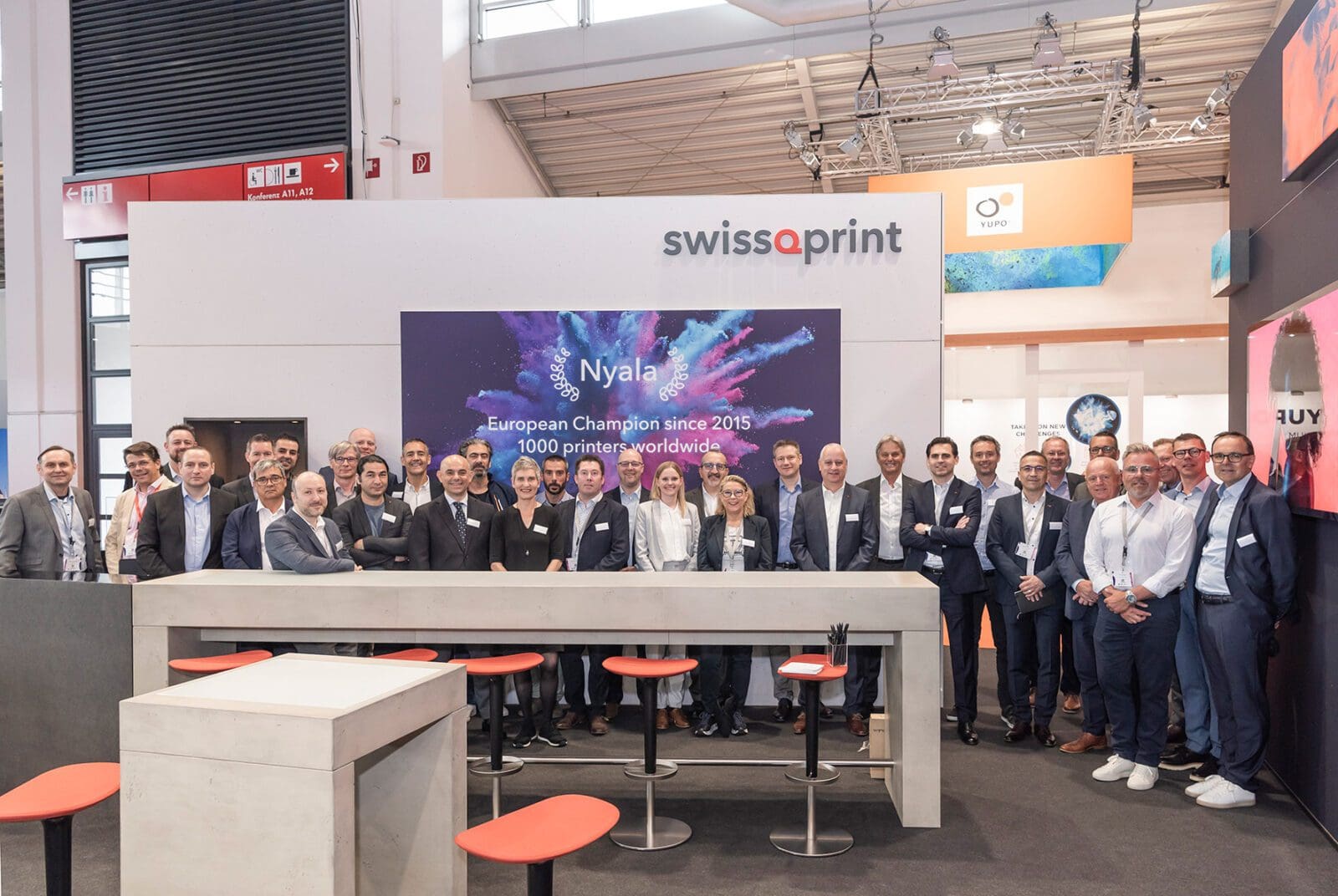
SwissQprint exhibited at this year's FESPA exhibition in Barcelona
Headline top speeds are often part of the marketing specifications battle, and in real day-to-day working they’re not usually used that often. That said, Stewart stresses that the 126sqm/hr top speed of the Topi does produce sellable work for applications that don’t require close viewing and which may have only limited life, such as corrugated displays. This machine offers four modes, equating to the number of passes with the single pass ‘speed’ mode hitting the top numbers, with ‘production’, quality, and ‘backlit quality’ respectively requiring two, three, and four passes, with increasing resolutions used at the higher quality settings. The company doesn’t divulge the speed or specific resolution figures for the higher quality modes but some simple arithmetic around the number of passes each takes should give a rough indicator.
If you’re happy with that, then a Topi can be yours for about 20% less than a single-channel Nyala 5, at a price that makes it competitive with alternatives from the likes of Durst/Vanguard, Canon, or Mimaki but with the swissQprint 36-month warranty and expected ten-year service life. Erskine points out that many of the company’s older models have exceeded this life and that there’s a healthy business in refurbished models too.
Statistics
Maximum Format: 3.2 x 2m flatbed/3.2m roll Maximum resolution: 1350dpi Maximum speed: 126sqm/hr Ink Set: CMYK plus lights, white, clear, orange, neon pink, and neon yellow; up to ten channels at once
HP is looking to boost the life and appeal of its R-series hybrid Latex printers in rigid media applications with the introduction of an automated feeder/stacker that aims to improve overall productivity from loading to output. Michael Walker joins the queue
Kongsberg set its sights on the corrugated market with the 2024 launch of the Ultimate line of digital cutting tables. Michael Walker looks at the smallest member of the family
If you ever need to print double-sided UV graphics, the Hapond UP-3321D from CPS might be just the timesaver you need, while giving you plenty of single-sided firepower for the rest of your work. Michael Walker looks at how this Chinese offering flips the script
Watch our latest video of the week
SignLink gives you the latest video coverage of companies, people, and events from within the signage, graphics, and wide-format print industries.