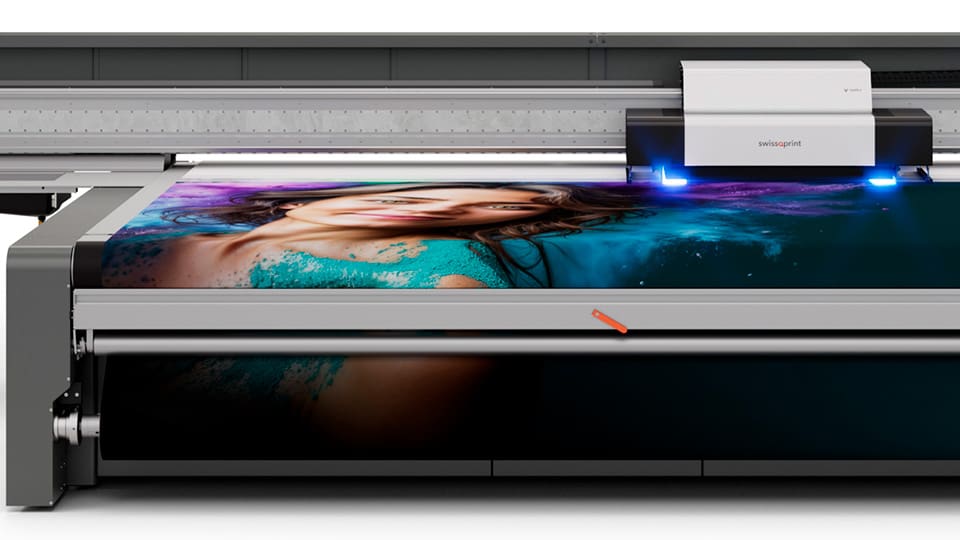
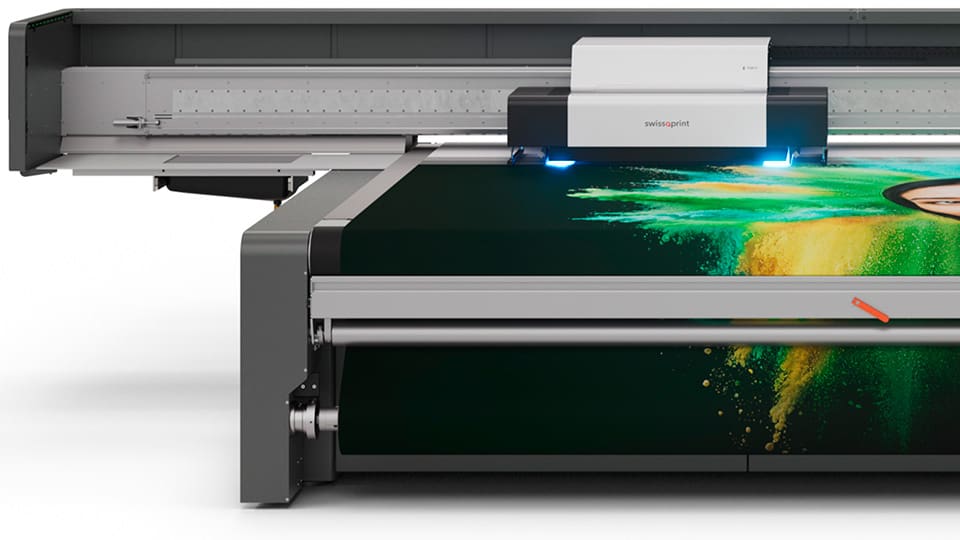
The start of 2025 saw the launch of swissQprint’s fifth generation of flatbed printers. Michael Walker looks at the latest features of the top-selling Nyala model
Michael Walker
June 16, 2025
January 2025 saw the introduction of the ‘fifth-generation’ models in swissQprint’s flatbed UV printer range, with the Nyala and Impala machines gaining the ‘5’ suffix. While the simple increment from four to five might imply the normal refinement and progression to be expected in any mature product line, there are some significant changes here, based on the design introduced with the range-topping Kudu that was launched at FESPA Global Print Expo 2022.
A key attribute of the Kudu was the capability support of up to 30 print heads in three rows. This increased the mass of the printhead carriage assembly and necessitated the design of a stronger and more rigid beam to support it, plus a redesigned printer base for greater stability. The structure was complemented by the adoption of linear drive motors which replaced the belt drive system used in previous swissQprint flatbeds. These enable faster acceleration and deceleration of the printhead carriage and so there’s an overall increase in speed, without sacrificing accuracy of dot placement and therefore image quality. The new motors are also said to be less noisy in operation and have better wear characteristics than the belt drives they replace.
The other thing the Kudu brought was an increase to ten colour channels instead of the nine that were previously standard. This allows more flexibility in selection of ink sets, which in addition to regular CMYK, light cyan, magenta, and key plus white and clear varnish for effects, also includes an orange for gamut expansion, and two ‘neons’ – pink and yellow. All the inks are GreenGuard Gold certified and thus suitable for both indoor and outdoor applications.
There are also some primer formulations for applications such as glass printing. This allows a wide range of production options to be supported without having to change the machine ink supply.
Nyala Not New?
While the Kudu was essentially a brand-new model, the Nyala was introduced a full decade earlier, in 2012, and has achieved significant market presence in its sector of high-end flatbeds, hitting 1000 installations worldwide in 2023, and holding a European segment leadership position since 2015, according to swissQprint.
The new version moves the Nyala to the same mechanical configuration as the Kudu, with the linear drive speed bringing a 23% speed increase, pushing the Nyala to 253sqm/hr in single-pass mode at 450 x 1200dpi, which UK managing director Erskine Stewart says is of saleable quality and has been demonstrated to prospective buyers at the company’s open house events.
The main difference now between the Nyala and the Kudu is that the latter can carry up to three rows of printheads while the former is limited to two
The main difference now between the Nyala and the Kudu is that the latter can carry up to three rows of printheads while the former is limited to two. Both offer beds of 3240 x 2030mm on which media up to 50mm thick and weighing up to 30kg per square metre can be handled. Both offer a 3.2m roll-fed option and dual 1.5m roll capability, to a weight of 180kg for a single roll and 50kg each for dual, plus an oversize board option that supports items up to 4m in length, mostly useful in architectural glass printing work.
Both machines feature the Konica Minolta 1280i printheads specifically designated for swissQprint that were used in the previous generation. These offer up to 1350dpi addressable resolution, which the Swiss company claims is equivalent to a ‘visual resolution’ of up to 2540dpi.
You might then wonder why the Nyala needed the uprated beam and linear drive assembly if its printhead carriage wasn’t getting heavier. Part of the answer is that the linear drives which come with the new design are responsible for the improved performance; the rest is to do with manufacturing efficiency and simplified support and maintenance.
“There is a lot of expertise with the Kudu,” explains Stewart, adding: “We’ve sold 100 worldwide, with 14 in the UK. The common design and engineering simplifies service, using the same bearings across all models, for example.”
The Nyala 5 was announced in January 2025
The Nyala 5 also gains the field-upgradeable ten-channel capability. Perhaps surprisingly, one of the configurations that you might expect – a dual CMYK arrangement for maximum productivity – isn’t supported in the new generation flatbeds, though there were ‘speed’ variants in the previous range which had it. Stewart explains that the increased speed of the new machines enables similar or better levels of performance plus the flexibility of the ‘spare’ ink channels.
This combination has been ‘uniquely’ successful in the UK already, Stewart says, with both the first Nyala 5 sale here and the most recent (at the time of speaking) both being fully-loaded with six ‘regular’ colours plus white, varnish, and both the neon inks. The latter are a particular driver for expanded colour setups, he adds.
It’s Curtains for Crashes
Safety and productivity are also better ensured through a new light curtain above and in front of the head carriage that detects objects – including people – in the way of the beam and head assembly’s progress and brings things to a safe halt before a head crash or worse can happen. The printer can also resume from exactly where it stopped once the obstruction is cleared, so minimising production delays.
With all this productivity on tap, the question of automation arises. Again, perhaps contrary to expectations in this segment, the answer is ‘no’, or at least ‘not from us’. Stewart confirms that there are third-party robotics integration specialists who can build an automated media load/unload system around a Nyala or Kudu but that there isn’t a swissQprint branded solution. This is because of the range of work that the typical customer undertakes, he says.
Statistics
Top Speed: 253 m2/h Addressable resolution: Up to 1350dpi Roll Width: Maximum 3,200mm Curing: UV LED Colour channels: Maximum ten
“There is a huge variety in the type and size of materials of customers print, a lot of variability in [their] work – the set-up time would be too long,” he notes, adding that for large amounts of highly repetitive work, such as printing corrugated boards or industrial applications such as glass printing, robotic systems have been implemented in Europe.
On the software side, swissQprint continues to offer the Caldera or PrintFactory RIP and workflow solutions as previously, taking care of pre-flighting, colour management (including harnessing the expanded gamut made available with the orange and neon inks), batching, tiling, or nesting.
If you need this kind of raw productivity from a true flatbed UV LED printer there aren’t too many alternatives. If you need that plus the flexibility of roll-feeding, long sheet print, and a range extra inks, including two neon inks, all at once, there simply aren’t any, demonstrating the uniqueness of this machine.
Michael Walker is a trade journalist, technical writer, and editor with over 37 years’ experience in the print, prepress, photography, and digital imaging sectors, with a particular interest in the digital transformation of processes. In addition to editing Desktop Publishing Today and Digital Printer magazines, he is co-author with Neil Barstow of Getting Colour Right (Ilex Press, 2004) and Practical Colour Management for Photographers and Digital Image Makers (2009, self-published e-book) and winner of a Communicators in Business Gold Award.
HP is looking to boost the life and appeal of its R-series hybrid Latex printers in rigid media applications with the introduction of an automated feeder/stacker that aims to improve overall productivity from loading to output. Michael Walker joins the queue
SwissQprint has added a lower production variant to its established 3.2 x 2m UV flatbed printer platform, offering the same features and fifth-generation engineering base as the established Nyala and Kudu models. Michael Walker looks at what’s on the table
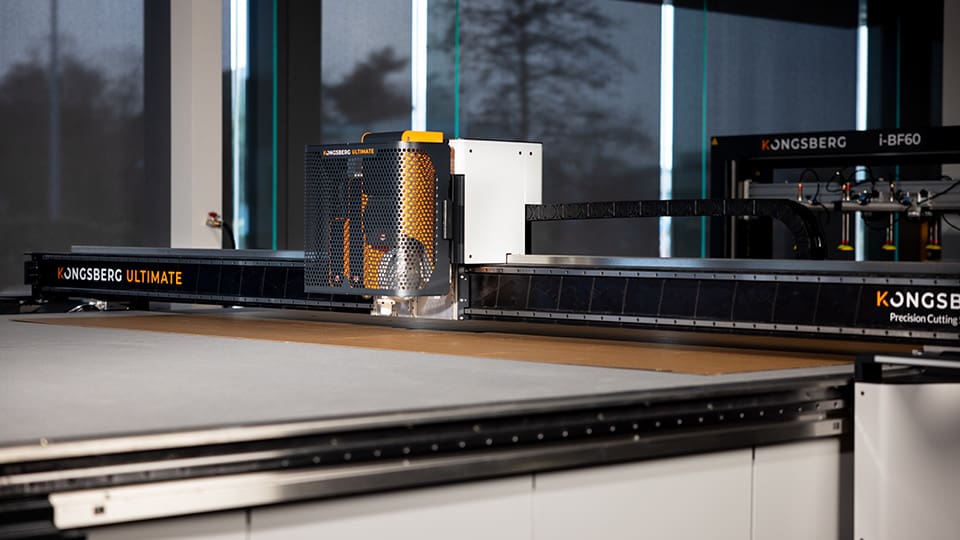
Kongsberg set its sights on the corrugated market with the 2024 launch of the Ultimate line of digital cutting tables. Michael Walker looks at the smallest member of the family
Watch our latest video of the week
SignLink gives you the latest video coverage of companies, people, and events from within the signage, graphics, and wide-format print industries.