Agfa has further upgraded its 3.3m flagship hybrid UV LED printer to achieve colossal throughput, but with great power comes the need for great automation, finds Michael Walker
Michael Walker
August 13, 2025
It really is a beast – something me and Mike Horsten, senior press & PR manager at Agfa agree on. “Even we didn’t foresee this when we were launching the Tauro,” says Horsten, who is speaking of the latest addition to the company’s hybrid LED printer range. The range began with the introduction in mid-2018 of the Jeti Tauro H3300, and saw increasingly faster S, HS, and UHS variants added over subsequent years.
The latest, and perhaps final instalment, as it’s now edging into the productivity territory occupied by what were the Inca machines prior to the acquisition of that company by Agfa in 2022, is the Tauro H3000 XUHS, launched at FESPA 2025 in Berlin. Developed by the same team in Belgium that was responsible for the all the previous Tauro models, this adds a further 30% speed capability to that of the already formidable UHS model, bringing it to a maximum 1280sqm/hr, delivered by 96 Ricoh Gen 5 printheads (rising to 120 if you take any of the white, primer, or varnish options) configured in 12 rows, and supported by a comprehensive range of automation options.
This obviously isn’t going to be a cheap machine – think seven figures for even a relatively simple configuration – so the natural question to ask is “who needs a printer that is this fast?”
Horsten is upfront that not many do, expecting to sell ‘one or two handfuls’ a year, but points to printers servicing large retail clients in the US and larger European countries, particularly national supermarket chains, where a store refresh or seasonal campaign might require the production of 15,000 pieces to fit out a thousand stores. These are sites that may already have a previous Tauro, an EFI Nozomi or Inca/Agfa Onset, or possibly even a SpeedSet for corrugated work, so similarities in operation with existing Agfa kit simplify training, while the Agfa inks, which are the same, would already be a known quantity.
The XUHS model is very much aimed at bulk production environments where the hybrid format suits a range of substrate materials and sizes, including but not limited to standard display boards, and diverse finishing requirements that could include contour cut-outs. It is available in four- and seven-colour configurations; the former doubles up regular CMYK inks for speed, while the latter introduces a mix of light and mid-tone inks.
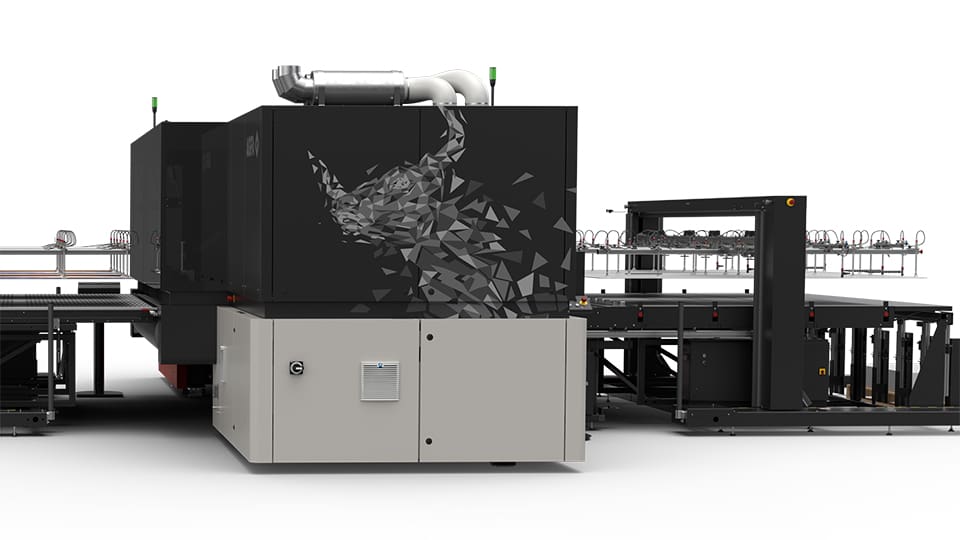
The H3300 XUHS with Max Pro Feeder and Stacker setup
Horsten says that rather than go with the more usual light C, M, and K, the colours are chosen to provide a balance of smooth skin tones while retaining the ability to provide punch in areas of solid colour. The 7pl drop size and 1200dpi resolution also allows for plenty of fine detail rendering, with Agfa claiming text legible down to 4pt and overall quality that ‘resembles offset printing’.
There are also the optional white, clear varnish, and primer inks. The clear varnish is a simple on/off spot UV effect that can be used to highlight items in the finished print – glistening drops of water on fresh fruit or vegetables, for example – and doesn’t offer some of the semi-gloss UV curing options found on the Inca-derived models. The primer is there to ensure ink adhesion on difficult substrates like glass or metal.
Feeding the Beast
With this kind of productivity, some form of automation is going to be pretty much essential to keep up with the printer, and Agfa offers a very wide range of options to support both roll-fed and rigid media production. On the roll side, single or dual rolls up to 700kg and up to 600mm diameter can be attached in the Max Master RTR configuration. These can be undocked to switch to rigid or sheet printing, while the Max Flex option restricts roll weight 400kg (still single or dual rolls) and diameter to 400mm but allows the rolls to remain in place while the input and output tables for rigid media are attached above, further speeding the switch from roll to rigid media feeding. Double-sided printing is also possible, with an optional back-to-front camera that scans specially generated QR codes to match front and back artwork and maintain register.
It really is a beast, something even we didn’t foresee when we were launching the Tauro
The options for rigid media printing involve a variety of alignment tables, feeders, and stackers to load and unload the printer with boards up to 2.65 x 3.3m in size, at up to 120 load cycles per hour. While the base engine can cope with rigid media up to 50mm thick, this upper limit drops to 20mm with any of the auto feeder options. There are also robotic solutions to both load and unload/stack media, in 1-, 2-, or 3-up arrangements, and which can also handle roll media. Horsten anticipates that some 90% of customers for the Tauro UXHS will opt for the robots, noting that: “It’s fast, efficient, and the same every time. The downside is of course the amount of floorspace that it requires, but this is not a machine for garage businesses!”
Keep on Running
For applications that require subsequent cutting, Horsten suggests that a fast laser cutter might be more appropriate than a cutting table in order to keep up with the new printer, though he notes that at least one existing Tauro customer has automated the transfer of printed media to a Zünd cutting table by robots to minimise bottlenecks in post-print operations.
The other critical aspect of keeping a very fast printer rolling is the RIP and workflow that drives it. Like other Agfa printers, the Tauro XUHS is driven by Agfa’s Asanti wide-format workflow, plus a dedicated RIP which can also be supplied as a ‘black box’ for use with third-party workflows such as Print Factory.
It’s fast, efficient, and the same every time. The downside is of course the amount of floorspace that it requires, but this is not a machine for garage businesses
here’s a fair bit of proprietary technology inside this box, according to Horsten. This not only ensures that the control data is fed to the printheads in a timely fashion to keep up with the head carriage and media movement, but also includes the control electronics for the robots, where installed, choreographing the picking, placement, and retrieval of boards to synchronise with the printing and delivery.
Statistics
Top Speed: Up to 1280m2/h
Print heads: Up to 120 Ricoh Gen 5 print heads in 12 rows, depending on option
Format: Roll media to 3.3m, boards to 2.65 x 3.3m
Colours: Four (CCMMYYKK) or seven (CMYKKcmk)
Optional: White, primer, and varnish
External validation of the Tauro XUHS arrived with the winning of three European Digital Press Association (EDP) 2025 awards, in the print engine, automation, and ink categories, so it’s not just Agfa that thinks this printer has a lot going for it.
If you need this kind of combination of throughput and media flexibility there aren’t too many alternatives – and some of them also come from Agfa.
Michael Walker is a trade journalist, technical writer, and editor with over 37 years’ experience in the print, prepress, photography, and digital imaging sectors, with a particular interest in the digital transformation of processes. In addition to editing Desktop Publishing Today and Digital Printer magazines, he is co-author with Neil Barstow of Getting Colour Right (Ilex Press, 2004) and Practical Colour Management for Photographers and Digital Image Makers (2009, self-published e-book) and winner of a Communicators in Business Gold Award.
HP is looking to boost the life and appeal of its R-series hybrid Latex printers in rigid media applications with the introduction of an automated feeder/stacker that aims to improve overall productivity from loading to output. Michael Walker joins the queue
SwissQprint has added a lower production variant to its established 3.2 x 2m UV flatbed printer platform, offering the same features and fifth-generation engineering base as the established Nyala and Kudu models. Michael Walker looks at what’s on the table
Kongsberg set its sights on the corrugated market with the 2024 launch of the Ultimate line of digital cutting tables. Michael Walker looks at the smallest member of the family
Watch our latest video of the week
SignLink gives you the latest video coverage of companies, people, and events from within the signage, graphics, and wide-format print industries.