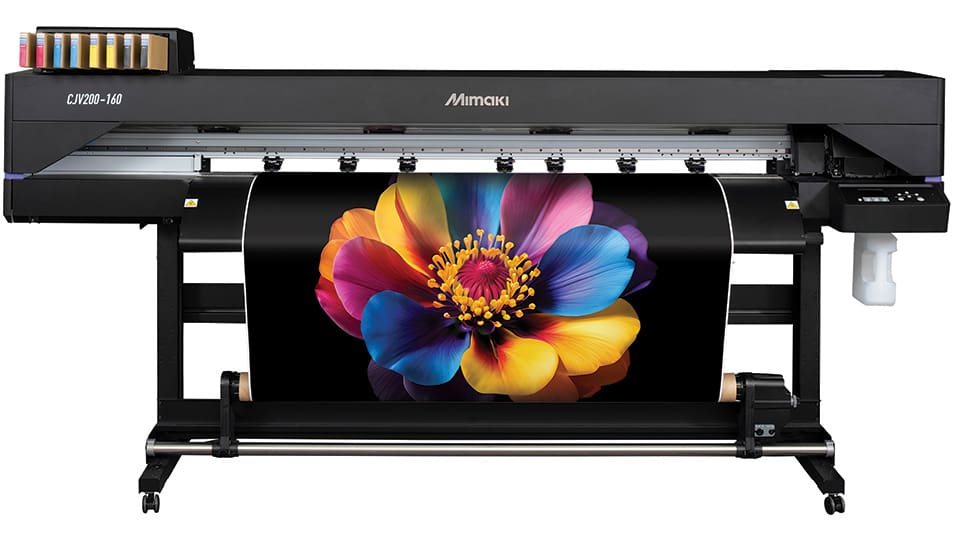
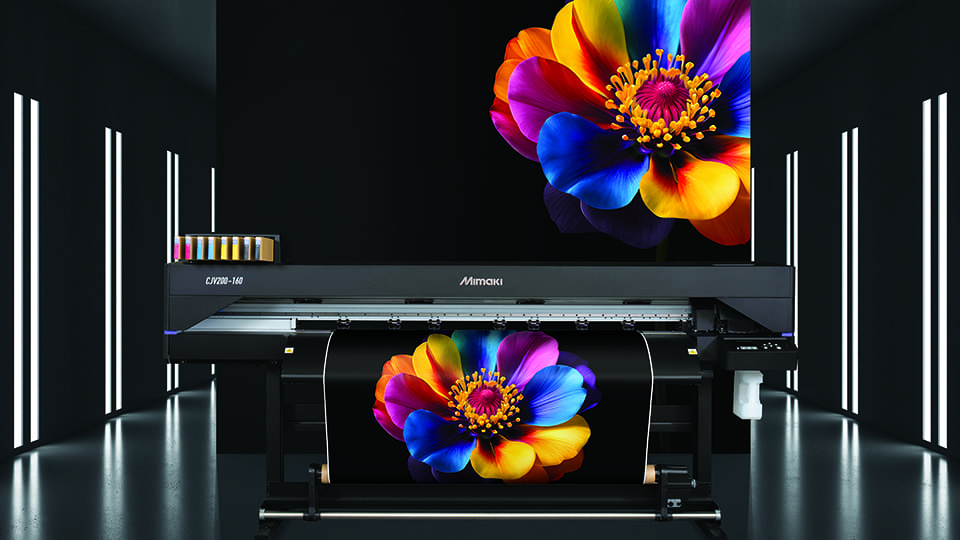
A recent addition to Mimaki’s range of roll-to-roll printers is the CVJ200, an entry-level solvent print-and-cut machine that aims to combine attractive pricing with ease of use, productivity and print quality. Michael Walker takes a look
Michael Walker
April 14, 2025
With the growing attention to water-based inks for signage and display applications, now even including UV, it’s easy to overlook the fact that solvent and eco-solvent printers are still very much around and represent the backbone – and indeed the starting point – of many small sign shops, with low entry costs, long-proven technology, and an improving environmental story to tell as inks and PVC-free media continue to develop.
This is the space that established Japanese printer manufacturer Mimaki, and its UK and Ireland exclusive distributor, Hybrid Services, is targeting with the CJV200 line of print-and-cut machines, launched in the UK at last year’s Print Show, and validated by more recent launches from its competitors.
The company said at the September 2024 launch that the new model is designed to be more accessible to printers of varying levels of experience in terms of operation and maintenance, while also bringing some new functions and offering a choice of ink sets.
The company said at the September 2024 launch that the new model is designed to be more accessible to printers of varying levels of experience in terms of operation and maintenance
Target applications for the CJV200 include vinyl banners, stickers, signs, vehicle graphics, window graphics, and other wide-format applications.
Mechanically the CJV200 is a roll-to-roll print-and-cut machine available in three variants that support printable widths of 80, 137, and 161cm, the latter two billed as 1.3 and 1.6m respectively.
Mimaki says that the new models use the same piezoelectric printhead assembly as its more productive CJV330 series models. This offers a range of resolutions from 600 x 600 to 1200 x 1200dpi, with drop sizes down to 3pl, allowing speed and quality to be traded off according to the work in hand.
The single printhead design is said to simplify maintenance, requiring less time to be spent on cleaning and subsequent adjustment. Mimaki’s Dot Adjustment System adjusts automatically for different media types, again saving time when changing media in the typical job mix likely to be found in smaller sign shops where one printer has to do a bit of everything. Further ease-of-use features that are new with the CJV200 include a wide-opening cover for easy access to the printhead and an upwards-facing control panel for easier viewing and operation.
The CJV200 printers are complemented by a choice of ink sets. There is the BS4 standard CMYK set, supplied in 600ml cartridges, which is aimed at the most cost-conscious operations. It is priced to compete with third-party inks, while meeting Mimaki’s warranty conditions. There is also a new expanded gamut set that adds light cyan, light magenta, orange, and light black to the standard process colours. Called SS22, the new ink has been developed from the existing SS21 ink which Mimaki claims has achieved the industry’s highest level of outdoor weather resistance.
High Speed: 22.0 sq m/h Standard: 17.0 sq m/h Quality: 12.5 sq m/h High Quality: 10.1 sq m/h
SS22 ink is free of increasingly tightly-regulated ingredients such as GBL (gamma-butyrolactone, used in some illegal drugs) and is supplied in 440ml cartridges, made using a paper-based design to reduce the plastic content. The additional ‘light’ colours can improve tonal rendering in subtle graduations such as skin tones, avoiding graininess, in both colour and greyscale images. The orange ink should not only help hit brand colours in that part of the spectrum but will add depth and vibrancy to reds and adjacent hues in general. Mimaki also claims ‘minimal streaking and unevenness in solid colours’ via its MAPS4 (Mimaki Advanced Pass System) technology.
In terms of raw productivity, Mimaki quotes standard output at up to 17sq m/h. That means 600 x 1200dpi with six-pass printing in regular four-colour mode. Maximum speed is 22sq m/h at 600 x 1200dpi with four passes, while top quality at 1200 x 1200dpi maximum resolution and six passes gets you 10.1sq m/h. All these figures are for the 1.6m largest model with two sets of CMYK inks loaded; all of them are halved in eight-colour mode.
Standard media handling on the CJV200 accommodates rolls of up 180mm diameter, weighing up to 25kg. A 45kg adapter is available as an option, as is a bulk ink supply, though machines in this category are not typically used to run unattended overnight printing, for example.
All Cut Up
On the cutting side, the CJV200 offers a maximum cutting speed of 300mm/s and cut force of between 10 and 450g. This supports kiss-cutting for labels and stickers, while through cutting reasonably heavy vinyls and similar materials. An overall accuracy of ±0.2mm is quoted, which should be quite sufficient even for smaller items such as stickers.
Included with the printer is Simple Create software which allows template-based design and set-up of common items such as labels, stickers, and wobblers. This is complemented by Mimaki’s RasterLink 7 RIP, which handles PDF and other common file formats and Mimaki FineCut, which works with the RIP to integrate the design, print, and cut processes into one workflow.
FineCut can work with layered Adobe Illustrator, Corel Draw, or PDF files to recognise, extract and execute vector-based cutting paths, either immediately after printing or following a separate finishing process such as lamination, with orientation and alignment automatically checked via a newly-added barcoding function.
There is also a variable ink saving function that Mimaki says can cut ink consumption by up to 50% while maintaining overall colour balance, though overall density and colour saturation are typically traded off. This can be accessed with only a couple of clicks in the RIP software. The printer can also be connected to PICT, Mimaki’s Cloud-based monitoring and management software.
Prices start from £7495 plus VAT for the 80cm model and are £10,995 and £11,995 respectively for the 1.3 and 1.6m versions. These are all based on a £2000 trade-in on a qualifying device; the pitch is that replacing an older machine that may be nearing the end of its life buys you Mimaki quality and reliability, with similar consumable costs to third-party inks if you opt for the BS4 inks, or the extended colour capabilities with the S22 ink set.
The CJV200 also benefits from a two-year warranty (extendable to three years) via UK and Ireland Mimaki exclusive distributor Hybrid Services, which also reports a high level of demand since the printer’s introduction.
If you’re looking for a more capable print-and-cut machine that can meet seasonal peaks in demand and which offers some extra capabilities in the colour and quality department that might expand your service repertoire into more lucrative areas, then the Mimaki CJ200 range is certainly worth a close look.
Michael Walker is a trade journalist, technical writer, and editor with over 37 years’ experience in the print, prepress, photography, and digital imaging sectors, with a particular interest in the digital transformation of processes. In addition to editing Desktop Publishing Today and Digital Printer magazines, he is co-author with Neil Barstow of Getting Colour Right (Ilex Press, 2004) and Practical Colour Management for Photographers and Digital Image Makers (2009, self-published e-book) and winner of a Communicators in Business Gold Award.
HP is looking to boost the life and appeal of its R-series hybrid Latex printers in rigid media applications with the introduction of an automated feeder/stacker that aims to improve overall productivity from loading to output. Michael Walker joins the queue
SwissQprint has added a lower production variant to its established 3.2 x 2m UV flatbed printer platform, offering the same features and fifth-generation engineering base as the established Nyala and Kudu models. Michael Walker looks at what’s on the table
Kongsberg set its sights on the corrugated market with the 2024 launch of the Ultimate line of digital cutting tables. Michael Walker looks at the smallest member of the family
Watch our latest video of the week
SignLink gives you the latest video coverage of companies, people, and events from within the signage, graphics, and wide-format print industries.