The first printer from Epson that provides resin-based technology for environmentally sensitive materials, Brian Sims takes a closer look under the hood of the SC-R5000
Guest Writer
July 29, 2024
There are a number of reasons we select one process over another; the options that are available to printers today are vast and at times it can be difficult to decide which is best for our needs. When we look into the technology available when striving to be greener – a big driver for a lot of our clients today – there is one emerging ink technology which is gaining ground quickly – resin ink printing.
These inks are generally thought to be one of the most environmentally friendly options due to needing minimal drying, being water based, and providing no VOC emissions. The products produced can be used in situations where sensitive environments are a factor and used on coated or uncoated stocks.
The technology behind resin-based inks is complex but as a brief overview, each ink droplet is a water-based fluid consisting of water, a wetting agent, and humectants (a moisturising substance) and within this fluid the pigment and resin are held in suspension. An optimizer is laid down and the wetting agent of the droplet disperses and the ink is applied for the image. With the resin undergoing the heat of the drying process, the droplet as a coloured dot is set and provides one of millions of dots making up the image.
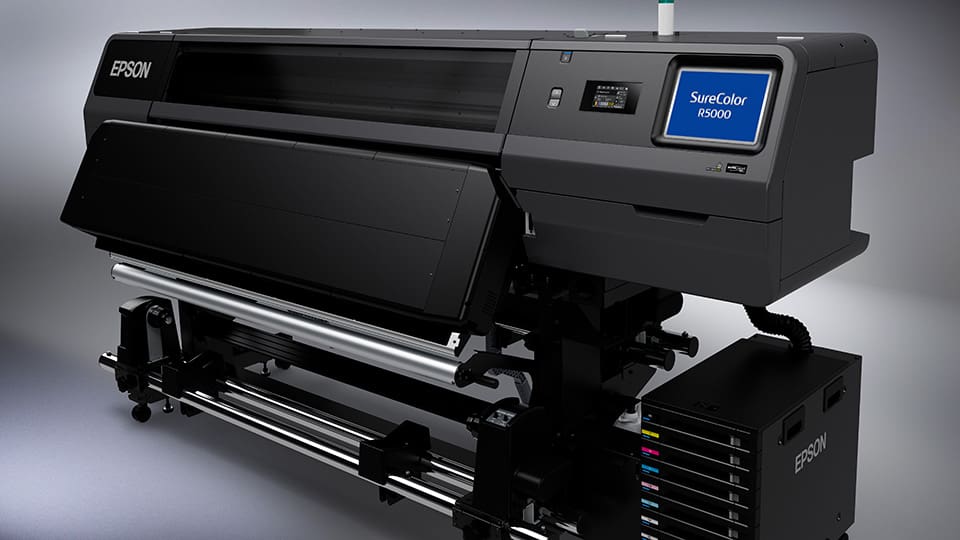
Whilst this technology is quite new, it is of no surprise that the Japanese printing giant Epson has brought to market the first resin printer to join its fleet. The SureColor SC-R5000 is a 64” printer that can print in up to six colours which as expected is the process colours CMYK along with light cyan and magenta.
The Piezoelectric printhead uses the well-proven specially developed inks which are known as the UltraChrome RS range. The UltraChrome RS range of inks are also developed with the ability to print up to 98% of the PANTONE solid coated colours which greatly enhances the printer’s ability to produce the eye-catching effects for a wide range of products.
As with a lot of the printers from Epson, the SC-R5000 comes with inkjet heads containing the now proven Epson Thin Film Piezo (TFP) technology. The technology contained in the head is deemed by Epson to be a market leader and is in a large number of its printers. In 2007 the manufacturer came to the market with this new concept TFP technology which is used across the complete range of printers and is now truly tried and tested.
The Piezo element of a printhead is common to all printers using this technology and has to be produced in very thin sections. Epson chooses not to follow this path and instead uses a proprietary process to form a dense piezo crystal element that is just one micron thick on a silicon wafer.
The heads are produced with what Epson calls Micro Electro Mechanical Systems (MEMS) which means elements of the head are placed 84.7 microns apart on silicon or glass. With ink channels and nozzles produced by the MEMS process, Epson claims the PrecisionCore Micro TFP printheads can produce almost perfectly round dots with great precision.
The PrecisionCore Micro TFP printheads have a print chip less than one hundredth the width of a human hair in thickness. By using materials this small you can have a relatively small print engine and large ink deployment.
The PrecisionCore TFP printhead can place dots extremely accurately in both size and position in the colour gamut which is why Epson claims the raw specification of DPI is now an “obsolete way to compare print systems”. Epson also argues that resolution measured in dots per inch (DPI) is not necessarily the best way now to quantify print quality. The manufacturer does agree that DPI is part of the methodology, greyscale, and accurate dot placement is also a key consideration.
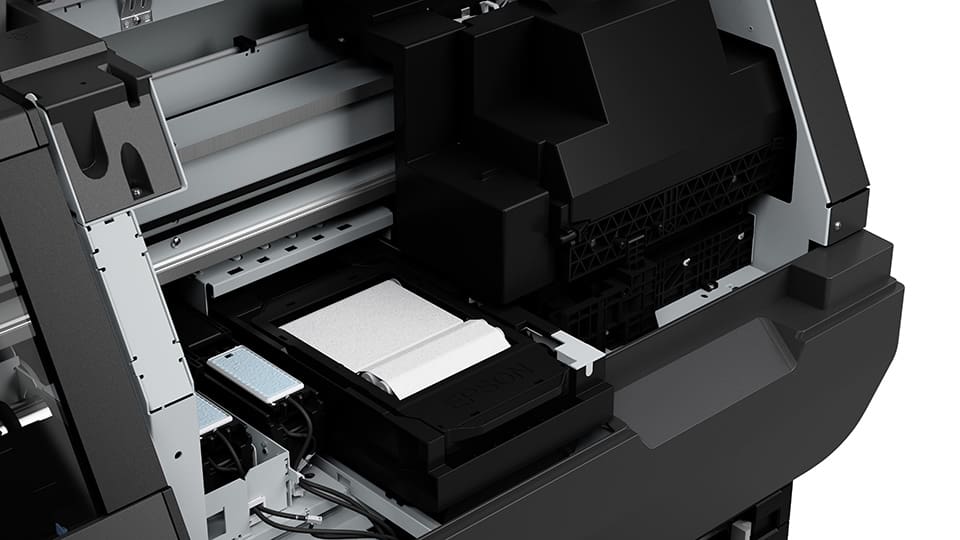
Wrapping up the printhead technology is Nozzle Verification Technology (NVT) which ensures the optimum condition of the printhead itself.
NVT monitors the signals sent to each nozzle; it expects to see no resistance to the impulse squeezing the Piezo Electric film. Should it detect a rebound signal from the drive impulse, this is almost certainly due to the nozzle being blocked and the NVT technology adjusts the nozzle pattern to override the blocked nozzle, maintaining print quality.
Supporting Roles
The dot is laid onto the substrate with the help of patented technology called Look-up Table (LUT). LUT technology has been developed in collaboration with the Munsell Color Science Laboratory at the Rochester Institute of Technology in the US. The purpose being to increase the colour fidelity and give a smoother graduation between colours.
This means the SC-R5000 prints high-quality images integrating three Epson technologies: Halftoning, fully optimised LUT, and micro weave which all ensure the minimum amount of graininess and banding, giving the repetition of quality, time after time with the minimum amount of operator intervention.
Should there need to be a printhead change, again Epson has not turned away from providing a solution that reduces service interventions. Rather than reach for the telephone and request a service intervention from an Epson engineer, within 60 minutes the operator can complete the exchange of a replacement getting you back up and running with minimum fuss.
Keeping Things Simple
The operation of the SC-R5000 could not be simpler; the printer is controlled via a handy but intuitive 4.3” LCD touchscreen panel. The panel contains all the functions needed for operation along with system alarms and status monitoring elements to not only plan and set the printer, but also keep it running at optimum levels.
The printer comes in a complete solution within a box containing everything needed to get up and running
Substrate is also not going to present any issues thanks to the touchscreen which features a media control device called Advanced Auto Tension Control (Ad-ATC) making sure the substrate is held with high dimensional accuracy such that the tiling of images can provide almost seamless overall printed images for wall covering and window displays.
Further operator control can be provided by the Epson Production Monitor which comes via the Epson Cloud Solution PORT which the operator can control and monitor several machines over a number of sites, or several on one.
Finally, as with a lot of the Epson solutions, they come in a one box solution meaning the printer can be out of the box and online with the least amount of technical intervention possible.
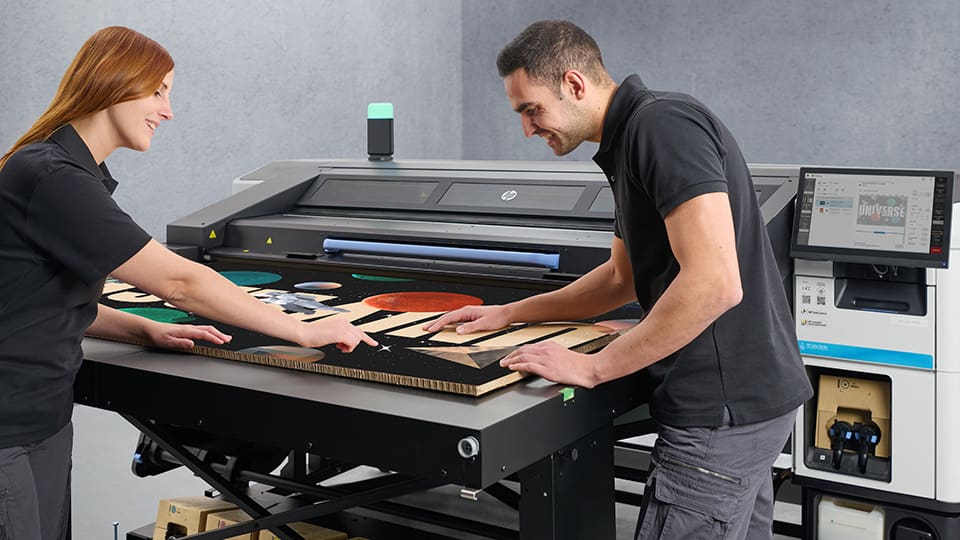
HP is looking to boost the life and appeal of its R-series hybrid Latex printers in rigid media applications with the introduction of an automated feeder/stacker that aims to improve overall productivity from loading to output. Michael Walker joins the queue
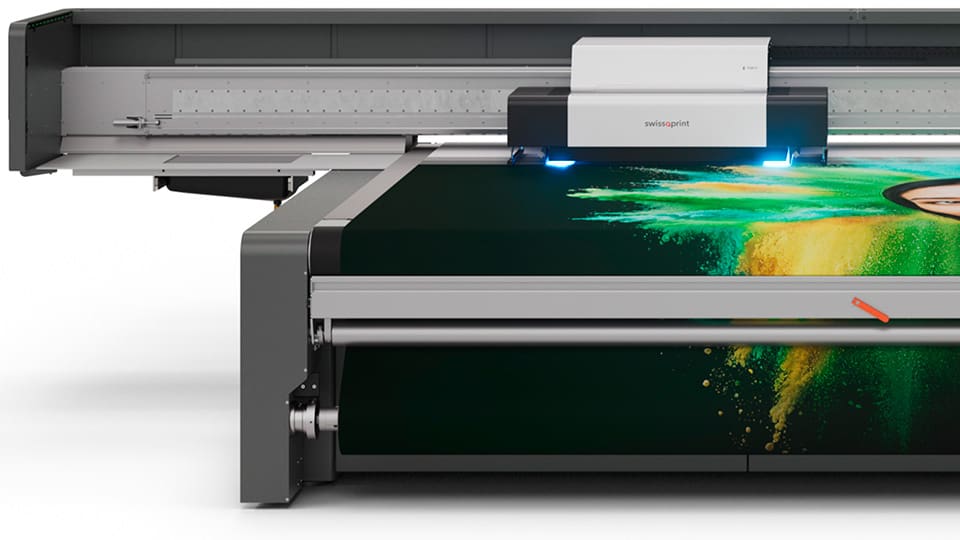
SwissQprint has added a lower production variant to its established 3.2 x 2m UV flatbed printer platform, offering the same features and fifth-generation engineering base as the established Nyala and Kudu models. Michael Walker looks at what’s on the table
Kongsberg set its sights on the corrugated market with the 2024 launch of the Ultimate line of digital cutting tables. Michael Walker looks at the smallest member of the family
Watch our latest video of the week
SignLink gives you the latest video coverage of companies, people, and events from within the signage, graphics, and wide-format print industries.