Liyu International has been producing high-quality inkjet printers for the point of display and advertising industries for nearly 20 years. Brian Sims takes a look at two of its hybrid models
Guest Writer
August 7, 2023
Both machines have been designed with a sturdy overarch which carries the printhead
Liyu International is a name that may not be immediately known, however, the company is one of the new up-and-coming Asian manufacturers of a range of computer-based equipment. Prior to this over the past 20 years, Liyu has focused on the production of wide-format printers.
Originally founded in 1993, Liyu Company started producing computer equipment and this experience and product knowledge gave it the option to produce the first Chinese plotters with the company priding itself on producing all parts for this equipment in-house.
As stated, in 2004 Liyu decided it had the relevant experience to produce large-format printer for the high-end products used in point of display, marketing, and many other products requiring large coverage with high-quality printed images.
Factoid: The PLATINUM Q2 HYBRID and PLATINUM HYBRID Q3 inkjet printers use Ricoh Gen6 printheads
Two decades on and Liyu International has distributors over many European companies and throughout North Africa and the Middle East. Showing dedication to building markets far to the west of China, Liyu International now has a headquarters in Ankara, Turkey and a large showroom in Milan, Italy. This certainly demonstrates the view that the product has a place up against the better-established manufacturers.
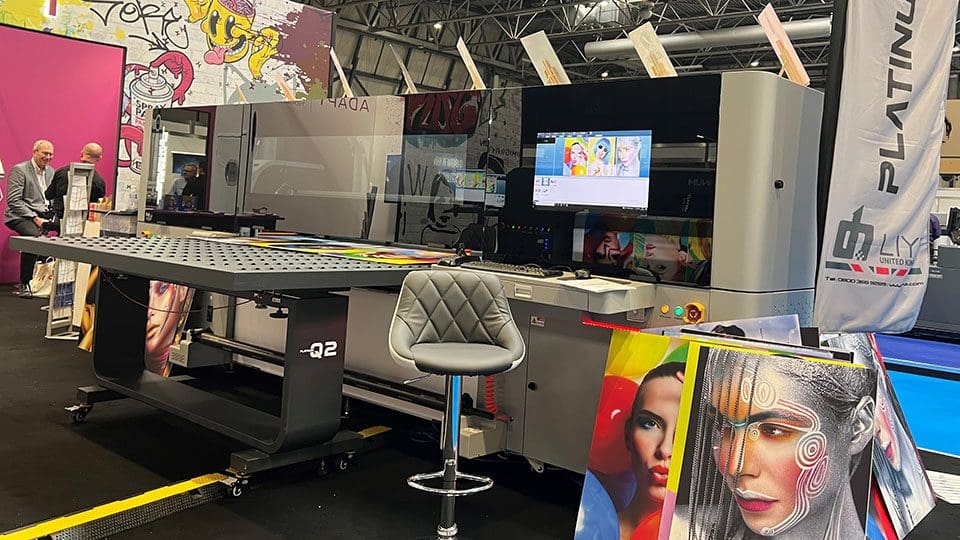
Liyu International has over 15 different machines all under the branding of ‘PLATINUM’ and the two printers this article will review are the PLATINUM Q2 HYBRID and PLATINUM HYBRID Q3, both being high-volume hybrid inkjet printers.
All in One
Liyu International describes the two printers as ‘all in one’, and when you look in detail at the specification, you easily see why this phrase is used.
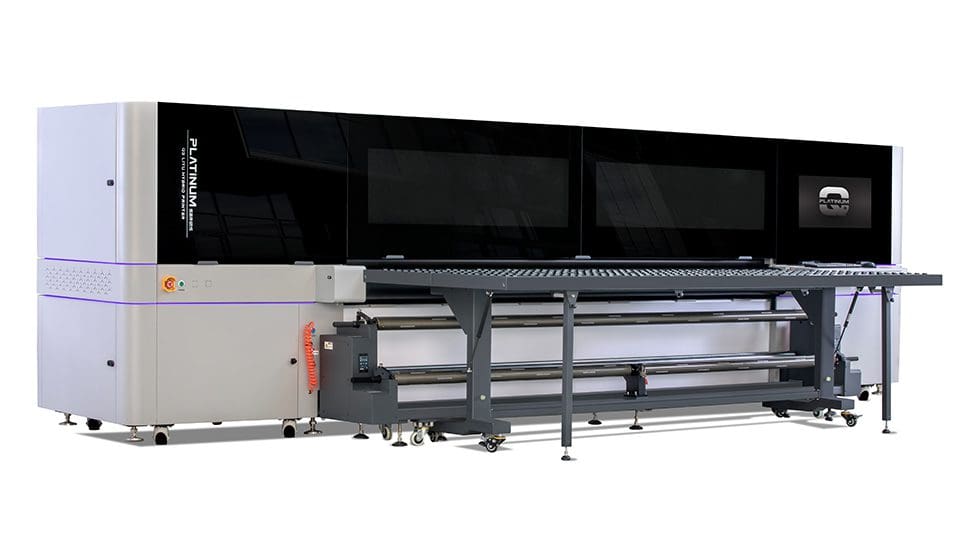
Both machines have been designed with a sturdy overarch which carries the printhead spanning 2050mm for the Q2 printer and 3200mm for the Q3 model.
The printhead is driven precisely by servo-motors and you can see the quality of the build in the use of linear bearings ensuring the printhead does not deviate from the designated position. Only by building with this depth of quality can you be sure you can reach the elevated resolution of 2,880 DPI.
Ink droplet deployment is available in four different volumes; 13, 7, 6 and 5 picolitres.
Liyu has not only focused its attention on moving and supporting the printhead, but the manufacturer has paid particular attention to the way the material is either transported or held when being printed.
Both machines can print on roll or sheet substrates up to 50mm in thickness and they have designed what they call the strong ‘quadro’ local vacuum. This grasps the substrate firmly to the machine bed to ensure when the printhead passes over the substrate, it is in the same place every time.
Obviously, you can have the architecture but the deployment of the ink is the vital component and Liyu has gone for some of the best printheads on the market; either the Konica Minolta 1024i, Ricoh Gen5 or as recently announced the Ricoh Gen6 updated version of the Japanese giant’s printhead. Ink droplet deployment is available in four different volumes; 13, 7, 6 and 5 picolitres.
Colourful Print
The Q2 and Q3 come with various resolutions, the highest being 2,880 DPI but lower output at higher speed is possible at 2,400 and 1220dpi respectively. This is accompanied by the printers having eight colours available which would be expected for machines designed for the display markets.
The colours are as to be expected with the process set (CMYK) along with light cyan and magenta, white and varnish. All of the inks are UV LED cured so they are dry as soon as the material has passed under the printhead and curing lamps. As these machines are used in a number of markets, Liyu International has worked hard to ensure they are of the highest environmental standards.
In this day and age when there is an added need for traceability or compliance, these inks are underpinned by the GREENGUARD gold standard. To satisfy the GREENGUARD gold standard, the inks supplied must meet the stringent emissions standards based on established chemical exposure criteria. Specifically the LED UV curing inks meet the UL2818 standard which is for low chemical emissions for indoor production.
The LED UV curing inks used in the new printers hold the GREENGUARD Gold certificate meaning they have passed the most rigorous testing and have a very low impact on the environment and contain very low levels of volatile organic compounds (VOCs) and are nickel free. These qualities in ink mean the Q2 and Q3 printers can be installed in a number of smaller operational sites without affecting operators.
Both machines can print on roll or sheet substrates up to 50mm in thickness
Both machines look very sleek, they have a large black semi-transparent cover extending almost the full width and to the height of the machine above the table. This allows for observation of the process but doesn’t make the printer look industrial.
Both machines come with the operation panel cleverly built into this black cover on either side of the machine. This gives the opportunity for a large computer panel being available to the operator but it doesn’t take up space on or around the machine. Both machines use PhotoPrint RIP software and Caldera software can be added as an option.
So much for what both machines have in common, but what sets them apart?
Basically, it boils down to the width of the substrate that can be printed on each machine. The PLATINUM Q2 HYBRIDprinter can print to a width of 2,050mm and this can be on roll or sheet substrate.
The PLATINUM HYBRID Q3 printer can print up to 3,200mm which is quite a considerable amount wider and this additional width allows the reel to be in either one full width or it can be split into two reels both front and back of the machine. The printer can be programmed to print either in duplex or multi-production meaning you can print two different jobs on separate reels in one pass.
Statistics:
Printheads
Konica Minolta 1024i - Ricoh Gen5/Gen6
Colours
CMYK + Lc + Lm + W + V
Resolution (DPI)
2880 DPI - 1200 DPI - 2400 DPI
Production speed
100m2/S
120m2/S
Max substrate height
50mm
Print width
2050mm
3,200mm
Brian Sims Principal Consultant, Metis Print Consultancy, www.metis-uk.eu
HP is looking to boost the life and appeal of its R-series hybrid Latex printers in rigid media applications with the introduction of an automated feeder/stacker that aims to improve overall productivity from loading to output. Michael Walker joins the queue
SwissQprint has added a lower production variant to its established 3.2 x 2m UV flatbed printer platform, offering the same features and fifth-generation engineering base as the established Nyala and Kudu models. Michael Walker looks at what’s on the table
Kongsberg set its sights on the corrugated market with the 2024 launch of the Ultimate line of digital cutting tables. Michael Walker looks at the smallest member of the family
Watch our latest video of the week
SignLink gives you the latest video coverage of companies, people, and events from within the signage, graphics, and wide-format print industries.