Mimaki has gone back to review its 300 series printers and the result is the new 330 series with some stunning increases in capacity and quality. Brian Sims takes a closer look at the range
Guest Writer
April 17, 2023
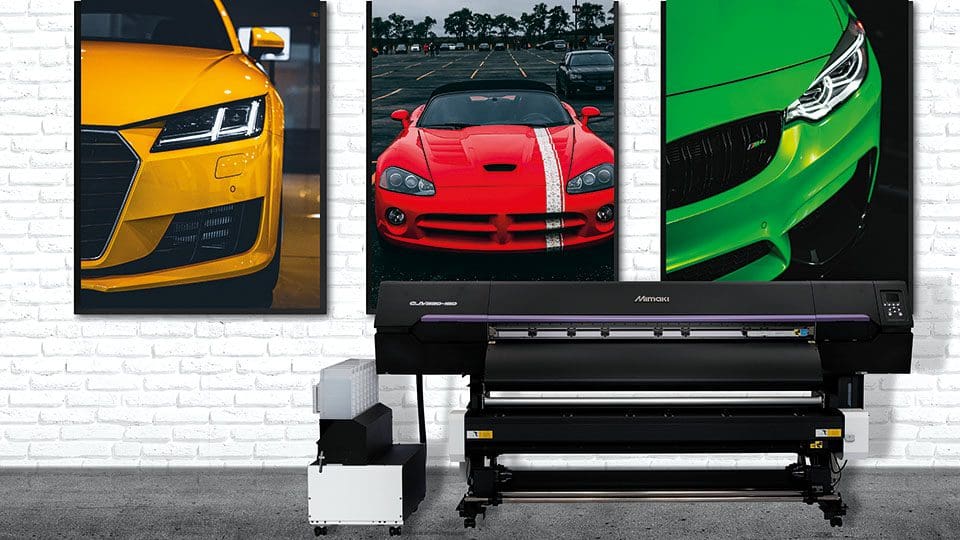
the CJV330-160 has a cutter station in the machine which can produce cut images on the substrate to within 0.2mm of repeatable accuracy
It goes without saying that Mimaki is well known with print businesses which have established a well-proven reputation in the market for a wide range of printing applications. It is very easy when you are in such a position to rest on your laurels and fail to notice competition slowly improving until they overtake your market-leading position. Before you know where you are, orders are failing to come in and you then have to play catch up, not the best place to be.
Mimaki has not been that complacent, the company has developed and released a new range of printers with the philosophy of ‘Loved, Evolved, Developed’ underpinning the development, and when you look in detail at each of the machines, you easily see where this tagline is a clear identifier for the changes.
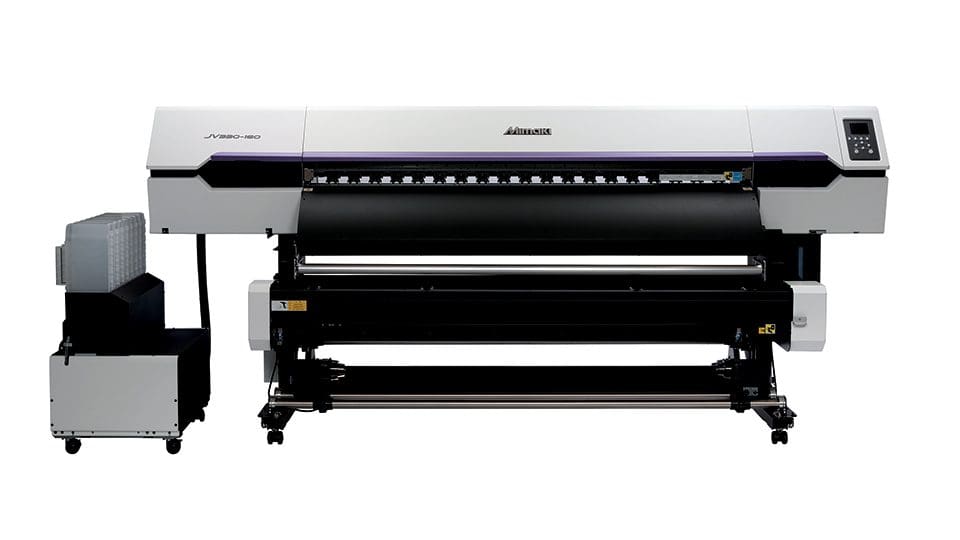
The generation step of the new 330 series of machines takes the three original wide-format solvent printers and upgrades both capacity and quality. The range is made up of two solvent printers, one with an in-built cutter and a dye-sublimation printer; the series being JV330-160 and the CJV330-160 with the cutter, plus the dye-sublimation TS330-1600.
All of the machines have undergone an in-depth design review of the architecture of the printer’s chassis and this has resulted in the new machines being 230% more rigid than the original 300 series. Stronger materials have been used in key areas identified in the review and new materials being placed into the chassis to improve flatness.
Factoid: The generation step of the new 330 series of machines takes the three original wide-format solvent printers and upgrades both capacity and quality
This obviously feeds into the 330 series of machines being able to place the dots onto the substrate with significantly more accuracy and repeatability. You do not need to be a design engineer to know this must mean the ability of the 330 series of printers being able to print to much higher standards than the 300 series of printers.
Mimaki does not rely on you looking at their printed product to see if these changes have made a difference, they actually measure it. If you were to look at a set of dots printed on the two machines, the 330 series of printers can control the dot landing accuracy in the X-Y direction to within 4μm 20μm respectively compared to 26μm and 35μm with the 300 series of older printers.
The updating of the chassis is not the only major update, the second and most important is the printer head nozzle design.
The new 330 series now has a nozzle row length up from 25.4mm to 33.8mm meaning there is a greater area for deploying ink onto the substrate. Furthermore, the new heads are staggered with a new pattern for each channel.
The 330 series now has four pairs of channels in the nozzle head rather than eight single channels. Each being a cluster of magenta/cyan and yellow/black on one side of the head with the mirror of this configuration being on the other.
Proven Technology
As you would expect, and with the ethos of the 330 series being ‘Loved, Evolved, Developed’ it must be of no surprise to see Mimaki continue to utilise its very successful ink deployment and machine management technology.
The first being Dot Adjustment System (DAS) which has been designed by Mimaki to automate the placement of the dot depending on the media and printing conditions. The idea being that the DAS reduces the input needed by the operator and reduction in streaking for overlaid inks, lack of image definition and the avoidance of white streaking across the sheet.
Ink deployment is enhanced by a key Mimaki tool called Mimaki Advanced Pass System (MAPS4). MAPS4 disperses the ink pattern on the sheet in such a pattern in a very specific array to allow the even drying of the product.
Further to MAPS4, the eco-solvent inks used in the 330 series printers come equipped with Mimaki’s Waveform Control technology (WFC). With this system, the printheads are able to round nearly perfect circles of ink droplets rather than the deformed circles that can form once the ink is deployed.
The benefit of this is that it allows the eco-solvent inks and Plus Series printers to produce high-quality images with sharp letters and lines and almost perfect-sized dots.
With regard to maintaining the inkjet heads there is a Nozzle Check Unit (NCU) which checks and cleans each nozzle automatically but if the cleaning process has not been successful, the Nozzle Recovery System (NRS) monitors and swaps nozzles when any become clogged or blocked. Both NCU and NRS allow the Mimaki to keep production stable meter upon meter.
The final part of the puzzle is the new drop technology Mimaki calls Mimaki Weaving Dot Technology (MWDT). This technology monitors and changes the firing order of each of the print head nozzles which greatly improves ink droplet placement. The implication of using MWDT is there is far smoother and deeper photographic reproduction of images.
The Nitty Gritty
As described earlier, there are three machines in the 330 series, two solvent printers and one dye-sublimation printer; the JV330-160 and CJV330-160 (with a cutter) and the TS330-1600.
The two solvent printers are very similar in design and specification, both having the same technology described but the difference is the CJV330-160 has a cutter station in the machine which can produce cut images on the substrate to within 0.2mm of repeatable accuracy.
The JV330-160 is equipped with an XY slitter to help reduce post-production activity by being able to slit and cut the printed product online
All the printers have a new conveyance mechanism in them which can handle substrates up to 250mm in diameter and the media changer can handle up to three of your most commonly used substrates on one printer saving both space and time when it comes to the interchange between jobs.
There is another version of media holder for the TS330-1600 where it can handle mini-jumbo rolls of substrate when media paper is needed for the job.
The JV330-160 and CJV330-160 are both equipped with an XY slitter to help reduce post production activity by being able to slit and cut the printed product online. Cropmarks can be read by the printer and this makes major in-roads into getting the product to the client quicker avoiding post production work.
Plenty of colours
Ink on the series of printers is broken down into the solvent and dye-sublimation models. The former has capacity for eight colours being CMYK along with LC, LM & Lk plus orange and white. The combination can be changed to match up a double set of CMYK or double white. The inks come in two-litre packs and the white in 500ml packs, with an ink circulation unit (MCTv2) recommended for white inks.
The TS330-1600 comes with CMYK along with LC, LM & Lk colours but with fluorescent pink and yellow which are much more in demand for the products the printer is designed for.
The range is made up of two solvent printers, one with an in-built cutter and a dye-sublimation printer
Another change with this printer is that the ink capacity unit can be upgraded to a 10kg ink tank. Due to the nature of the product produced on the TS330-1600 the Sb411 inks all come with the ECO PASSPORT meaning they are safe for direct contact with the skin and have high ecological credentials.
The 330 series has a new tool with is pre-set in whichever RIP software you chose (RasterLink 7 for the solvent models) and it is called ‘Deep Color Natural’. This is has a number of functions but basically it can print with more vivid and high contrast colours giving brighter highlights and deeper blacks.
The tagline ‘Loved, Evolved, Developed’ seems very simple, but you can see where it has produced some very impressive developments on already well-proven printers.
Statistics:
JV330-160
CJV330-160
TS330-1600
Print resolution
300,600,900,1200 dpi
Print head technology
On-demand piezo head (2 staggered printheads)
Colours
C, M, Y, K, Lc, Lm, Lk, Or, W
C, M, Y, K, Lc, Lm, Lk, FY, FP
Ink volume
2 litres/500ml white pack
2 litres pack 10 litre tank
Max printable width
1,610mm
Media width
1,620mm
Media diameter
250mm
Brian Sims Principal Consultant, Metis Print Consultancy, www.metis-uk.eu
HP is looking to boost the life and appeal of its R-series hybrid Latex printers in rigid media applications with the introduction of an automated feeder/stacker that aims to improve overall productivity from loading to output. Michael Walker joins the queue
SwissQprint has added a lower production variant to its established 3.2 x 2m UV flatbed printer platform, offering the same features and fifth-generation engineering base as the established Nyala and Kudu models. Michael Walker looks at what’s on the table
Kongsberg set its sights on the corrugated market with the 2024 launch of the Ultimate line of digital cutting tables. Michael Walker looks at the smallest member of the family
Watch our latest video of the week
SignLink gives you the latest video coverage of companies, people, and events from within the signage, graphics, and wide-format print industries.