The Power of Partnerships in Sign-Making
Working with other businesses can open doors to new markets, services, and expertise. Here, SignLink examines how building the right partnerships can strengthen day-to-day operations and long-term success.

With versatility high on the agenda of many printers and sign-makers, Jonathan Pert catches up with a range of manufacturers and suppliers of hybrid printers to see what some of the latest solutions on the market can bring to the production floor of businesses throughout the industry

In an industry increasingly dictated by fast-moving trends and fluctuating demands, modern sign-makers need to be agile in order to keep pace. Today’s print shops are expected to be chameleons, flipping from heavy-duty rigid hoarding to delicate textile banners at a moment’s notice, without breaking a sweat or blowing the budget.
With this in mind, many sign-makers are looking to the latest generation of hybrid print solutions as the solution – printers specifically engineered to serve as a ‘multi-tool’ to handle unpredictable production schedules. Instead of fighting with finicky setups, operators can now utilise new technologies such as intelligent vacuum beds, adaptive tension controls, and inks designed to stick to almost any substrate. It’s a shift that can turn operational chaos into a competitive edge, showing that in a fluctuating market, versatility can be the ultimate superpower. Speaking to a range of suppliers and manufacturers, we aim to unpack the latest hybrid solutions designed to cut down your setup times and boost your production capacity.
For those looking for the lowdown on the hybrid print hardware available to the market, a good place to start would be UK-based independent wide-format kit supplier, CMYUK, which provides production technology for a wide range of industrial applications.
Included in CMYUK’s portfolio is EFI’s latest 3.2m hybrid platforms including the EFI VUTEk M3h, the higher throughput EFI VUTEk M3h X, and the EFI Pro 30h+. The M3h X, which was unveiled at FESPA 2026 in Barcelona, builds on the success of the M3h since its launch in April 2025. The press adds extra heads for greater speed and an extended colour set, including orange and clear, for demanding brand and retail applications, with the aim of offering customers more options for their workflow.
The Pro 30h+, launched last year, is the faster evolution of the EFI Pro 30h printer, an accessibly priced entry-level printer for 3.2m-wide production.
The Pro 30h+ offers a realistic route into 3.2m super-wide production and is a faster version of the proven Pro 30h, rather than a step into the unknown
Chris Martin, sales director at CMYUK, explains that the response to the new EFI solutions has been “characterised by real anticipation,” saying: “The runaway success of the M3h as a natural mid-volume workhorse has led to strong interest in the M3h X for additional speed and throughput. The Pro 30h+ offers a realistic route into 3.2m superwide production and is a faster version of the proven Pro 30h, rather than a step into the unknown.”
These EFI hybrids have been developed to directly address the traditional conflict between roll-to-roll and flatbed production. Martin says that they offer print service providers (PSPs) “a single platform that can handle both, with very little compromise, at production speeds.” He continues: “They respond to demand for faster turnarounds on complex, high coverage files without banding or colour instability.”
By consolidating multiple devices into a single 3.2m hybrid footprint, the EFI solutions can also help relieve space and staffing constraints. EFI’s hybrids also offer precise vacuum control to attain challenging media, with a rear redirect roller helping to relax flexible materials during printing, reducing curl, and tracking issues on rolls. This allows them to handle tricky, irregular, or difficult materials reliably, thereby preventing mistakes and saving money on wasted stock.
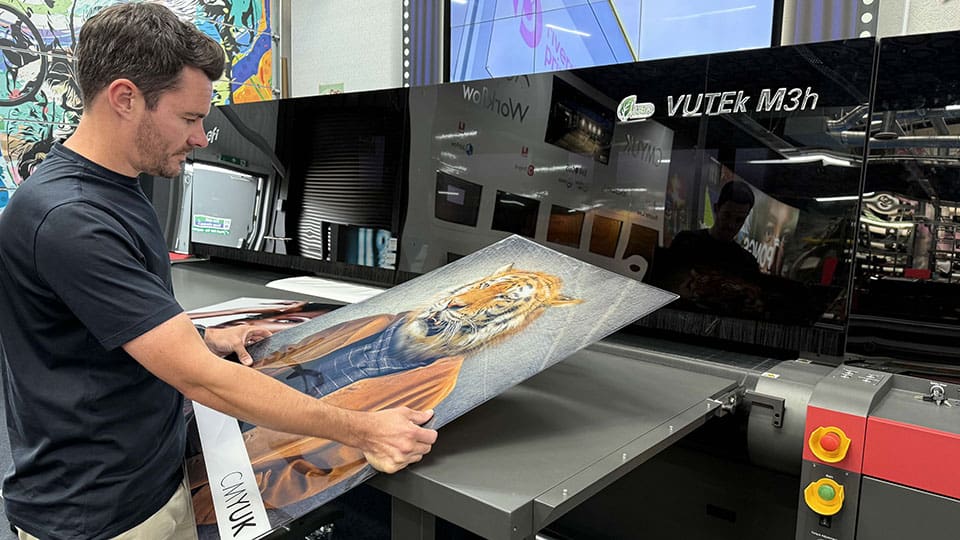
The technology is underpinned by six independently controlled vacuum zones which can secure rigid boards, limiting micro movement that causes misregistration and print defects. Media edge guards also enable corrugated and other uneven substrates to become more predictable on the table. With M3h/M3h X printers, split roll shafts also allow two different 1.6m wide rolls to run side-by-side, with one changeable while the other continues printing. Martin adds: “Collectively, these details underpin consistent quality across a broad media mix.”
Martin highlights that the flexibility of the EFI solutions is in direct response to market needs, commenting: “Printers unquestionably need to have more agility than ever, with shorter runs, tighter deadlines, and a widening applications range that are increasingly becoming the norm.
“EFI’s hybrids deliver that agility by allowing rapid switching between roll and rigid work on the same device, without the need to move jobs between multiple printers. In addition, high print speeds and stable handling of difficult media help protect schedules from reprints and wastage. With the Pro 30h+ and the addition of the M3h X to the M3h line-up, PSPs can scale capacity as demand grows, while remaining with a familiar, proven technology platform.”
Another UK company that has detailed knowledge on hybrid print technologies is the aptly named Hybrid Services, Mimaki’s exclusive distributor for the UK and Ireland. Among its many offerings is the Mimaki UJ330H-160, a new hybrid UV inkjet printer that enables switching between roll media and rigid substrates.
According to Andrew Edwards, partner sales manager for Sign & Graphics at Hybrid Services, the origins of the UJ330H-160 date back almost two decades, when Mimaki offered a UV hybrid printer that used pinch rollers and folding tables for flexible roll and rigid media production. He explains: “While this was a popular machine, research has since then focused on dedicated roll-fed and flatbed machines, until the recent launch of the UJ330H-160. Drawing on its expertise in both roll fed and flatbed technologies alongside its LED UV ink development, the new hybrid UV printer brings together the key strengths of the Japanese manufacturer’s hugely successful UCJV330 and JFX ranges.”
The UJ330H-160 is designed to address multiple challenges faced by PSPs. This includes a highly compact footprint, which offers a solution for businesses operating in older or smaller premises. With a front-to-back measurement of just 785mm, the printer can fit through standard single doors making it immediately attractive to companies that may have space but can’t easily access it. As Edwards puts it: “For a sign-maker and PSP who would have hitherto outsourced their rigid media work because of access, floorspace, or simply budget to invest in a dedicated flatbed printer, it very readily brings the capability in house.”
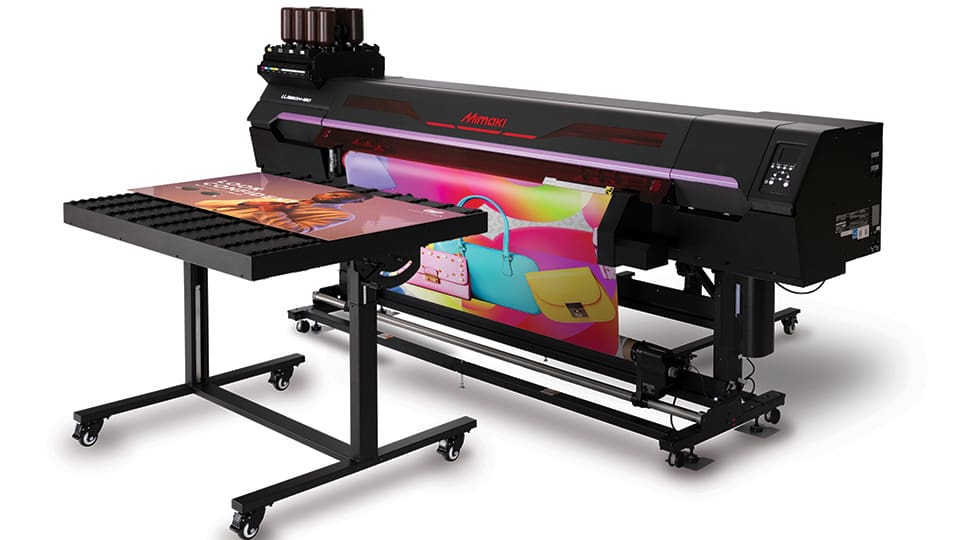
Edwards also says that customers appreciate the flexibility that the printer offers, with it capable of printing a vast range of media including roll-fed materials and boards up to 8’ x 4’ in size. While a sign-maker may have had to previously print roll media and then apply to board, they can remove a layer of cost and additional process by simply printing direct to rigid materials on the new machine. Edwards comments: “Starting from under £36,000 including a set of tables and Mimaki’s powerful RasterLink RIP software, it completely rewrites the rulebook for this sector.”
By utilising a proprietary vacuum belt, the UJ330H removes the need for pinch rollers to transport roll and rigid materials through the printer. This can resolve the challenges presented by delicate media such as leather and vegan leather, some window films, heavy gauge magnetic rolls, and other softer substrates that are prone to denting from the pressure created by pinch rollers. Edwards adds: “The Mimaki UJ330H-160 enables a print company to be incredibly agile, covering almost every application conceivable across both roll and rigid media.”
The Mimaki UJ330H-160 enables a print company to be incredibly agile, covering almost every application conceivable across both roll and rigid media
According to Edwards, the response from customers and reseller partners has been extremely enthusiastic, with the first set of machines already installed in the UK. He attributes this to UJ330H-160’s price-to-performance ratio in contrast to full-size flatbed printers, which many PSPs may have found financially out of reach in the current economic climate. He adds: “We’re also seeing customers who had previously looked at alternative hybrid UV printers, but found them too large for their premises, choose the Mimaki because its compact footprint makes access to their premises possible.”
The UJ330H-160 will have a prime position on Hybrid’s stand at The Print Show 2026. Sitting alongside a wide range of the latest Mimaki technology on the largest stand Hybrid has ever had at the exhibition, it is set to be a key focus for demonstrations throughout the show. For those that want to see the machine in action and can’t make it to Hybrid’s purpose-built showroom in Crewe, The Print Show will offer a unique opportunity.
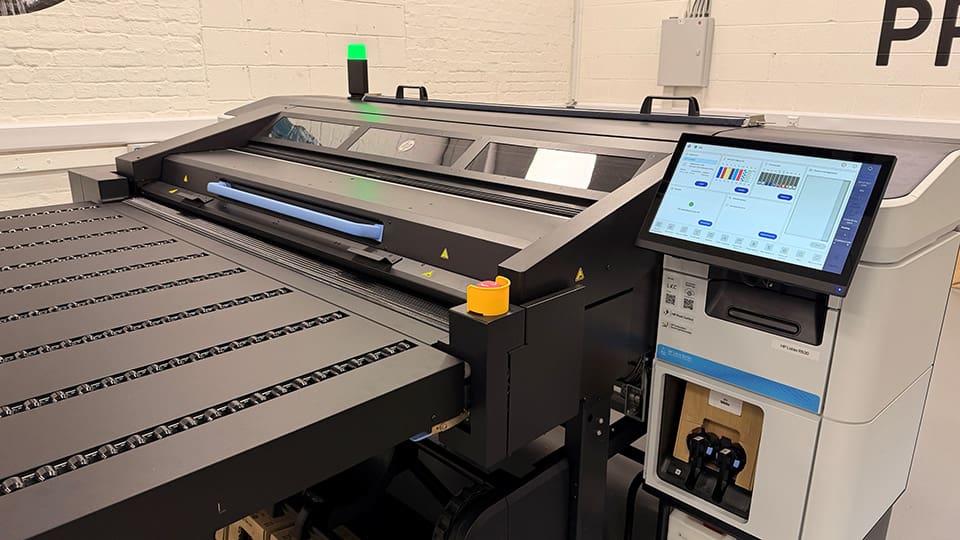
We conclude our look into hybrid print solutions with digital printing equipment manufacturer, Roland DG. The company offers a range of belt-driven hybrid UV models including the 64-inch print-and-cut TrueVIS LG-640, which supports optional extension tables to process semi-rigid stock alongside traditional rolls. The range also includes the more entry-level TrueVIS MG-640, which utilises tension bars and extension tables to handle thin films and folding box boards up to 1mm in thickness.
However, our focus for this particular deep dive moves away from wide-format to focus on the recently released Roland VersaStudio BY2 20, a compact direct-to-film (DTF) printer designed to deliver consistent, high-quality apparel production for daily use.
The hybrid solution combines DTF printing with built-in standalone contour vinyl cutting capabilities and versatile finishes. It acts as a standalone contour cutter to process traditional heat-transfer vinyl, while offering metallic, glitter, and holographic finishes without the need to switch machine.
Building on Roland DG’s existing expertise in colour science and print technology, the CMYK + white DTF printer is designed to deliver sharp detail, vivid colour, and repeatable results, supporting a wide range of apparel applications from T-shirts and sportswear to workwear, décor, and accessories.
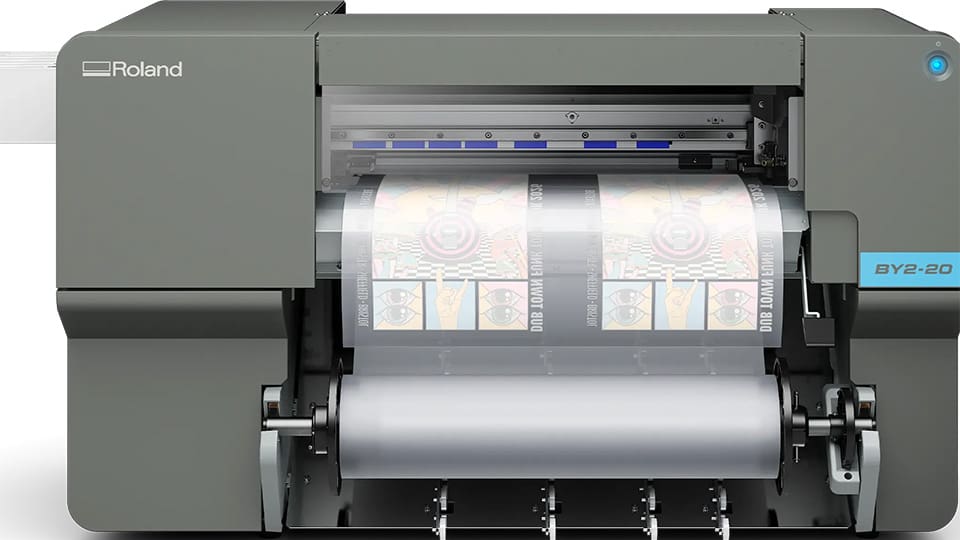
As the DTF market continues to expand with many solutions prioritising low upfront costs over long-term reliability, the BY2 20 is positioned as a professional alternative designed for dependable output and predictable performance. By bringing together advanced print technology, integrated software, and a fully supported ecosystem, it aims to remove much of the complexity associated with DTF printing and help businesses focus on larger-scale growth.
Speaking about the solution, Ryugo Nimura, executive officer for the Global Sales and Marketing Division at Roland DG, says: “With the BY2 20, we set out to redefine expectations for compact DTF printing. This is a professional, production ready solution delivering consistent quality, integrated simplicity, and dependable day-to-day performance.”
One of the key features of the BY2 20 is its connectivity with the wider Roland DG ecosystem. The press is fully integrated with cloud and browser-based graphics design application, Connect Designer, which provides design tools to help print providers to produce custom artwork. VersaWorks 7, the newest generation of Roland DG’s proprietary RIP software, then prepares designs for print, with data hub and app ecosystem, Roland DG Connect, facilitating monitoring and maintenance. Ultimately, this workflow allows users to focus on producing and selling finished products, rather than managing technology.
By bringing together hardware, software, inks, media, and support into a single workflow, we’re helping businesses protect their reputation by producing professional quality apparel they can rely on
Nimura adds: “By bringing together hardware, software, inks, media, and support into a single workflow, we’re helping businesses protect their reputation by producing professional quality apparel they can rely on.”
The intuitive operation of the BY2 20 makes it well-suited to small production spaces and users new to DTF printing, while still delivering the reliability and output consistency required in professional environments. Engineered for stable day-to-day operation, the system supports continuous production while minimising the hands-on intervention often associated with compact DTF systems.
This focus on streamlined operations also extends to the printer’s inks, with refined ink flow, internal temperature control, and large-capacity white ink cartridges supporting predictable performance and stable continuous printing. Automatic white underbase generation also helps to simplify production, particularly in demanding environments such as apparel production print shops where consistency is critical.
Ultimately, the BY2 20 aims to prove that industrial grade DTF reliability no longer requires an industrial footprint.
Ultimately, today’s hybrid hardware isn’t just about survival in a fickle market – more importantly, it’s about expansion. By stripping away the downtime between rigid and roll-to-roll jobs, manufacturers can provide sign-makers with the freedom to pivot, experiment with unusual substrates, and capture higher-margin work that used to require third-party help. Embracing the hybrid model can allow your print shop to be less boxed-in by hardware limitations, ensuring that whatever unpredictable brief lands on the desk tomorrow, your business is geared up to deliver.