The Power of Partnerships in Sign-Making
Working with other businesses can open doors to new markets, services, and expertise. Here, SignLink examines how building the right partnerships can strengthen day-to-day operations and long-term success.

As workflows grow increasingly complex, maintaining consistent colour across devices and substrates is no small task. SignLink investigates how modern colour management tools are helping the industry stay in control

In an industry where even the slightest variation can undermine a brand, colour accuracy has become a defining measure of quality. From retail displays to large-format signage, customers demand and expect consistency, no matter the substrate, device or location. For wide-format print companies and sign-makers, that means controlling colour at every stage of production, not just hoping for the best at the output stage.
Advances in colour management software, spectrophotometers, and automated workflows are making this level of control more achievable than ever. Modern solutions can profile devices with high precision, compensate for material differences, and maintain consistency across multiple printers and sites. At the same time, cloud-based platforms and integrated RIP technologies are simplifying what was once a highly technical and time-consuming process.
However, technology alone is only part of the equation. Achieving true colour accuracy still relies on a disciplined approach: calibration, standardisation, and a keen eye for detail. For those willing to invest the time and tools, the reward is not just better-looking output, but stronger customer trust and fewer costly reprints.
Sign-makers and wide-format printers seeking solutions in this area are advised to work with reputable and trusted providers in order to get the best colour accuracy in their work, with Caldera being one of the names that meets this criterion. Sebastien Hanssens, vice-president for marketing at Caldera, explains that large-format print production means working across multiple printers, inks, and substrates, each with its own colour gamut and behaviour. With this, he says without proper control, the same file can produce visibly different results from one device or material to another.
Brand colours that don’t match, gradients that break, or signage that looks different in-store versus in production are not minor issues, they really affect brand trust and profitability
“From a business perspective, that inconsistency translates directly into waste, reprints, and dissatisfied customers,” Hanssens explains, continuing: “Brand colours that don’t match, gradients that break, or signage that looks different in-store versus in production are not minor issues, they really affect brand trust and profitability.
“Good colour management is about repeatability and predictability. It allows sign-makers and wide-format printers to hit the same result today, tomorrow, and across locations. That consistency is what enables scalable production, faster approvals, and ultimately higher margins and is something which is a priority for Caldera.”
On this, Hanssens goes on to say the most common mistakes are not about lack of tools, but more about inconsistent processes. He explains that skipping proper profiling for each substrate, relying on visual adjustments instead of standards, ignoring embedded profiles, or mismatching colour spaces are some examples of this.
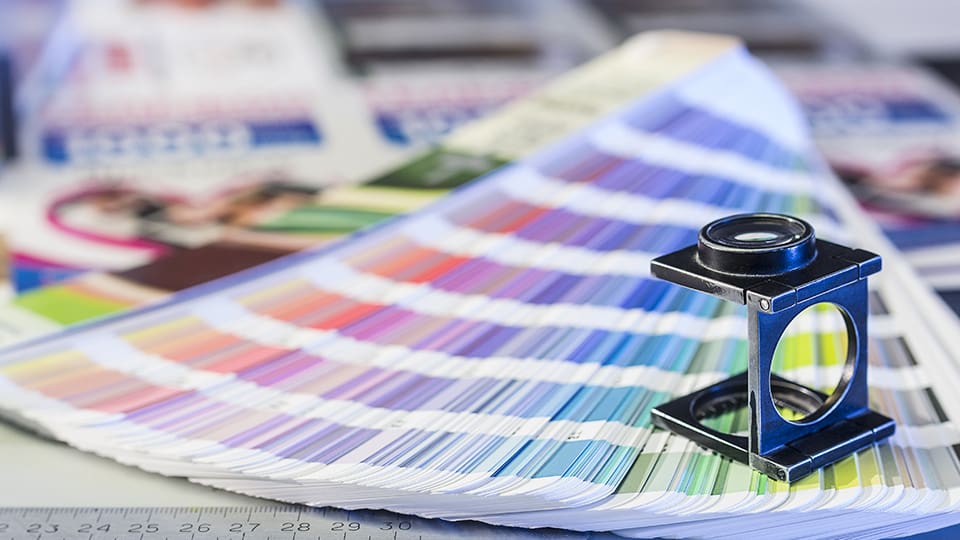
“A profile built for one material cannot simply be reused on another,” he says, continuing: “Each combination behaves differently, and failing to profile accordingly leads to immediate inconsistencies. Manual tweaks in the RIP might fix one job, but they are not repeatable. Without standardised profiles, results vary from operator to operator and job to job.
Ultimately, the biggest issue is treating colour management as a one-time setup rather than an ongoing production process.”
So, what are the most important tools and processes to have in place to achieve consistent colour across different devices and substrates? Hanssens says consistency does not come from a single tool but is instead the result of a structured workflow that combines colour measurement and colour profiling, with accurate measurement and profiling, ICC-based colour management, and spot colour management all being key.
“You should be using spectrophotometers to measure how each printer, ink, or substrate combination behaves and generating ICC profiles accordingly,” Hanssens says, adding: “This is important because every device interprets colour differently.
“Standardised input, simulation, and output profiles will ensure that files are translated correctly from design (RGB or CMYK) to the final print conditions. Meanwhile, access to libraries such as Pantone or RAL and tools for spot colour matching and replacement is essential in signage, where brand colours must be exact. All of these are included in Caldera solutions.”
Factoid: Colour management relies on ICC profiles, a global standard maintained by the International Colour Consortium, or the ICC
The good news, Hanssens continues, is that colour management is becoming significantly more automated, integrated, and accessible. He notes that some of the key trends seen at Caldera include the automation of complex processes, cross-technology consistency, and data-driven and repeatable production.
Tasks like media profiling, calibration, and job preparation are increasingly automated within RIP workflows, reducing the need for deep specialist expertise and speeding up onboarding. In addition, sign-makers and printers diversify across textile, rigid, soft signage, and industrial work, Hanssens says that solutions are evolving to maintain colour consistency across very different technologies and substrates.
“Looking ahead, our objective with Caldera solutions is less manual intervention, more intelligent automation, and tighter integration between design intent and final output,” he says, adding: “The goal is to make accurate colour not just achievable, but effortless and scalable for any print or signage business.”
Elsewhere, Barry Mann, who manages the Colyer Demonstration Centre and is trained in colour theory and a range of technologies, including Barbieri, says colour management is not a niche technical extra, but fundamental to everyday success.
“It’s the difference between crossing your fingers and hoping the colour works, and having the confidence to know it will,” he says, adding: “Done properly, it underpins consistency, reduces waste, and builds the client trust that comes from delivering repeatable, predictable results. Each printer, ink set, and substrate behaves differently, and without proper control, those differences become visible — and costly.
It’s the difference between crossing your fingers and hoping the colour works, and having the confidence to know it will
“Many issues stem from expectations rather than equipment. Different print processes have inherent limitations, and no two materials behave identically. Managing client expectations early — supported by hard-copy proofs where colour is critical — prevents costly reprints and disputes. Reliable colour has always depended on correct processes, the right tools, and skilled operators. When any one element is missing, inconsistency follows.”
Mann goes on to say that the industry is evolving quickly, setting out how Barbieri’s automated measurement removes operator variability, while HP’s embedded colour intelligence and Epson’s built-in calibration are lowering the barrier to professional consistency for businesses of all sizes. He says that what was once a specialist discipline is becoming integrated, accessible, and increasingly intelligent.
“At the heart of any well-run sign shop is a professional RIP, the colour control hub that translates creative intent into reproducible output,” Mann explains, continuing: “Solutions such as Onyx or Caldera offer profiling and calibration options simply not possible with entry-level software.
“Pair this with a quality spectrophotometer, such as the Barbieri Spectro LFP qb, and businesses can build custom ICC profiles that accurately bridge the gap between devices and media. For operations running multiple print technologies, a spectrophotometer is no longer a luxury; it is essential.”
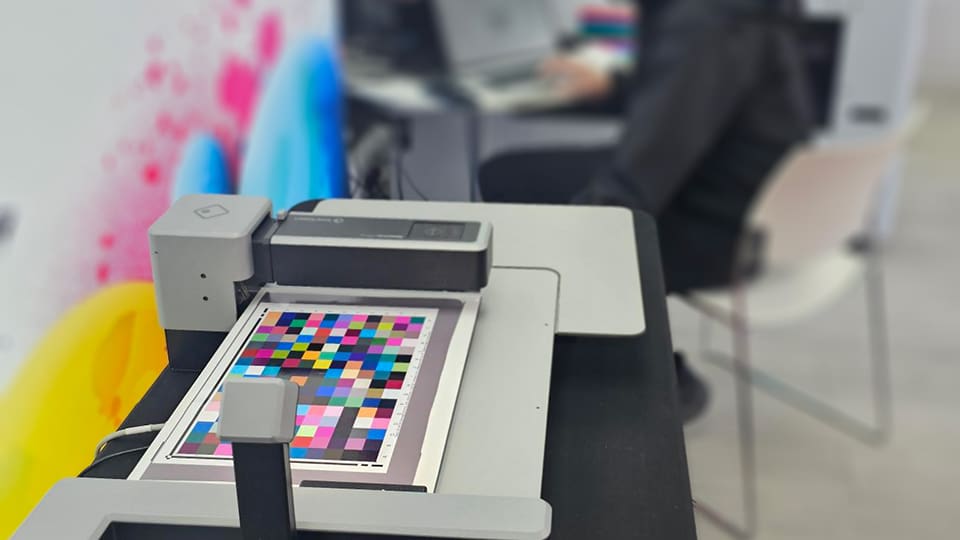
He goes on to say how Epson’s UltraChrome ink systems, engineered for wide colour gamut and consistency, work in close harmony with these workflows, making them a natural fit for sign-makers that demand reliability across a broad range of substrates. HP, meanwhile, brings its own colour intelligence to the table, with hardware increasingly capable of self-calibration and built-in colour control. As an authorised reseller of both Epson and HP, Mann says Colyer is well placed to match the right technology to each customer’s production environment.
“With brands like HP and Barbieri leading the way, the future of colour management looks not just brighter, but smarter, opening new possibilities for quality, efficiency and confidence in print production,” Mann adds.
He also notes how Colyer does not just supply the tools but also helps its customers get the best from them. Based at the company’s Demonstration Centre in Woking and run by Mann, the Colyer Academy, offers short, hands-on courses for creatives, print professionals, and production teams.
“Participants work directly with industry experts across colour science, RIP software, media optimisation, and large-format hardware, gaining first-hand experience with the same Barbieri measurement technology used in professional workflows every day,” he explains, adding: “Whether new to colour management or refining advanced technique, delegates leave with practical knowledge — and the confidence that comes with it.”
Also stepping up to offer advice is Ray Weiss, vice president of eLearning and certifications for the PRINTING United Alliance. He says colour management is not optional, but instead something that can give your business a competitive edge.
“Think about the last time a customer called to complain about colour,” he says, adding: “Maybe the banner didn’t match the display, or a reorder looked nothing like the original. That call costs you time, materials, and credibility. In most cases, it was preventable. Colour management isn’t a “nice to have”; it’s the difference between running a shop that reprints jobs and one that gets it right the first time.”

Weiss goes on to say that in day-to-day print and sign production, poor colour management shows up as wasted substrate, overconsumption of ink, and customers who do not come back. On this, he says the real cost is not the reprint but the customer who quietly takes their next job somewhere else.
So, what should printers and sign-makers have to hand? Weiss says consistent, repeatable colour starts with a spectrophotometer, adding that if you are still relying on your eyes to evaluate colour, even perfect vision is affected by fatigue, lighting, and age, meaning you need objective data.
“Beyond the device, you need a process,” he explains, continuing: “The colour management pyramid — starting with your environmental conditions, such as temperature, humidity, clean power, and working up through printer calibration, ink limits, linearisation, and finally ICC profiling — gives you a structured path to follow. Each step builds on the last. A great profile sitting atop a poorly calibrated printer is like a GPS giving you perfect directions to the wrong destination.”
Planning ahead, Weiss says colour management is getting smarter, with AI increasingly being integrated into print workflows, automating colour calibration, and helping predict equipment maintenance needs. Weiss highlights RIP software such as Onyx Graphics and EFI Fiery that integrate AI-driven colour profiling and cloud-based job management, allowing users to automate more repetitive tasks and reduce errors. This, he says, means shops will spend less time chasing colour and more time producing, adding cloud-based verification tools are making it easier to track trends over time and catch drift before it becomes a problem.
The automation coming down the pipe will make accurate colour more accessible than ever
“The fundamentals aren’t changing; you still need a good process, the right tools, and trained people,” he says, concluding: “But the automation coming down the pipe will make accurate colour more accessible than ever. The shops that build good habits now will be the ones best positioned to take advantage of it.”
The stand-out theme running throughout this feature is ignore colour management tools at your own risk. While printers and sign-makers are indeed a talented bunch with an eye for detail, they should be making use of the innovative tools at their disposal to achieve the best possible colour quality in their work.