The Power of Partnerships in Sign-Making
Working with other businesses can open doors to new markets, services, and expertise. Here, SignLink examines how building the right partnerships can strengthen day-to-day operations and long-term success.

As demand grows for rigid media, faster turnaround, and greater flexibility, flatbed printers are evolving into high-productivity platforms delivering precision and scale. Rob Fletcher finds out more

For many sign-makers, flatbed printers have shifted from more of a specialist investment to core production equipment. The ability to print directly on rigid substrates such as acrylic, aluminium composite, and board has opened up new opportunities across key areas such as retail, wayfinding, and interior applications.
At the same time, customer expectations on turnaround times and finish quality continue to rise, with signage companies under increasing pressure to deliver durable, high-impact graphics quickly, while also keeping production costs under control.
Manufacturers have responded by refining flatbed technology to offer higher print speeds, improved ink performance and greater automation. Here, SignLink takes a closer look at some of the latest solutions within this sector, considering how these more productive and versatile machines are enabling sign-makers to broaden their offering without adding unnecessary complexity to workflow.
First up, Anda Baboi, product manager at Fujifilm Ink Solutions Group, says for printers and sign-makers evaluating new equipment, several factors consistently separate a capable machine from an adequate one. She adds that consistent quality at production speeds is critical; print quality is no longer judged solely by resolution, with the real test being whether colour consistency, sharpness, and adhesion remain stable when the printer is running at realistic production speeds.
“Today’s sign and display market demands flexibility. From foamboard and PVC to aluminium composite, acrylic, and specialty materials, a flatbed must be able to handle a wide range of substrates with minimal setup and reliable adhesion,” Baboi says, adding: “Vacuum design, media handling, and ink chemistry all play an important role here.
“Headline speeds are easy to compare on a brochure, but true productivity includes loading times, job setup, RIP integration, and workflow efficiency. A printer that fits seamlessly into the production environment will often outperform a faster machine that disrupts it.
Headline speeds are easy to compare on a brochure, but true productivity includes loading times, job setup, RIP integration, and workflow efficiency
“Downtime is the cost that never appears on a specification sheet but is felt immediately on the shop floor. Proven mechanical design, accessible maintenance, and responsive technical support are critical considerations when investing in any production device.”
Taking this a step further, Baboi says any new equipment should support not only existing business needs but also the next stage of development. At the same time, some companies invest in very high-end machines but never utilise their full capacity, while others choose entry-level systems that quickly become bottlenecks.
“The right machine is the one aligned with realistic production needs and growth plans,” she says, continuing: “Workflow is also often underestimated. Handling rigid materials, managing job queues, and integrating finishing processes can have as much impact on productivity as print speed itself. Finally, training and adoption are sometimes overlooked. Even intuitive systems require time for operators to become confident and efficient.”
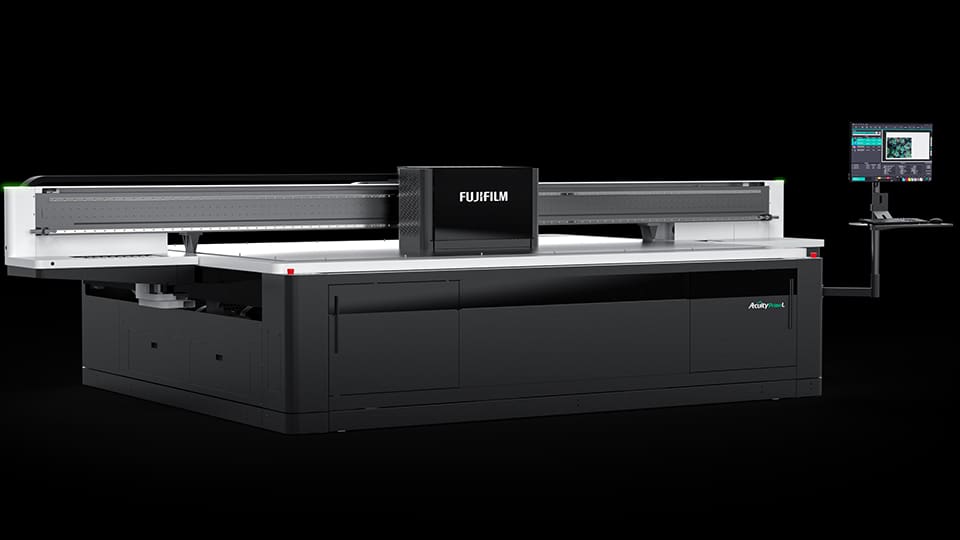
As for solutions from Fujifilm, Baboi immediately points to the Acuity Prime platform, which she says was designed for modern sign and display production, and developed to address the needs of mid-range and high-productivity sign and display printers requiring both quality and versatility in a dedicated flatbed.
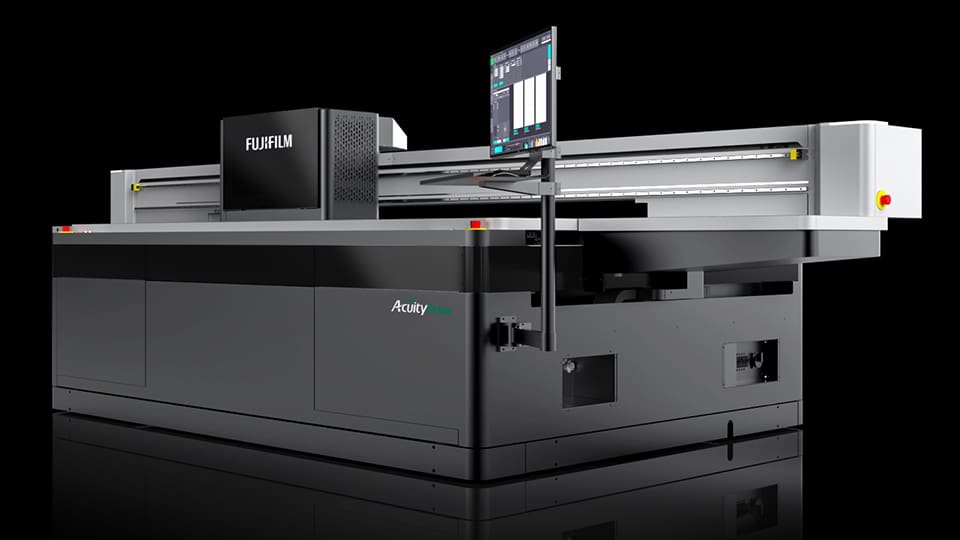
Within this family are the Acuity Prime 20 and 30, which Baboi says were both designed for consistent production environments. She comments: “They combine industrial build quality with a user-friendly operating environment, making them well suited to sign-makers producing retail graphics, display panels, exhibition materials, and bespoke interior décor applications. The printers are engineered to deliver stable output across a variety of rigid substrates, with options such as white ink and clear ink enabling more creative and value-added work.”
Also within the same range is the Acuity Prime L, suited to businesses requiring higher throughput or larger sheet sizes, offering increased productivity and a larger bed format. This, Baboi says, makes it an effective solution for industrial applications, large signage, and high-volume display production, while highlighting other features such as dual-zone functionality and efficient vacuum control help maintain productivity during continuous operation.
Finally, the Acuity Prime Hybrid offers flexibility between rigid and roll media, allowing operators to produce both board and flexible graphics on a single machine. For signage companies handling banners, self-adhesive vinyl, and rigid signage, Baboi says this can streamline production and reduce the need for multiple devices.
Elsewhere, Martin Southworth, partner account manager for industrial products at Hybrid Services, Mimaki’s distributor for the UK and Ireland, also talks up the value a flatbed printer can bring to a signage company. For those in the market for a machine, he advises looking at quality across performance, reliability, and long-term value.
“Print accuracy and consistency are obviously fundamental factors, so new buyers should look for stable and proven printhead technology, intelligent drop control, and a curing system that delivers sharp text, smooth gradations, and dense, opaque whites across a wide range of rigid and flexible substrates.”
Southworth adds: “Versatility is equally important; a strong flatbed platform should comfortably handle materials such as acrylic, aluminium composite, foamboard, and more specialist rigid media. Vacuum strength, ink delivery, and media handling will all also directly affect productivity and finished quality.
“Finally, build quality and service or support should not be overlooked. A production flatbed needs to withstand continuous use as well as be straightforward to maintain, so it’s important to assess the strength of the distributor’s support infrastructure. Technical expertise, parts availability, and structured training will have a direct impact on uptime and return on investment.”
Building on this, Southworth offers words of advice to avoid some of the common mistakes when investing in this type of kit. These include underestimating future production needs and ignoring software and workflow compatibility. He also issues a warning on overlooking maintenance requirements, adding that as some printers demand high levels of day-to-day attention, it is important to ensure your team has the time and training to maintain peak performance or choose systems designed for easier upkeep.
With this, he draws attention to some of the machines available from Hybrid Services and Mimaki. He says the most established platform remains the Mimaki JFX200-2513EX, an 8ft x 4ft UV flatbed printer.
Factoid: Unlike traditional screen printing or laminating printed film to board, flatbed printers do not require pre-staging of media. Instead, print goes straight to the rigid surface with no adhesive film or additional curing time
“Its combination of dependable build quality, strong white ink performance, and consistent output has made it a mainstay for sign-makers producing retail graphics, display boards, and bespoke interior applications,” Southworth comments, adding: “It offers an excellent balance of productivity, creativity, and accessibility, which goes a long way to explaining its enduring popularity.”
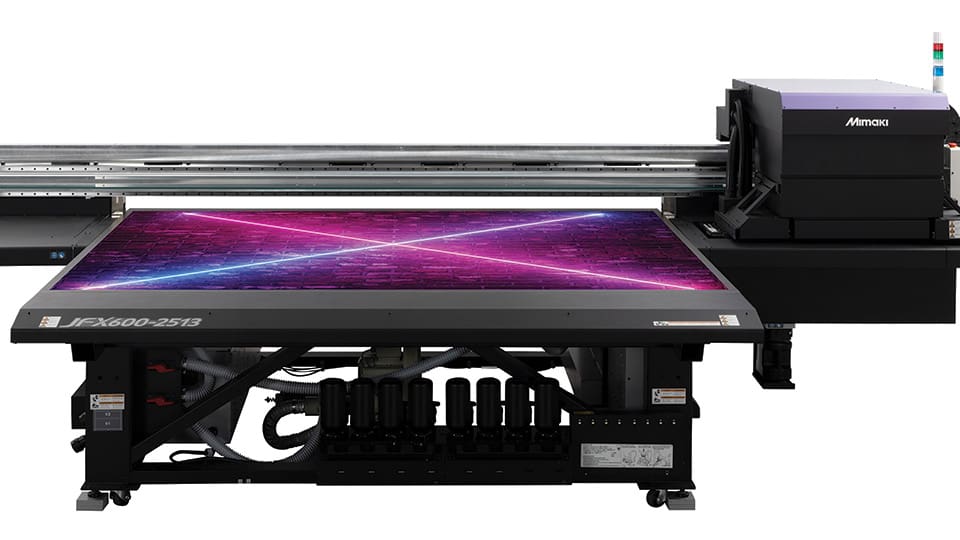
Meanwhile, a recent addition is the Mimaki JFX600-2513, along with the larger double-bed Mimaki JFX600-2531. These models, Southworth says, represent a “significant” step forward in throughput and application scope.
Headline speeds are easy to compare on a brochure, but true productivity includes loading times, job setup, RIP integration, and workflow efficiency
“The JFX600-2513 provides a natural progression in productivity on the traditional 8 x 4 format, while the ‘double bed’ JFX600-2531 extends capacity to 2.5 x 3.1m, reducing handling and enabling oversized or multi-board production in a single setup. Together, they offer a scalable pathway from established production through to high-volume industrial output.
“Ultimately, a flatbed investment should be viewed as part of a wider production strategy. When hardware, finishing equipment, and support infrastructure are aligned, the result is greater efficiency, broader application capability, and stronger long-term profitability.”
Also stepping up to offer advice is Dieter Jancart, segment manager of High-End Inkjet Printing Systems at Agfa. Jancart explains that while it is often tempting to focus purely on speed when investing in a flatbed, doing so misses the bigger picture, with quality, consistency, versatility, and cost efficiency also playing a part in defining a “truly valuable machine”.
“A high-quality flatbed printer needs to deliver on image precision and colour management across a wide range of substrates and support reliable uptime even under heavy workloads,” he says, continuing: “Workflow integration is equally important; software-driven automation, remote diagnostics, and intelligent maintenance features can all help to maximise productivity and minimise the amount of operator time wasted.”
A high-quality flatbed printer needs to deliver on image precision and colour management across a wide range of substrates, and support reliable uptime even under heavy workloads
“A common misstep can be underestimating the importance of workflow. Companies that lack smart software integration may stumble with costly bottlenecks during particularly busy production cycles.
“Some users also overestimate short-term demand and overspecify their equipment, leading to underused capacity. Working closely with a knowledgeable supplier to correctly scale equipment to your real production profile is key to achieving the right balance between flexibility and return on investment.”
Turning to Agfa’s solutions, Jancart picks out the Onset Panthera FB3216, the manufacturer’s flagship flatbed device. Jancart says that the machine combines advanced LED curing with industrial-scale productivity at speeds up to 1,514sq m/hr without compromising on performance, while it can accommodate formats up to 3.22m x 1.6m.

To enhance productivity, several automation options are available, from manual operation to semi-automated such as laytable and unload robot options, as well as fully automated configurations, including dual robots or dual-flex systems.
“This scalability enables print businesses to tailor automation to their requirements and ambitions, supporting them with peak efficiency every step of the way,” Jancart says, adding: “The Onset Panthera is also available in multiple colour configurations, including white and light colour options, giving operators even greater creative muscle.”
Rounding off the discussion is Erskine Stewart, managing director of swissQprint UK, who says a flatbed printer is a production asset, so it must deliver consistent performance and predictable uptime, meaning reliability should be the most important factor when buying new machinery.
“This reliability should extend beyond the machine itself,” Stewart says, adding: “Strong local support is equally critical, including responsive technical service and access to application expertise.
“Sign-makers and printers should look for a platform that supports long-term growth. That means not only producing high-quality output across a broad range of materials but also enabling businesses to develop new applications and higher-value products. A quality flatbed system should contribute directly to profitability and competitiveness, rather than simply adding capacity.”
Continuing his guidance, Stewart says a common mistake is specifying a system that does not properly align with the real needs of the business, both now and in the medium term. He explains that there can be a tendency to overspecify, such as investing in a six-colour configuration when a four-colour system with high-resolution printheads would meet current demand.
“Similarly, choosing maximum production speed from day one may not always be the most commercially disciplined decision if that capacity is not immediately required,” Stewart says, adding: “Selecting a modular platform that can be upgraded over time allows businesses to invest appropriately today while maintaining flexibility for future growth. That approach often provides a stronger return on investment.”
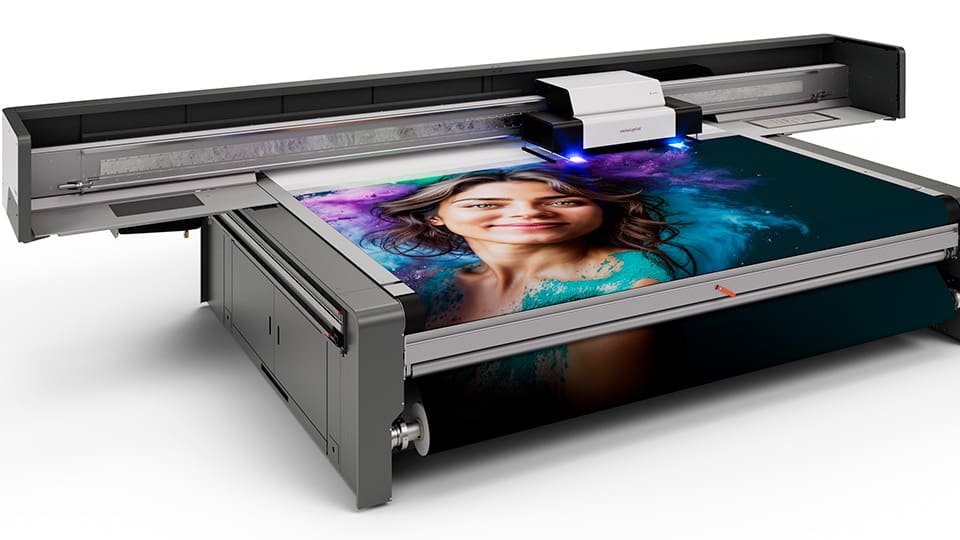
For swissQprint, the Nyala remains its most popular flatbed platform, Stewart says it offers a well-balanced combination of productivity, precision, and reliability, making it suitable for a wide range of sign and display applications. As it is modular in design, this allows customers to configure it to meet their current needs while retaining the option to expand functionality or capacity as their business evolves.”
From speaking with several big manufacturers, what is clear is not only the benefits of running a flatbed printer but also how to best go about identifying the machine that will best suit your business. Consider the next steps for your company and how a new device will support you moving forward, rather than focusing solely on attributes such as print speed.