A hugely important tool for many sign-making businesses, SignLink takes a closer look at flatbed vinyl cutters, speaking with manufacturers and suppliers about how their latest solutions can help improve production
Rob Fletcher
December 2, 2024
Cutting is an integral part of many vinyl-based sign applications. Be it colourful window graphics in shop windows or eye-catching vehicle graphics covering cars and motorbikes, ensuring a high-quality finish is crucially important – and cutting plays a key part in this.
The good news for sign-makers is that there have been significant advancements in cutting technology in recent years. Gone are the days when sign-makers would painstakingly have to cut out designs by hand; nowadays, sign professionals can use flatbed vinyl cutters to create all manner of designs, no matter how intricate they may be.
Here, we take a look across the market, picking out some of the latest machines available to sign-makers and gain insight into how these new technologies can help improve the quality of sign applications across a range of sectors.
Accuracy is Key
First up is CMYUK, which works with leading manufacturers to supply both large-format print and finishing equipment to the industry. Finishing business manager Nick Reed explains that taking cutting in-house allows greater control over design production timelines and quality, ensuring that products meet brand standards consistently.
“By cutting in-house, sign-makers can reduce lead times and respond to customer orders more quickly, enhancing customer satisfaction and competitiveness in the market,” he says, adding:
“Eliminating outsourcing costs for cutting services can lead to significant savings, especially for small to medium sized businesses. Over time, the investment in equipment can pay off through reduced external costs.
“Having a flatbed digital cutter on site offers flexibility to make last minute changes, create prototypes, or produce short-run custom jobs without the constraints of third-party schedules. In-house capabilities open up creative possibilities for sign makers, allowing them to experiment with new materials, shapes, and designs, leading to more unique offerings.”
So, what should sign-maker be looking for in a quality flatbed vinyl cutter? Reed says accuracy of cutting is vital, recommending a blade that is sprung rather than fixed. He explains this blade has a spring mechanism that allows it to adjust to the thickness of a material, allowing for cleaner cuts – especially on uneven or thicker materials – by moving up and down as needed.
Reed adds that the speed and repeatability of cutters is also very important, in addition to a conveyorised bed, which he says helps with vinyl as the latter comes on a roll. This means if you want to carry out a job that is longer than the bed or a series of jobs on the roll, having a conveyorised bed offers you the automated handling of material.
Supplied by CMYUK, the JWEI JCUT 1612 is available in a width of 1.6m with customised table lengths
On this, he picks out some of the solutions on offer from CMYUK. These include the JWEI JCUT 1612 digital cutting table, which he says is perfect for vinyls and a wide variety of substrates.
“Packed full of features making it highly versatile, it enables owners to add a variety of new applications to their service roster,” Reed says, adding: “With a multi-functional machine head – it’s fast and easy to change tools and includes a variety of cutting blades and different sized creasing wheels.”
The JWEI JCUT 1612 is available in a width of 1.6m with customised table lengths. It also has a conveyorised bed with vacuum zones, making it easier to load substrates and keep them firm to the table when being processed. The machine offers a maximum of 1G acceleration and speeds of up to 1,200mm per second, while it is supplied with OptiScout software as standard along with an air compressor, vacuum pump, and vacuum extraction.
Considerable Cost Savings
Also weighing in is Vivid Laminating Technologies, which counts flatbed vinyl cutters among its wide range of print finishing solutions. Sales director Richard Marlow says that one of the most significant advantages of brining cutting process in-house is the ability to drastically reduce lead “By eliminating the need to rely on external suppliers, sign-makers can complete projects faster, giving them greater control over their production schedules,” Marlow comments, continuing: “This not only enables them to meet tight deadlines more efficiently but also provides flexibility to accommodate last-minute changes or urgent requests without delays.
By eliminating the need to rely on external suppliers, sign-makers can complete projects faster, giving them greater control over their production schedules
“Additionally, keeping the process in-house can result in considerable cost savings. Outsourcing often involves high service fees, transportation costs, and potential delays, all of which can add up over time. When sign-makers invest in their own equipment and processes, they can achieve the same high-quality finishes at a fraction of the cost, which directly improves profitability.”
When it comes to investing, Marlow says selecting the right flatbed cutter involves several important considerations. Firstly, he recommends working with a supplier that is innovative and forward-thinking, committed to continuous improvement and introducing new technologies that can enhance your capabilities.
In addition to support, Marlow says the quality of the finished product is a significant factor. He says the cutting system should deliver precise, high-quality results consistently, which directly impacts the final appearance of signs and graphics, both durability and visual appeal.
On top of this, Marlow says support and aftercare from the supplier is crucial, continuing: “A reliable supplier should offer comprehensive support, including installation, training, and ongoing maintenance. This ensures your machinery operates at peak performance and any issues are promptly addressed, minimising downtime and disruptions to your business.”
Highlighting solutions from Vivid, Marlow picks out the Veloton, which is compatible with its VeloBlade range of digital flatbed cutters. Veloton is a patented interchangeable system that allows users to turbocharge their cutting speed with multiple aligned cutting heads.
“Veloton dramatically increases cutting speeds on positioned multiple cuts, making your production up to ten times faster,” Marlow says, adding: “This advancement extends the digital cutting capabilities of both roll and cut sheet, making it even more efficient and productive for businesses of all scales. By using Veloton, you can significantly reduce production time without compromising quality.”
Intelligent Investment
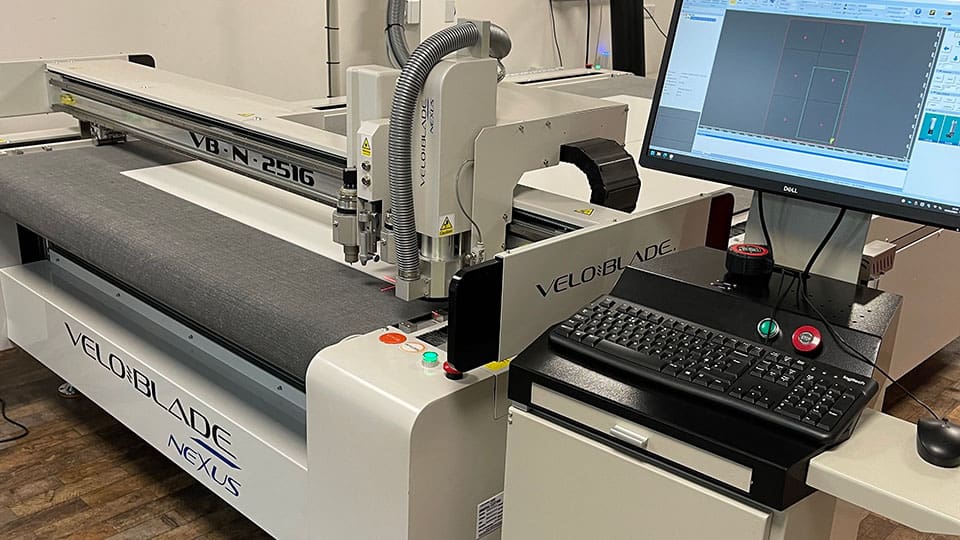
Vivid is supporting with its distribution of flatbed technology by Soyang Europe, which last year was appointed as a reseller for Vivid’s VeloBlade Volta range of digital flatbed cutting tables and Vivid’s VeloBlade Nexus wide-format digital die cutting range.
“We are delighted to be able to offer the Vivid VeloBlade Volta range of digital flatbed cutting tables,” Soyang Europe business development manager Damien Martin comments, adding: “We can supply various sizes of this machine to best suit the needs of each individual customer.
“With the VeloBlade Nexus range, these machines offer more advanced options, with a wide range of tooling included as standard, allowing for even more possibilities for sign-makers and wide-format printers.”
Soyang Europe is an approved seller of Vivid’s VeloBlade Nexus range
On the subject of new technology, Martin says companies should take care with investment in new machinery in this sector. He offers several pointers to anyone in the market for a new flatbed cutting solution.
“Firstly, UK-based support is very important,” he says, adding: “Working with a manufacturer or supplier based in the UK means you will have much easier access to parts and technical support from specialist engineers than if you were to work with someone overseas.
“In terms of the actual machine, you should be focusing on speed and flexibility; which device will you get the most out of and what model will allow you to produce the most work at a high standard?”
On this, Martin emphasises that flatbed technology will represent a long-term investment. As such, he says it is important to consider any future developments that may come from the manufacturer you are buying from and how this can further help you moving forward. On a similar note, he recommends looking at the software offered alongside the hardware and how this might improve the performance of the machine.
“Taking vinyl cutting in house will make your operation much more efficient,” Martin says, adding: “You will save time on having to outsource work and also allow you greater control over the whole process, meaning you can produce your own work to your own high standards.
“There is also the benefit of flexibility in terms of what services you can actually offer to customers, this makes you a more self-sufficient business and expands the skillset of your employees, which will put you in a stronger position moving forward.
“On top of this, investing in a flatbed vinyl cutter will allow you to automate parts of production that previously may have had to have been carried out by hand.”
Explore New Markets
One company that can attest to the quality of the VeloBlade Nexus is The Big Ink Tank, a large-format printing business based in Coventry that took on a VeloBlade Nexus 2516 from Soyang back in January.
One of four machines in the VeloBlade Nexus range, the 2516 offers users a bed size of 2,500mm x 16,00mm. Combined with a CNC router, the system enables users to work with stocks up to 25mm in thickness such as Dibond, MDF and acrylic, which the company says has opened up more opportunities for new work. Working alongside other machinery, the cutter has been put to work on a range of applications, with founder of The Big Ink Tank, Ty Power, saying the machine’s automation capabilities have made life much easier for staff.
Ink purchased a VeloBlade Nexus 2516 from Soyang in January
“The VeloBlade Nexus fits in with our existing workflow by allowing files for cutting, routing, and creasing to be automatically uploaded with minimal input from our team,” Power says, adding: “We are really benefitting from the speed of the machine; we no longer have to change the tools as they are automatic. “The quality of the cutting is also excellent, while the fact that the vacuum keeps the cuts so clean results in a huge time saving. We are still learning about new processes that we can then launch into the market.
“We are demoing the machine to our existing customers showing them all the new materials and options we can offer. It has opened up more varied work and will hopefully win us new customers. We are really excited by all the new product types we can offer and getting to learn what we can do with the machine.”
Power’s comments should offer food for thought to those considering investment in a new machine in this market. Taking on a new device can help your company access work that may previously been out of reach, opening up your offering to existing customers and help you attract new clients. Careful research of the market and conversations with trusted manufacturers and distributors, including those featured here, will allow you to identify the most effective solution for your business.
Working with other businesses can open doors to new markets, services, and expertise. Here, SignLink examines how building the right partnerships can strengthen day-to-day operations and long-term success.
What is the best approach and strategy for your business: investing in a
new management information system or upgrading your current setup?
Rob Fletcher speaks to a range of suppliers, and finds out more
Architectural wrapping is opening up new revenue opportunities for sign-makers, offering a cost-effective alternative to refurbishment and replacement. SignLink explores the rapid rise of this growing market
Watch our latest video of the week
SignLink gives you the latest video coverage of companies, people, and events from within the signage, graphics, and wide-format print industries.