John Davies: Is 2026 the Year 'Intelligent Signage' goes mainstream?
After a busy 2025, we speak to John Davies, UK managing director of FASTSIGNS UK about the past year and what's to come in 2026
David Osgar
January 12, 2026
John Davies, UK managing director of FASTSIGNS UK.
Can you introduce your company and the changes it has seen in the industry in the past year?
FASTSIGNS was founded in 1985 in the US with the simple goal of delivering fast, high-quality signage and graphics solutions to businesses. The concept quickly grew, leading to franchising in 1986 and expansion into the UK in 1995.
Now, we’re celebrating 30 years in the UK, as FASTSIGNS has developed into a strong network of 23 centres, including our newly opened Bristol location, supported by a dedicated local team and backed by the global brand’s expertise.
Over the past year, we have seen the signage industry shift towards more integrated, technology-led solutions, an increased demand for sustainable materials and a stronger focus on customer experience. In response, we have continued to evolve by introducing AI-driven operational tools, investing in the latest print technologies, and expanding our use of eco-friendly substrates and energy-efficient digital signage.
Our refreshed brand positioning, ‘Make Your Statement’, has also helped us better reflect what signage means for our customers today. Signage is no longer just a product, but a powerful expression of identity and impact. These changes, combined with our ongoing UK expansion, ensure we remain at the forefront of a fast-moving, creative, and highly customer-focused industry.
How do you think these changes will continue into 2026?
By 2026, signage will become increasingly intelligent and interactive. AI and data will allow digital signs to adapt instantly to the audience, the environment, and even the time of day, delivering personalised content that drives engagement and actionable responses. Businesses will be able to track interactions and refine their messaging in real time, making signage a fully integrated communication tool, rather than a static display.
QR codes, NFC, and augmented reality will enable far more immersive experiences, allowing printed signage to act as a gateway into digital and augmented spaces. QR codes can be scanned, while NFC allows users to simply tap their smartphone on a sign to instantly access content such as videos, product information, or interactive experiences. Posters and displays can guide customers into augmented spaces that encourage deeper engagement and help them learn more about products or services. These technologies will also be crucial in locations where large or permanent signage is restricted, providing flexibility without sacrificing impact.
At the same time, design-led interior solutions are growing, offering multi dimensional, textured, and interactive signage for premium spaces. Biophilic elements, such as living walls and nature-inspired signage, are increasingly used to enhance wellbeing and create immersive, experience-driven interiors. Across industries, signage plays a key role in enhancing customer journeys, supporting intuitive wayfinding and reinforcing brand identity, in spaces that are both functional and visually compelling.
What are some of the new or evolving changes you foresee in 2026 within the print and signage industries?
In 2026, signage will move beyond simply displaying information, to becoming a dynamic communication medium that learns, responds, and delivers instant calls to action. This means signs will not only present messages, but also adapt based on who is viewing them, its environment, and real-time data, making them far more effective and actionable.
For example, schools will use digital signage as part of emergency and weather alert systems, instantly guiding occupants to safety and providing critical information to first responders. In industrial and manufacturing sites, dynamic signage will help manage operational challenges by displaying real-time instructions, safety updates, or workflow alerts, reducing delays and improving efficiency.
Healthcare facilities and office environments will benefit from interactive wayfinding and signage that assists staff and visitors where human guidance is limited, helping people navigate complex spaces quickly and safely. In cities, dynamic signage will become part of smart city infrastructure, delivering real-time updates about traffic, events, or public services directly to residents and visitors.
Across all these applications, digital signage can integrate with online platforms such as YouTube, TikTok, and Instagram, allowing businesses and organisations to combine advertising, information, and interactive experiences in a seamless, multi-channel way.
What change has FASTSIGNS specifically seen in 2025?
In 2025, at FASTSIGNS UK, we observed strong growth in demand for technology-driven and immersive signage solutions. Clients increasingly requested interactive, multi dimensional installations and sustainable materials. Our AI-powered operational systems allowed franchisees to deliver services more efficiently, while focusing on custom design and building deeper customer engagement.
There was a notable increase in demand for premium interior signage, including biophilic and living wall installations, reflecting a growing trend toward integrating signage with interior design to create engaging, experiential spaces that enhance wellbeing and brand perception. The impact of signage extends even further when we consider wellbeing. Modern branding strategies increasingly incorporate environmental psychology, using elements such as living walls, natural light, and calming textures, to create spaces that nurture mental and emotional health.
A great example is the refurbishment of the Children’s Radiotherapy Department at St James’s Hospital conducted by FASTSIGNS Leeds. The space was transformed into a bright, engaging environment, with a teenage chillout area and recovery room, with FASTSIGNS contributing bespoke signage that helped bring the new look and feel to life, adding clarity, comfort, and warmth throughout the department.
Integrated digital solutions that combine messaging, branding, and functionality also became more popular, highlighting how signage is evolving from a simple communication tool into a strategic, multi-channel component of business operations and customer experience.
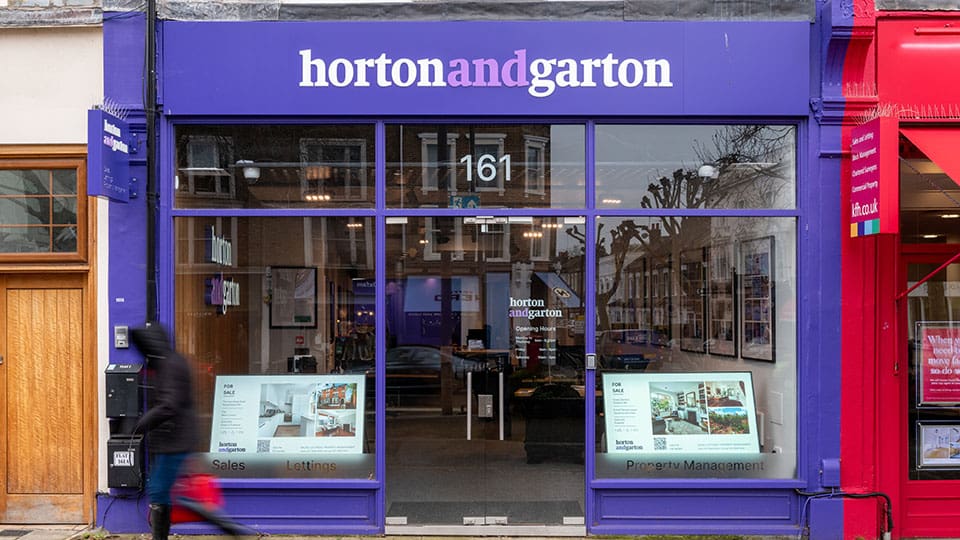
These trends are reflected in recent projects across different sectors. For example, Horton & Garton wanted to stand out on a road saturated with estate agents and the FASTSIGNS Hammersmith team delivered bold signage that made that possible. They installed a striking exterior stencilled wall graphic that dramatically increased visibility, backed by an internally illuminated fascia, and projecting signs, frosted window graphics, and a large 55‑inch window screen for dynamic messaging, helping the brand attract attention, share real-time messages, and engage local communities.
FASTSIGNS has worked on a number of bespoke projects, including this one for Horton & Garton estate agents
How are you implementing changes throughout the franchise?
At FASTSIGNS UK, we support our franchisees through a combination of technology, training, and operational enhancements, to help them deliver high-quality, innovative signage solutions. We use AI-driven systems to streamline workflows, improve efficiency, and free up teams to focus on bespoke design projects and building stronger relationships with customers. We provide updated marketing materials, digital design tools, and tailored support to ensure a consistent and modern customer experience across all centres, helping our franchisees stay competitive, in a rapidly evolving market.
We also provide ongoing education on emerging technologies, digital and interactive signage trends, biophilic and design-led solutions, and sustainable practices. This ensures that each centre can respond to evolving client demands, whether that involves immersive interior environments, multi-dimensional displays, or integrated digital signage.
We invest in advanced printing equipment, eco-friendly substrates and energy-efficient technologies network-wide, giving every franchise the tools to deliver visually striking, environmentally responsible, and innovative signage solutions that meet both commercial and creative needs.
What advice would you give companies to best prepare for new trends or technologies?
We believe companies should see signage as a powerful communication and engagement tool, rather than just a static product. By integrating AI, digital signage, QR codes, NFC, and other interactive elements, businesses can better understand their audiences, track engagement, and respond in real time to customer behaviour or environmental factors. This allows signage to not only inform but also inspire action, guide decision-making, and create memorable experiences.
We also recommend planning for immersive, design-led, multi-dimensional signage that enhances physical spaces. Solutions such as interactive displays, biophilic elements, living walls, and augmented reality experiences can differentiate brands and make customer interactions more impactful, particularly in competitive environments or premium spaces.
Sustainability should be embedded in every decision, from selecting eco-friendly materials and energy-efficient technologies, to minimising waste in production and installation. We advise companies to stay informed about evolving industry trends, invest in staff training, and trial new technologies through pilot projects or small-scale deployments. These steps allow businesses to remain agile, test what works best for their audience, and adopt innovations confidently as signage continues to evolve.
What will FASTSIGNS be looking to do in 2026?
In 2026, at FASTSIGNS UK we will continue to expand AI-driven and data-focused signage solutions, delivering real-time, personalised digital experiences that engage audiences, and support measurable business outcomes.
We’ll be looking at how we can develop more intelligent and adaptive signage that responds to viewer behaviour, environmental conditions, and operational needs, creating truly dynamic communication channels for businesses across all sectors. Interactive features, digital displays, and augmented reality will be integrated into both interior and exterior signage, helping brands deliver memorable, immersive experiences that go beyond traditional static signs.
Premium, multi-dimensional, design-led solutions will continue to take the spotlight, with textured displays, living walls, biophilic features, and media installations transforming spaces into engaging and unforgettable environments. We’ll keep looking for expansion opportunities across the UK, while ongoing investment in sustainable materials and advanced printing technologies, ensures our franchisees are equipped to meet evolving customer demands.
We also aim to strengthen franchisee support through enhanced training, operational tools, and creative guidance, enabling every centre to deliver innovative, high-quality signage.
At FASTSIGNS UK, our goal is to help businesses make a statement by providing end-to-end solutions that combine creativity, technology, and sustainability, keeping pace with the ever-changing signage industry.
Following the launch of The Manchester Screen, the largest combined banner and digital billboard in the UK, we speak to Katie Smith, owner of the new site, about how the billboard came to be, and her ambitions going forward
SignLink speaks to Linda Edwards from the BSGA following the launch of the new SICCS Provisional Card for commercial signage installers, which is designed to provide compliant site access
Following the launch of The First Drill, Make it Happen’s latest signage workshop created for people who have just entered the industry, we speak to Libby Clifford head of business development, who is leading these new workshops
Watch our latest video of the week
SignLink gives you the latest video coverage of companies, people, and events from within the signage, graphics, and wide-format print industries.