While the primary role of lamination is to protect printed work, it can also offer added value to customers.
Here, Rob Fletcher takes a closer look at the latest options and solutions in this market
Rob Fletcher
August 13, 2025
In years gone by, lamination was seen as something of a chore for print companies and sign-makers; a process that had to be done to simply protect work. However, fast-forward to the current day and lamination has come on leaps and bounds, with the latest materials and machinery allowing users to create all manner of effects with their printed work.
From simple roles such as providing anti-slip qualities to floor graphics or to adding texture to printed work for special effects, lamination can help open doors to profitable new markets and customers. In this feature, we speak with both manufacturers of lamination equipment and materials suppliers to find out more about the opportunities with laminating and how the latest solutions in the market can support print companies and sign-makers moving forward.
Visual Appeal
Up first is Vivid Laminating Technologies, whose commercial director, Lewis Evans, says that in addition to protection, lamination significantly enhances the visual appeal of prints by offering a variety of finishes such as gloss, matt, or crystal matt.
“Each creates a different visual effect,” Evans explains, continuing: “Gloss finishes amplify colour vibrancy, while matt options provide a more refined look. Lamination also boosts durability, making prints resistant to wear, UV exposure, and moisture. This added resilience is crucial for outdoor displays and signage, extending the life and improving the perceived value of the printed materials.”
With this, Evans says investing in the right lamination technology ensures consistent, high-quality output while improving efficiency. He explains how modern laminators incorporate advanced features including faster processing, sharper results, and innovative handling technologies.
Machines that offer modularity, intuitive controls, and multi-functionality, such as roll-fed and flatbed capabilities, can streamline operations andadapt to a range of production needs
“Machines that offer modularity, intuitive controls, and multi-functionality, such as roll-fed and flatbed capabilities, can streamline operations and adapt to a range of production needs,” he adds.
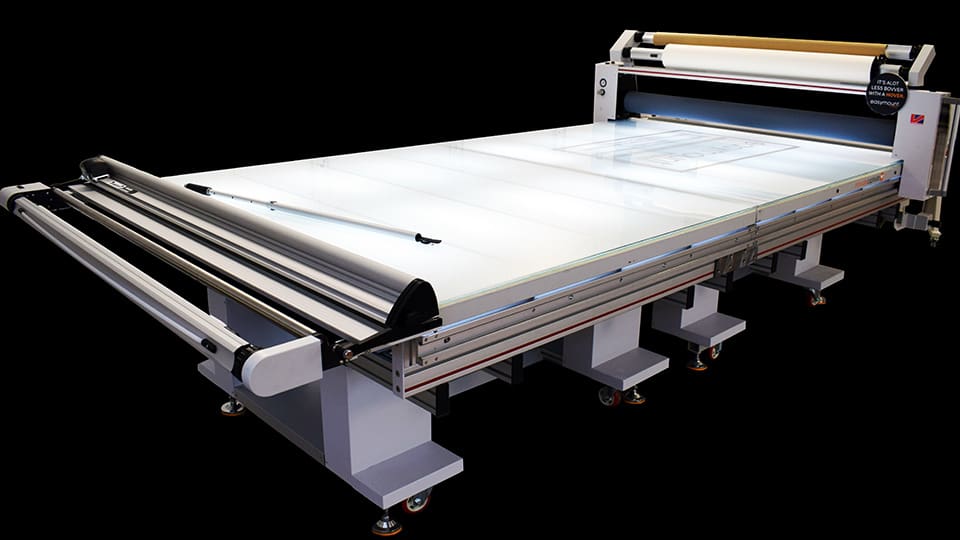
Vivid’s Easymount Hybrid solution is an all-in-one roll-fed laminator and flatbed applicator
On this note, he draws attention to Vivid’s Easymount Hybrid flagship solution, an all-in-one roll-fed laminator and flatbed applicator. Featuring the patented ‘HOVER’ technology, Evans says this enables seamless transitions between laminating and mounting.
“With electromagnetic locking and floating rollers, it provides smooth substrate handling and edge protection. Its modular design allows users to configure the machine to suit individual production requirements, eliminating the need for separate systems.”
Expand Your Services
Another manufacturer in this market is Mimaki, which is represented in the UK and Ireland by Hybrid Services as its exclusive distributor. Andrew Edwards, partner sales manager for sign and graphics at Hybrid, says lamination goes far beyond protection and can enhance the visual and functional quality of a print.
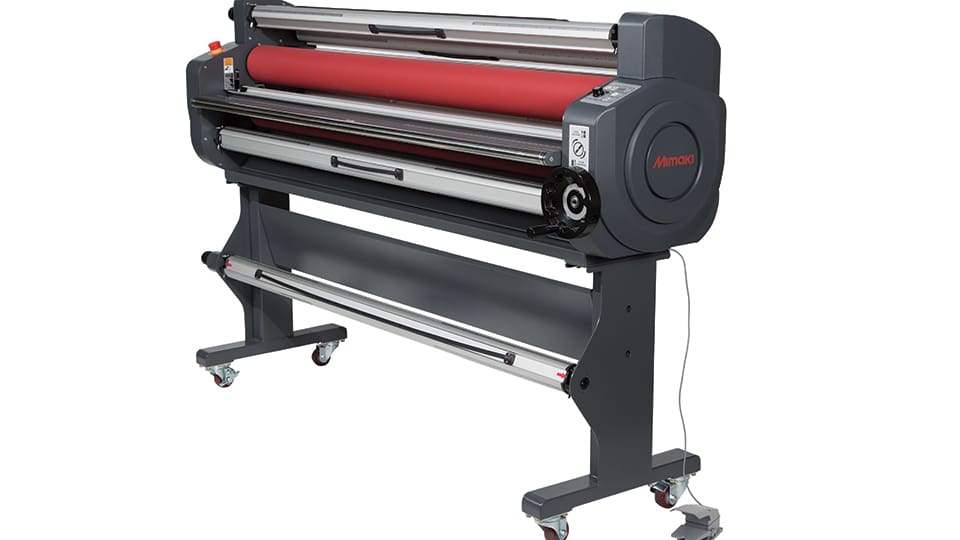
“With systems like the Mimaki LA-160W, users can alter surface finishes, switching between gloss and matte to suit different applications and create a more cohesive look,” Edwards says, adding: “For example, at exhibitions where bright lighting is common, a matte lamination would be the preferred choice to reduce glare and prevent distracting reflections.
Available from Hybrid Services, the Mimaki LA-160W has a maximum lamination speed of 7.5m/minute
“Lamination also adds rigidity, making prints more durable and suitable for use in display systems, floor graphics, and vehicle wraps. Additionally, laminates with textures or anti-slip properties open up further creative and safety-conscious possibilities, expanding the range of services a printshop can offer.”
Going into further detail on the Mimaki LA-160W, Edwards says that this has become a “go-to choice for new and established businesses wanting a future-proof solution that delivers consistent results”. The machine has a maximum lamination speed of up to 7.5m/minute and can handle prints up to 1.6m wide.
“It is commonly chosen for high-impact applications like exhibition graphics, floor decals, vehicle wraps, and retail displays, where durability and finish quality really matter,” Edwards comments, continuing: “It handles a wide range of laminates, including flexible cast vinyl and textured films, and are engineered for speed, simplicity, and consistent results.”
Lamination also adds rigidity, making prints more durable and suitable for use in display systems, floor graphics, and vehicle wraps
Leading on from this, Edwards speaks about the importance of investing in quality kit for lamination. He says this choice is “crucial”, explaining that it can have a lasting impact on efficiency and output quality. Edwards adds as lamination is often a long-term investment, build quality and reliability should be top priorities when choosing a machine.
“A high-performance machine like the Mimaki LA-160W tackles common lamination issues such as silvering by applying controlled heat, up to 60°C, for a smooth, bubble-free finish,” he says, adding: “Features like support for specialist materials, ease of use, and single-operator handling make a big difference in day-to-day production.”
Match Made in Heaven
Switching the focus to materials, Soyang Europe has a host of options on offer. Sales director, Oliver Mashiter says in addition to protecting pieces they lamination materials can add more value to applications.
He offers the example of the floor graphics market, saying certain materials carry an anti-slip rating, meaning when applied to printed floor pieces they will help prevent people from slipping, no matter what the weather conditions are like or where the piece is installed.
Mashiter says there is also the benefit of textured effects for display purposes. He offers the example of when you want one part of an application to have a different texture than the other, lamination can help you to achieve this, without impacting the rest of the piece.
Matching the type of material to the print is of huge importance
“Matching the type of material to the print is of huge importance,” Mashiter says, adding: “For example, monomeric print to monomeric laminate is best practice as, if they would shrink, then they will move and shrink at the same rate and limit the failures to the piece.”
The latest addition to the lamination offering at Soyang Europe is SoStick, a new collection of self-adhesive vinyl solutions. Featuring 18 products, the SoStick range has a selection of PVC monomeric and polymeric solutions, all of which have been produced in-house, at Soyang. Products span permanent, removable, grey back, bubble-free, and high-tack options.
SoStick monomeric materials are suitable for use in applications including retail graphics, exhibition graphics, POS graphics, and short-term indoor graphics. Meanwhile, SoStick polymeric solutions can be used to produce pieces such as signage, vehicle graphics, hoardings, long-term outdoor signage, window graphics, and more.
“This is just the start for Soyang and SoStick,” Mashiter says, continuing: “We will continue to develop the collection and introduce new solutions, with PVC-free and specialist media options joining the collection in the near future.”
Soyang Europe recently rolled out its new SoSitck range of solutions
Vehicle branding and customisation specialist The Vinyl Guys, was one of the first businesses to work with a new SoStick solution, saying the material has resulted in “genuinely fantastic” prints. The Vinyl Guys ran SoStick on both eco-solvent and UV printers, producing a set of branded test and inspection stickers for a client in the electrical services market.
In addition to materials, Soyang sells lamination equipment from both Vivid Laminating Technologies and Mimaki through its Soyang Hardware business. Solutions include Vivid’s Easymount Sign laminator, which offers laminating up to 50m at a speed of 5m/min, allowing users to laminate signs, roll-up banners, window graphics, and other applications.
Time and a Place
Another material supplier in this sector is Drytac, which, like Soyang Europe, offers a range of laminating solutions, suitable for various applications. Among these are the Interlam Pro laminates, which include options for gloss and matte, as well as Interlam Pro Emerytex with a matte pebble textured finish.
In addition, Drytac offers solutions within its Weathershield collection of high-performance, polymeric PVC overlaminating film. Again, all these are offered in gloss, matte, and Emerytex versions to support customers across various applications.
However, as noted by Dennis Leblanc, senior product and business development manager at Drytac, there is a time and place for laminates, as well as occasions and applications when they might not be needed.
“The most common use for lamination is to protect your output from the elements – such as UV degradation – and enhance outdoor durability. You can also use laminates to finish a job with gloss, lustre, or matte textures or to add an extra property to the graphic such as an anti-graffiti coating or slip resistance,” Leblanc says.
“Laminates can also be used to add body and thickness to your output. This can be particularly useful when printing onto thinner materials; the extra layer will stop the graphic stretching and simplify the installation process.”
Breaking this down into situations where lamination may be required, Leblanc highlights one example in UV protection. Here, he says lamination is a must for long-term applications if they are to stand the test of time, as these projects will be exposed to the elements and will need support if they are going to survive.
If the focus is on protecting the ink layer of a graphic, Leblanc says consider laminating all long-term work – both indoors and outdoors – as well as pieces that will be situated in high traffic locations such as corridors and hallways.
When considering lamination for finishing effects, Leblanc advises this is only necessary on some occasions as most print media is available in different finishes. He adds that newer print hardware even allows for gloss and matte output from the get-go via ink setup.
Factoid: Lamination in print is available in three primary options: gloss, matte, and soft-touch
In terms of short-term revolving graphics, Leblanc says outside of adding additional functionality to the graphic, in most short-term applications you can eliminate the need for laminating by choosing a thicker print media with an easy install or removable adhesive solution.
“These materials will do the job and avoid added cost and labour of lamination, providing savings for you and your clients,” Leblanc says, continuing: “Today’s print media offerings have addressed this with 4mil materials and dot adhesives for easy installation and 6mil removable solutions that won’t stretch as you work with them.
“To that point, there are now textured solutions readily available that can provide scuff, scratch, and slip resistance on their own.”
The message here is simple: lamination is much more than a way of protecting printed work. It opens up a world of opportunities for sign-makers and wide-format printers, allowing them to offer their own customers new options for finishing that adds value to printed pieces and opens up additional revenue streams on top of their established offering.
Working with other businesses can open doors to new markets, services, and expertise. Here, SignLink examines how building the right partnerships can strengthen day-to-day operations and long-term success.
What is the best approach and strategy for your business: investing in a
new management information system or upgrading your current setup?
Rob Fletcher speaks to a range of suppliers, and finds out more
Architectural wrapping is opening up new revenue opportunities for sign-makers, offering a cost-effective alternative to refurbishment and replacement. SignLink explores the rapid rise of this growing market
Watch our latest video of the week
SignLink gives you the latest video coverage of companies, people, and events from within the signage, graphics, and wide-format print industries.