Programmatic DOOH advertising reached £1bn in 2025
An independently aggregated study measuring programmatic digital out-of-home advertising revenue found that the global market reached $1.339bn (£0.99bn) in 2025


Signage and graphics professionals met to discuss topics including enhancing production efficiencies and providing eco-friendly offerings

Last Thursday (November 28th), over 100 representatives from across the graphics and signage industries gathered together for the first annual Graphics Sustainability Summit, hosted by FESPA UK Association.
The event, which took place at the Hellidon Lakes Hotel & Spa in Daventry, included a range of keynote speakers with expertise in sustainable business practices. Attendees were tasked with considering how their businesses and the industry as a whole can push for greater environmental responsibility and reduce ecological impact.
A range of industry sponsors also demonstrated their environmentally conscious products to the gathered attendees.
Among the sponsors was 3M, which was demonstrating its DI-NOC RC architectural film. Designed with sustainability in mind, the film is made with 80% post-consumer recycled polyester with a release liner made from 40% recycled content.
Also sponsoring the event was wide-format print material and hardware supplier, Soyang Europe. The company’s offerings include its Solar mesh banner material which is PVC free and free from heavy metal, phthalates, and plasticisers which is designed to be fully recyclable.
Additional sponsors of the event were Durst, Spandex, HP, Compass Business Finance, Kene Partners, and Howden Insurance.
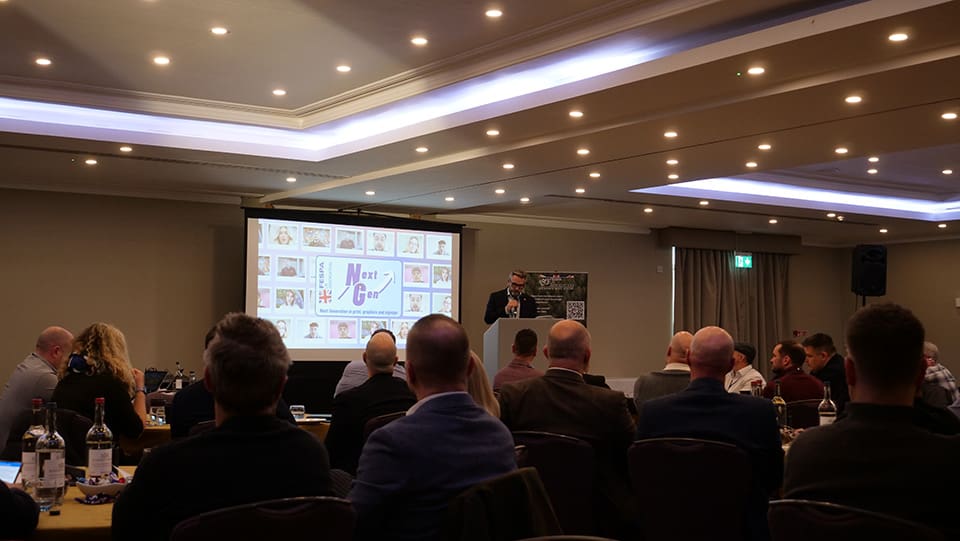
The summit kicked off with an opening speech by David Bunker, director of Compass Business Finance and FESPA UK board member.
Bunker spoke to attendees about the need to “ignite a more sustainable future” and the responsibility the signage and graphics industries have to reduce their environmental impact. Bunker also spoke of the many difficulties businesses will face in creating effective change. “Our path is not without its challenges”, he said.
Bunker then introduced the first keynote speaker at the event, Graeme Richardson-Locke, head of global associations at FESPA. Among his almost 40-year experience in the screen and digital printing industries, Richardson-Locke was reportedly instrumental in securing FESPA’s 14001 ISO accreditation, an internationally recognised certification that helps businesses implement an environmental management system (EMS).
Richardson-Locke highlighted how more robust environmental legislation is likely to come into place in the near future after the UK has fallen behind on many of its Sustainable Development Goals for 2030. Those companies that are not prepared for such legislation would, in his words, be set for “a rude awakening.”
According to the UN Global Compact Network UK, the UK is only performing well on 21% of the Sustainable Development Goals it set and has in fact regressed in at least 14 of its 64 targets.
Richardson-Locke advised the assembled attendees to “find your champion”, an individual in their business passionate about sustainability who could push the company as a whole to become more eco-friendly and innovate with more sustainable practices and products.
He also highlighted how systems like EMS could not only decrease the environmental impact of a business but also lead to profit savings through increasing overall efficiency. He referred to the ‘People, Planet, Profit’ (PPP) framework, which encourages businesses to consider methods that improve the social and environmental impact of their operations while still driving revenue.
The next speaker was David Humphreys, director at Green Circle Solutions (GCS). Along with the GCS team, Humphreys has helped organisations across various industries adopt more sustainable business practices, providing strategic advice and tools including a suite of ‘carbon calculators’ that GCS has developed.
Using an online carbon calculation tool accessed through a QR code, Humphreys tasked the attendees with calculating the amount of carbon emissions they had produced from attending the event itself. The task demonstrated how seemingly small choices such as transport options and hotel stays can significantly alter a company’s overall emissions.
In his talk, Humphreys stressed that quick and decisive change in an industry’s environmental consciousness is possible, but that it required leaders from across the industry to effect that change en masse. As he put it, “the more that create the demand, the quicker the change will happen.”
He also reiterated the potential profit increases that systems such as carbon calculations can bring, stating that “companies that engage in sustainability improve profits.”
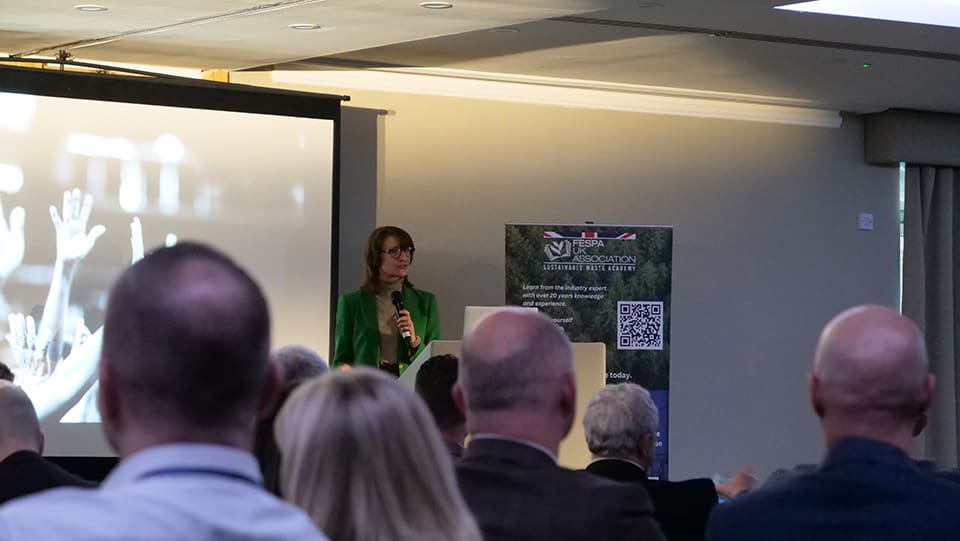
The final speaker was Courtney Holm, managing director and founder of the Holm Edit. A respected global expert in sustainability, Holm has previously spoken at COP 26, COP 27, and The World Climate Summit, having previously helped a range of businesses including Tesco and Unilever improve their sustainable practices.
In a talk titled ‘Bridging the Supply-Demand Gap for Sustainable Impact’, Holm spoke about how systemic change towards more environmentally conscious practices must come from an entire sector rather than individual companies. To emphasise this, she had the attendees repeat the mantra aloud: “sectors don’t shift on their own”.
Holm called on a “sustainable by default” practice to be adopted, where companies offer products with less environmental impact as standard, rather than as an additional option, with non-sustainable products coming only by special request. In this way, she attested, companies could utilise their power within the supply chain to effect change.
But she also underlined that in order for these practices to be adopted and for sustainable products to be embraced, “there needs to be a clear value proposition across the supply chain.”
Similarly to Richardson-Locke, Holm suggested that improving a company’s practices requires “engaging the team on the ground”, encouraging employees with competitions and prizes for sustainable practices.
The set of talks was followed up with a Leadership Exchange workshop, where industry attendees were asked to collaborate to answer key questions about how they might improve their own environmental credentials and the public perception of their eco-consciousness.
Speaking at the event, Jon Hutton, sustainability consultant at FESPA UK, said: “It’s so great to see such a large group of people across our industry come together to discuss this important topic. It means the world.”
In a closing statement after the main summit, Hutton stressed the importance of discussions about environmental impact and robust waste accreditation at a time when several recycling companies have gone into administration in the UK. This includes QC Polymer, a West Midlands recycling company that went into administration in November.
After the summit, dinner and drinks were served alongside live music from La Fox Duo. During the dinner, Hutton and FESPA managing director Suzi Ward presented prizes to a range of companies within the FESPA network who took part in the organisation’s Waste Accreditation Scheme.
The scheme provides guidance and education on how companies can dispose of graphics waste in a more responsible manner.
Speaking to SignLink about the event, Ward says: “The Sustainability Summit was an incredible event, bringing together a room full of industry leaders united in driving meaningful change.
“I’m so proud of the FESPA UK team for their hard work and dedication in uniting the industry for such an important cause.”
After the event, FESPA UK released a set of mission statements based on findings from the summit.
The organisation stated that its mission is to promote waste management, encourage the circular economy, foster education and collaboration, ensure transparency and accountability, and lead by example.
It rounded off its mission statement with a declaration that "now is the time to work together to protect our industry’s future, set new standards, and create lasting impact."