The Power of Partnerships in Sign-Making
Working with other businesses can open doors to new markets, services, and expertise. Here, SignLink examines how building the right partnerships can strengthen day-to-day operations and long-term success.

While the primary role of lamination is to protect printed applications, technologies can also be used to add value to work. Here, we speak with manufacturers and suppliers about their latest solutions

With wide-format print being the hugely visual market that it is, making sure all finished pieces look as good as they can possibly be is critically important. This might be working with a certain type of material to add that extra special finish, or even using various effects for the additional sparkle.
Another way of adding value is lamination. While protection is one of the main functions of wide-format lamination, several additional benefits make it an essential process in the printing industry. Luckily for those working within this market, there are lots of options to consider when it comes to lamination.
SignLink recently went in search of some of these products and solutions from manufacturers and suppliers to gain further insight into the additional benefits of wide-format lamination and how companies in this sector can take advantage.
Up first is the aptly named Vivid Laminating Technologies. Bruce Cozens, export director for Vivid, says one of the advantages of lamination is its ability to enhance the visual appeal of prints.
“By applying a lamination layer, you can choose from various finishes, such as gloss, matt, or crystal matt, each providing a distinct look and feel,” Cozens says, adding: “A glossy finish, for example, can intensify the colours, making them appear more vibrant and eye-catching, whereas a matt finish offers a more elegant appearance. This flexibility in finishes allows printers to tailor the final product according to customer preferences.
“Beyond visual appeal, lamination can also improve the durability and longevity of prints, making them resistant to wear and tear, UV damage, and even moisture. The overall lifespan of printed materials is extended, which is particularly important for outdoor displays and signage. All these factors contribute to a more premium product, enhancing both the quality and perceived value of the print.”
Beyond visual appeal, lamination can also improve the durability and longevity of prints, making them resistant to wear and tear, UV damage, and even moisture
With this, Cozens goes on to talk about the importance of investing in new machinery, with this allowing wide-format printers to take advantage of technological advancements, which will in turn lead to improvements in print quality, allowing for sharper and more detailed accuracy.
“Additionally, modern technology often includes features that enhance production speed and efficiency, enabling businesses to complete jobs more quickly without sacrificing quality,” he says, adding: “This not only boosts productivity but also helps meet tight deadlines.”
As for what is new from Vivid, Cozens highlights the Easymount Hybrid, a laminator and flatbed application table that is multi-patented and runs with unique roll to roll HOVER technology across long run and roll-fed laminating. Billed as the world’s first all-in-one roll-fed laminator and applicator, the Easymount Hybrid can be used for work such as outdoor signage, banners, and pop-up displays.
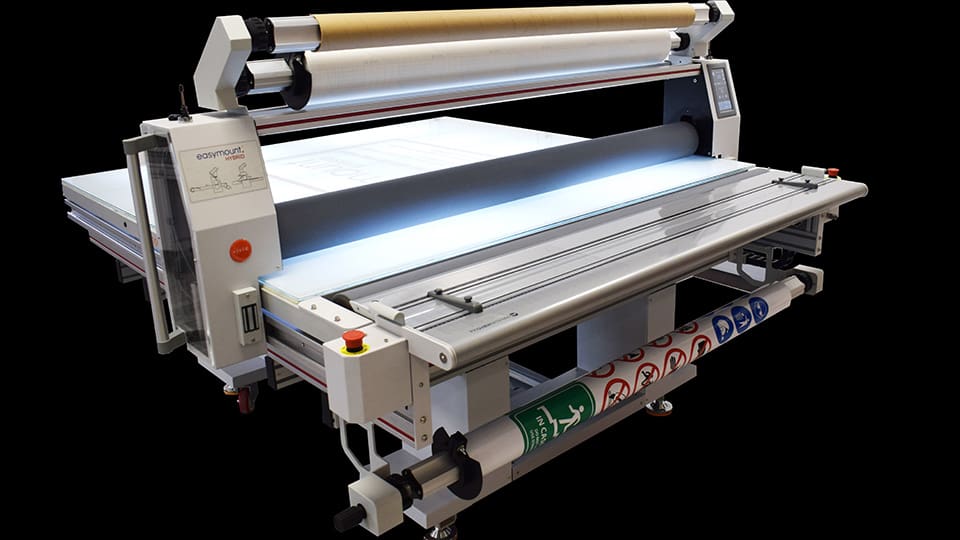
“With electromagnetic locking, the Easymount Hybrid allows for easy transitioning from roll laminating to application table,” Cozens explains, continuing: “The patented floating rollers save time and keep the edges of substrates in perfect condition. The modular design can be configured according to your specific production needs and incorporates both a traditional roll-fed laminator and a flatbed applicator.
ombining the benefits of both applications into one easy-to-use flatbed laminator and saving on the need for two systems.”
Also well placed to advise on the hardware front is Hybrid Services, the exclusive distributor for Mimaki in the UK and Ireland. Andrew Edwards, partner sales manager of sign and Graphics at Hybrid, says laminators such as the Mimaki LA-140/160W series, are not just about protecting work but also unlocking a whole new level of creative possibilities.
“One of the key benefits of wide-format lamination is the ability to alter the surface finish,” Edwards says, continuing: “With the LA-140/160W, users can switch from a matte to a glossy finish or vice versa, giving them the flexibility to match various campaign elements. Whether you’re working on a point-of-purchase (POP) display or exhibition graphics, this feature helps elevate the overall look of your work, making it more cohesive and professional.”
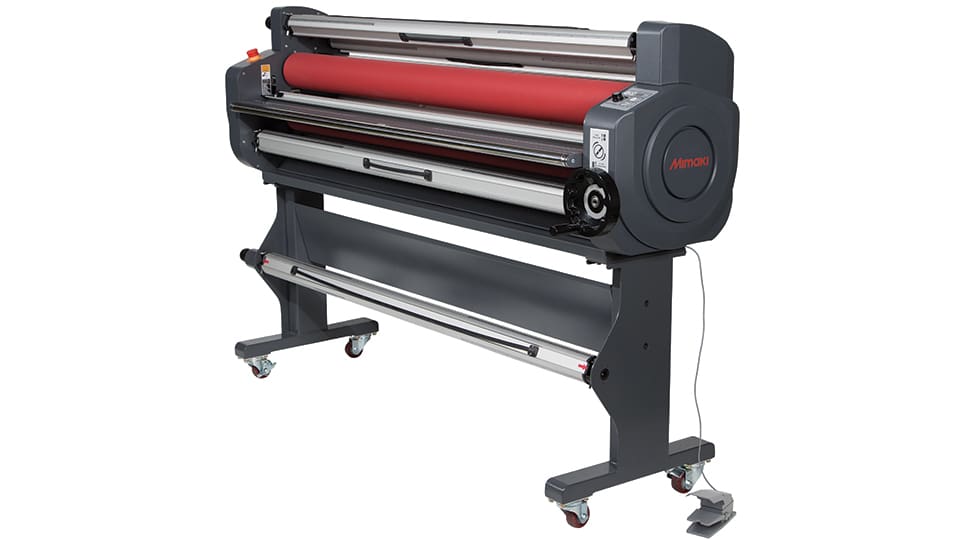
Going into further detail on the LA-140/160W, Edwards explains that the machine also adds an extra layer of thickness, enhancing the rigidity of prints. He says this added sturdiness is essential for many display systems, expanding the range of applications that printers can offer their clients.
The LA-140/160W also supports laminates with features like cast vinyl flexibility and special textures such as anti-slip properties. According to Edwards, such enhanced laminates open up exciting possibilities for new applications including floor graphics that require slip resistance for safety, and outdoor walls or vehicle wraps where durability and adhesion are key.
In addition, LA-140/160W addresses challenges such as silvering, which is caused by tiny air bubbles trapped under the laminate. As Edwards explains, the machine applies up to 60 degrees of heat, ensuring smooth, even application and minimising the occurrence of these air bubbles.
On this note, Edwards says that a laminator should be seen as a long-term investment for any print company, often outlasting the printers themselves. He explains: “A poorly made laminator can lead to a decade of wasted time, money, and frustration. By choosing a high-quality, versatile machine like the LA-140/160W, businesses ensure that they can meet their customers' demands efficiently while enjoying years of reliable service.
“With the LA-140/160W, users can expand their offerings, enhance print quality, and improve operational efficiency, making it an invaluable tool for any modern business.”
Of course, investment in brand new kit might not be the best approach for everyone, with some companies opting for quality second-hand solutions to support them with their wide-format lamination needs. One company that can help here is Laaco Laminates, which offers both new and second-hand photo finishing equipment, laminators, cutters, trimmers, eye-letting machines, and laminating films.
Commenting on lamination in general, Laaco director Simon Dobson agrees that it can be used for much more than simply protecting printed work. He says: “The over lamination of a print obviously gives it protection but can also enhance the value and look of a print.
“You can reduce glare on an exhibition stand with a matte laminate, or high gloss a print for visual impact at an art gallery. Then there are floor graphics, which is still a big market and working with a good, anti-slip film is absolutely essential.”
Dobson is hugely knowledgeable when it comes to the subject of lamination, having worked in the industry for 40 years. Supporting customers with all manner of lamination work, the company partners with a number of manufacturers to distribute solutions to the market.
These partners include Neschen, with Laaco counting the Neschen ColdLam 1650 among its offering. Billed as an “all-rounder”, the machine features a foldable feed table, ergonomic control panel, and integrated compressor and roll-to-roll functionality.
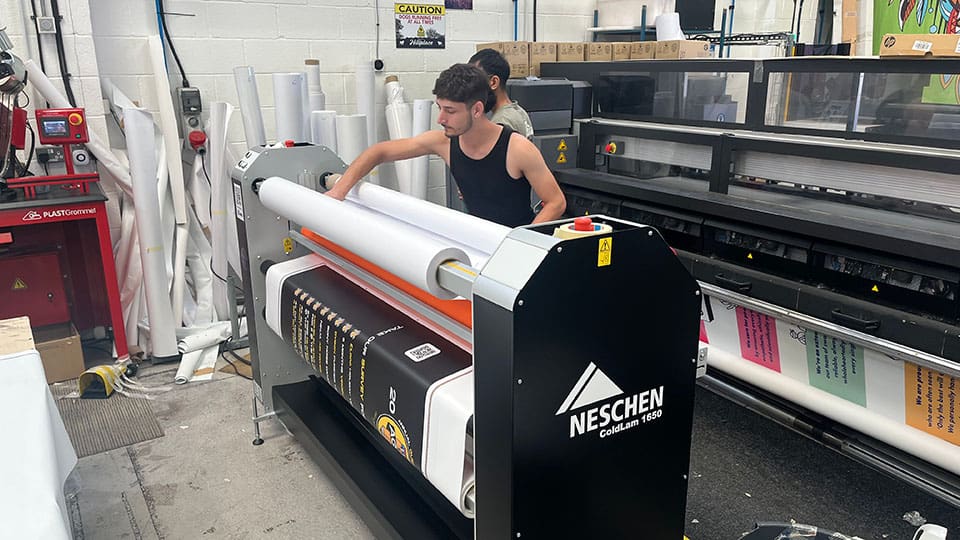
As for other options from Laaco, the company is often asked to refurbish old Seal laminators. While these machines have not been available as new for some time now, Dobson says that with some TLC and a new top roller, Laaco can get the devices back up to speed quickly, allowing customers a less expensive route to improved lamination.
“It’s great to see a machine recycled and back in service in three to four hours,” Dobson says.
As hinted at by Dobson, materials also play a key role in the lamination of wide-format print applications. Drytac has a range of solutions on offer to the market, with Dennis Leblanc, its senior business development manager, saying lamination can also be used to bring added value to pieces, allowing them to stand out and capture the attention of passers-by as well as bring additional qualities to certain applications.
“An excellent example of this is floor graphics; by using films and vinyls that have anti-slip properties, this will help to prevent falls and unnecessary headaches down the line for your business,” Leblanc says, adding: “Some products also feature anti-graffiti qualities and can protect applications such as wall graphics or even painted pieces from damage.”
That said, Leblanc goes on to say that lamination is not always required. He says companies should consider the piece they are producing and where it will be installed to see whether lamination is necessary. For example, with UV protection, he says lamination is a must for long-term applications if they are to stand the test of time as these projects will be exposed to the elements and will need support if they are going to survive.
Similarly, if your focus is on protecting the ink layer of a graphic, you should also consider laminating all long-term work – both indoors and outdoors – as well as output that will be situated in high traffic locations such as corridors and hallways.
“When considering lamination for finishing effects, this is only necessary on some occasions as most print media is available in different finishes,” Leblanc explains, adding: “Newer print hardware even allows for gloss and matte output from the get-go through their ink setup.
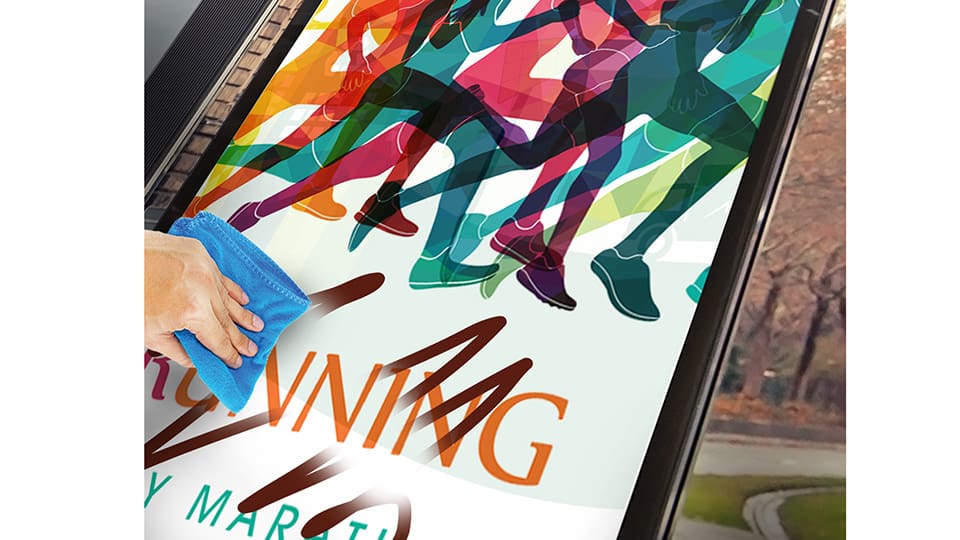
“On the other hand, short-term graphics printed onto thicker, more durable media do not necessarily need to be laminated. Aside from this, advances with print media have reduced the need for lamination by offering built-in resistance features. Be sure to understand the media you are working with as this will save time, effort, and money.
“For those sign-makers that do require some form of lamination, Drytac can help with our collection of products. These solutions can be paired with our established printable films for use on a wide range of jobs.”
Clearly there are many benefits of lamination in wide-format print production. Obviously, it is an absolute must if you are looking to protect print work that is at an increased risk of being damaged. However, lamination also allows wide-format print companies, and indeed their customer, to explore all manner of eye-catching effects that can make the application stand out even more to passers-by – which is the common purpose of many wide-format printed pieces.