Printing Beyond the Flat Surface
What opportunities are emerging for sign-makers as direct-to-object printing technology becomes more capable and accessible? Rob Fletcher sits down with several key names in the market to find out


How can investment in new etching and engraving equipment help sign-makers expand their offering and create more distinctive, high-value applications? Rob Fletcher speaks to several key manufacturers and suppliers to find out more.

Etching and engraving have long been established techniques within sign-making, offering signage professionals a way to produce durable, tactile, and distinctive graphics. From traditional plaques and nameplates to architectural and wayfinding signage, these processes continue to have a strong place in modern sign production.
For sign-makers, one of the main draws is the ability to work across a range of materials and create finishes that stand out from more conventional printed applications. Engraved letters, etched graphics, and detailed decorative work can all add depth and permanence, while also opening up opportunities in areas such as architectural, interior, and specialist signage.
As demand grows for more personalised, premium, and hard-wearing signs, manufacturers are continuing to develop new equipment, software, and materials. With technology making these processes more accessible, etching and engraving could offer businesses another way to broaden their capabilities and add value to their work. Here, SignLink gets the inside track on new developments within this sector.
First up to comment is Thorsten Brandt, chief marketing officer of Eurolaser, who says one key trend is that cutting and engraving are increasingly becoming part of the same process. He explains that customers may want to contour-cut a large-format workpiece while also adding lettering, markings, or decorative elements within a single digital workflow.
At the same time, he says applications are becoming more diverse, adding that it is no longer “just about traditional signage” but also large-format displays, decorative elements, and bespoke solutions for interiors and visual communication. This, Brandt says, is where laser technology offers possibilities, combining size, complex geometries, and individual designs within a single production system.
“One of the main challenges in the print and sign industry is handling an increasingly diverse range of jobs while facing growing time and cost pressures,” he says, adding: “Advances in machine technology, software, and automation are helping to address exactly this.
“In print-and-cut, for example, large, printed areas need to be processed both quickly and accurately. Modern camera systems can scan large areas at high speed, recognise the printed image, and enable precise contour cutting. For large-format applications, scanning speed has a direct impact on productivity.”
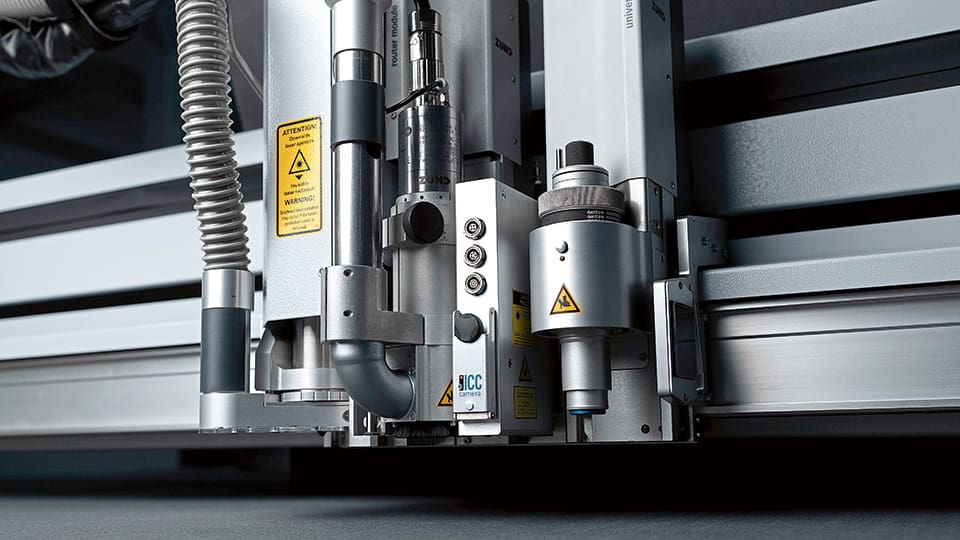
Brandt flags material diversity as another challenge, setting out how not every material is suitable for laser processing. This, he says, is why Eurolaser combines laser technology with mechanical tools from Zünd and, depending on the application, users can choose between laser, knife, routing, or creasing tools.
Leading on from this, Brandt says software also enables a higher degree of automation. He offers up the example of QR codes, highlighting how these can identify individual jobs and automatically assign the relevant cutting data, processing parameters, and quantities, reducing manual input and potential errors.
“On the production side, conveyors, shuttle or twin-table concepts, and robot integration can further reduce handling and machine downtime,” Brandt says, adding: “The real advance, therefore, is not one individual technology, but the way software, machine technology, and automation work together.”
With all this, what should a sign-maker consider when choosing an engraving or etching system? Brandt says the starting point should be actual demand and the enquiries coming from your own customers; which jobs are regularly requested, and which ones currently have to be declined or outsourced, and where might there be new opportunities?
One of the main challenges in the sign industry is handling an increasingly diverse range of jobs while facing growing time and cost pressures
At the same time, he says sign-makers must remember that an investment should not only meet today’s requirements, advising them to consider how their business and customers’ needs may develop over the coming years.
“A system should offer enough flexibility and scope for expansion to accommodate new materials, applications, or increasing levels of automation,” he says, adding: “It is important to consider the long-term picture; can additional capabilities be retrofitted? What are the ongoing operating costs? What level of service and spare-parts support is available? And does the system offer open interfaces for future integration into automated production environments? Over the lifetime of a system, these factors can ultimately be more important than the initial purchase price.”
Elsewhere, Greg McCarthy, managing director at Lean 5S Products UK / National Engravers, says the industrial etching and engraving sector is experiencing strong momentum, driven by stringent regulatory mandates, manufacturing automation, and an uncompromising demand for durability in harsh operational environments.
“Facilities now require permanent Direct Part Marking (DPM), 2D data matrix barcodes, sequential serialisation, and asset identification to maintain full operational audit trails,” he says, adding: “Traditional printed labels or adhesive tags quickly degrade when exposed to chemical washdowns, UV exposure, extremes of temperature, or severe mechanical abrasion.
“As a result, industrial clients heavily depend on deep-milled rotary engraving and high-precision fiber laser etching to guarantee lifetime legibility and uncompromised safety compliance on essential hardware.”
In practice, McCarthy says demand is heavily anchored in industrial control, switchgear, and process engineering, with prime applications including multi-colour Traffolyte valve tags, stainless steel pipe markers, control panel mimics, switchgear identification, and custom safety notices.
Beyond standard asset tagging, McCarthy says the company is now seeing a major surge in continuous improvement integrations. He explains how modern manufacturing plants are embedding precision laser marking and profile cutting directly into their Lean 5S strategies, employing colour-coded tags, custom tool shadow boards, and engraved equipment locators to standardise shop-floor workflows, mitigate human error, and streamline shift handovers.
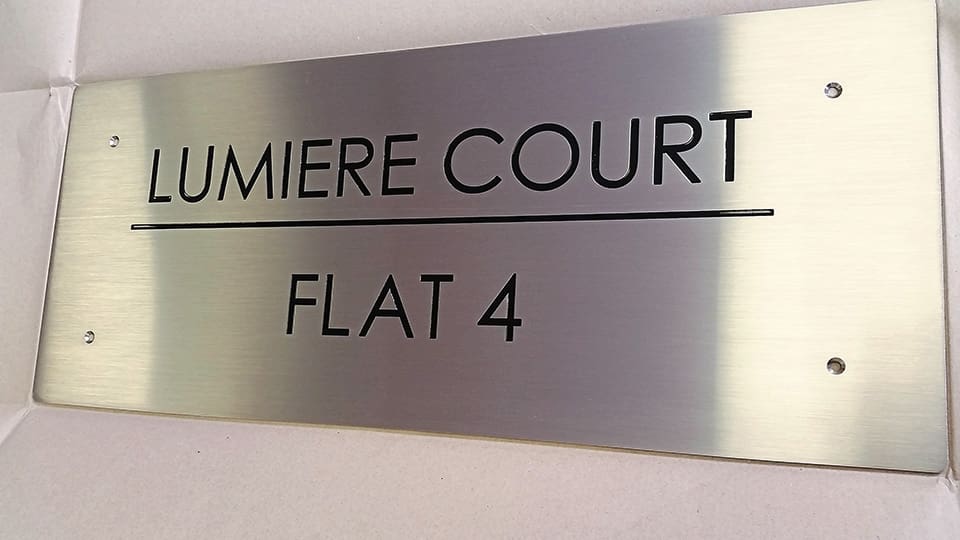
“Delivering these solutions requires a balanced machinery fleet,” he says, continuing: “High-rigidity gantry CNC rotary engravers remain indispensable for deep mechanical milling, edge bevelling, and heavy profiling on rigid laminates, acrylics, and non-ferrous metals. For non-metallic sheet processing, CO2laser platforms provide rapid rastering and clean polished edges.
“However, the most significant shift in modern productivity stems from upgrading to high-speed fiber laser marking technology. Integrating galvo-driven fiber laser systems alongside conventional rotary platforms drastically alter operational capacity. Fiber lasers operate with zero ink or chemical consumables, requiring negligible maintenance while achieving sub-micron precision on raw metals and engineering polymers.”
McCarthy goes on to say that this capital investment delivers a “step-change” in production velocity. He explains how galvanometer scanning heads reduce cycle times on batch metal tagging from minutes to seconds. Furthermore, he says that fiber technology unlocks high-contrast direct marking on untreated stainless steel, anodised aluminium, and dense polymers without needing pre-coatings or chemical sprays.
“Complex high-density 2D barcodes, micro-text, and detailed corporate branding can now be applied with absolute repeatability, expanding our service offering to meet the stringent demands of high-specification engineering clients,” he adds.
Also weighing in is Rob Goleniowski, regional general manager for the UK, Ireland, Scandinavia, and Baltics at Roland DG. He says that while UV printing is increasingly being used as an alternative for some applications, there is still demand for engraved signage, particularly where durability “needs to be of the highest standard”.
“Manufacturing sites, heavy plant environments, and other industrial settings are good examples,” Goleniowski says, continuing: “In these situations, signage and labelling often need to withstand demanding conditions while remaining clear and legible over time, which is where engraving continues to have a strong role.
“For sign-makers, the important point is different technologies suit different applications. UV printing offers excellent versatility, but engraving remains highly relevant where permanence, robustness, and material performance are key requirements.”
Looking closer at areas of demand or sectors to monitor, Goleniowski says promotional products remain a strong complementary opportunity for sign businesses. He explains how a company already producing signage for a customer may also be able to supply engraved pens, branded merchandise, or personalised items such as metal water bottles.
“Rather than seeing engraving as a completely separate market, sign-makers can use it to broaden the range of products they offer to customers they already know,” he explains, adding: “That is one of the key commercial opportunities. A signage project does not necessarily have to end with the sign itself. Engraving gives businesses another way to add value to an existing customer relationship and potentially capture more of that customer’s branding and promotional requirements.
Another advantage for those in this sector is that engraving and etching are becoming much more readily available.
Goleniowski set out how websites now allow customers to create or upload their own artwork and send production-ready files directly to the sign-maker. This, he says, can simplify the ordering process and reduce some of the manual preparation traditionally involved.
Factoid: The earliest known deliberate engraving dates back more than half a million years. A shell discovered in Indonesia featured an incised zig-zag pattern, attributed to Homo erectus
Leading on from this, Goleniowski says software is also helping customers visualise the finished result before production. He highlights how programs such as Cut2D can create previews of the artwork, making it easier for customers to understand what they are ordering and make decisions more quickly.
So, what should sign-makers consider when choosing a new machine? Goleniowski says ease of use is one of the most important considerations, particularly when engraving is an additional service rather than something the business will be producing every day.
He goes on to say the equipment should add capability without becoming an operational distraction, advising sign-makers to start by considering exactly what they want to engrave and choose a machine that is suitable for those materials and applications. For example, if a business wants to produce brass house signs or building signage, it needs to make sure the equipment is appropriate for that type of work.
As for solutions from Roland DG, he recommends the DE-3 desktop engraver, saying this has been designed for professional engraving applications. “Ultimately, engraving does not need to replace the other production methods available to sign-makers,” he says, adding: “Its strength is in complementing them, providing a durable solution for demanding signage applications while also opening the door to personalised products and additional revenue opportunities.”
Etching and engraving may be established techniques, but the opportunities they offer sign-makers continue to evolve. From durable industrial identification and safety signage to personalised products and branded merchandise, the technology can help businesses respond to a wider range of customer requirements while opening up additional revenue streams.
The key is understanding where the technology fits within an existing operation. Rather than viewing engraving and etching as a replacement for other production methods, sign-makers can use them alongside established capabilities to add value, improve durability, and take on work that may otherwise be outsourced.
With equipment becoming more accessible and software helping to simplify the production process, the barrier to entry is also falling. For businesses willing to look beyond traditional signage, investing in the right system could provide a relatively straightforward way to expand their offerings, strengthen existing customer relationships, and uncover new opportunities.