Shropshire signage firm purchases new Veloblade Nexus
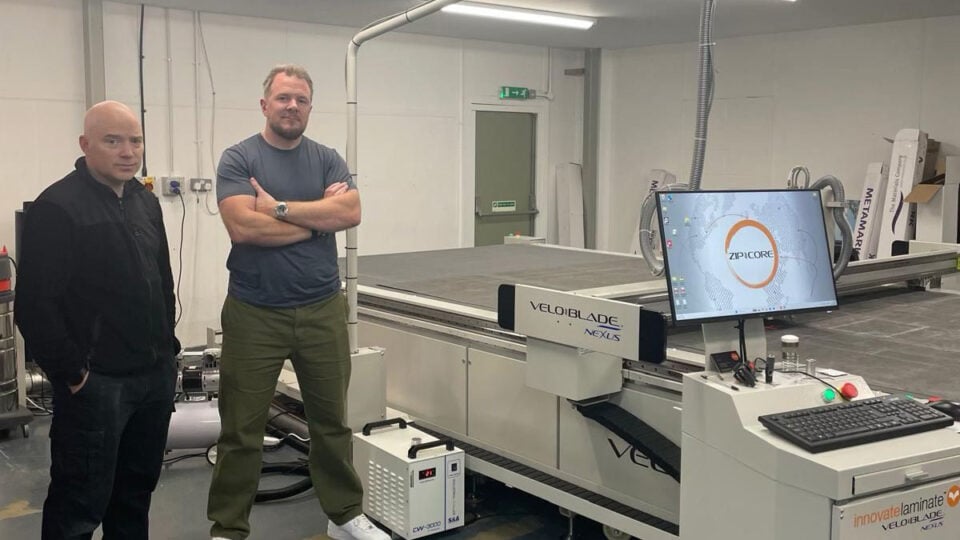
Print and signage firm, Big Value Banners, has invested in a VeloBlade Nexus cutting system from Vivid Laminating Technologies to support its fast turnaround times and allow for future growth


Corplex has revealed details of its new de-inking process that allows for direct printing on mono-material Correx boards, reducing wastage from vinyl stickers and cutting carbon emissions by up to 80%

Plastic fabrication company, Corplex, has highlighted its new closed-loop recycling process which can cut carbon emissions by up to 80%, as part of goals to improve the recyclability of current signage materials and installation methods across the sector.
According to Corplex, printed advertising boards for buses are traditionally used only two or three times, with limited scope for recycling.
Traditionally, bus signage uses printed vinyl glued onto Correx polypropylene sheets, which can limit reuse. Although paper‑based alternatives exist, Corplex highlights that they can often fall short under the demands of public transport environments and shifting weather conditions.
Corplex has been exploring ways to address this issue for many years, with the aim of prolonging the lifecycle of plastic packaging through reuse, recycling, and repurposing.
In a statement about the current state of plastic recycling, Corplex says: “With 70% of plastic waste in the European Union still ending up in landfill or incineration, the need for scalable closed-loop solutions is clear.”
Working with a global creative agency and printing partner, Corplex set out to develop a recyclable, weather‑resistant bus advertising solution that maintains high visual impact.
In a traditional ‘linear’ model, a vinyl sticker displaying the ad is printed and applied to the Correx board. Once the campaign ends, the vinyl is stripped and sent to landfill or incineration, while the board may be reused only two or three times before being downcycled into low‑grade material.
Corplex’s new method removes the need for glued vinyl altogether, instead printing directly on mono-material Correx boards. Corplex, which is the original manufacturer of Correx, can then shred the used sheets into flakes and wash the ink off without degrading the plastic.
The fresh white chips are then used to create new, high-quality boards for advertising, making true closed‑loop recycling possible.
Corplex has estimated that 70% of the recycled material is put back into the new boards with this method compared to 20% previously, thanks to the purity of the de-inked flakes. Boards can now be re‑used more than ten times, cutting virgin material use and emissions.
Independent certification from Carbon Quota confirms the solution delivers an 80% reduction in carbon footprint, saving over 3,000 tonnes of CO₂ per year.
The innovation, which offers the first scalable mechanical de-inking process for printed polypropylene signage, was recognised with a win in the Circular Economy Initiative category at the National Recycling Awards.
Tabitha Clark, market director (Construction, Steel & Manufacturing) at Corplex, says: “When we first explored the idea of creating a closed‑loop solution for Correx, it felt almost experimental. That initial concept has evolved into a fully operational, first‑of‑its‑kind system.
“What makes it so powerful is that we’re not just recycling material. We’re restoring it to a quality that allows up to 70% of it to go straight back into the same product. That’s genuinely circular. The process itself is also impressive. It’s simple in principle, but the engineering behind it is pioneering, especially for such a heavy substrate.”
Corplex is now engaging with customers across sectors such as retail and pharmaceuticals to explore how the technology can support their sustainability ambitions.
Eva de la Torre Sans, director of new solutions at Corplex, adds: “For me, one of the most important aspects of this project is how many partners came together to make something genuinely pioneering a reality.
“This wasn’t just a technical achievement; it was a shared vision. We’re talking about the world’s first de-inking capability for this type of substrate, which is a major milestone not only for us but for the industry as a whole.”