In this edition of Fresh Perspectives, KGK Genix, a provider of wide-format print solutions, highlights the experience of one of its print apprentices, Tom Brazier
Guest Writer
April 22, 2026
Tom Brazier, apprentice print technician at KGK Genix
In an industry that thrives on precision, craftsmanship, and speed, the future of print depends on the next generation stepping forward with confidence and skill. Apprenticeships have long played a vital role in building that future. For Tom Brazier, an apprentice at KGK Genix, choosing this path has been both challenging and transformative.
After finishing college, Brazier faced the same decision as many young people. University was an option. So was staying in education. But he wanted something different. “I saw it as a great opportunity,” Brazier explains, “I had finished college and I wanted to get a skill.”
For Brazier, the appeal was clear – rather than continuing with classroom-based learning alone, he wanted hands on experience and a qualification that would open doors within the industry. An apprenticeship offered the chance to earn, learn, and gain real responsibility from day one. In a sector like print, where technical knowledge and practical understanding must work side by side, that combination is powerful.
First Steps on the Shop Floor
Walking onto the shop floor for the first time can be intimidating. The pace is fast. The machinery is complex. There is a strong sense of teamwork and routine.
“It was daunting at first,” Brazier admits, “but I was welcomed and I enjoyed it pretty quickly.” That early support made a significant difference. Being part of a team that values learning and patience helped Brazier settle in. What could have felt overwhelming soon became exciting.
Print production environments demand focus and accuracy. There is little room for error. For a new apprentice, absorbing that culture takes time. But it also builds resilience and discipline.
Learning the Craft: Skills Developed Over Three Years
With his apprenticeship now more than halfway complete, Brazier has gained a deeper understanding of what it really takes to produce high-quality print. One of the most important lessons has been about finishing.
“I understand now how important finishing is to the final quality of the print,” Brazier says. It is easy for those outside the industry to focus on the press alone, but finishing, from cutting and folding, to binding and packaging, plays a critical role in how a product looks and feels. Small adjustments can make a big difference.
Through daily hands-on work, Brazier has developed technical skills, attention to detail, and an appreciation for how each stage of production connects. He has also seen how print technology combines precision, speed, and problem solving.
Every job is different. Materials vary. Deadlines shift. Machines need to be set correctly and monitored carefully. When something goes wrong, quick thinking is essential. Learning to troubleshoot under pressure is part of becoming a skilled print professional.
Balancing Work and College
While the shop floor has been a place of growth, the classroom has brought its own challenges. “College has probably been the hardest part,” Brazier says, adding: “It’s been tricky balancing the work with college.”
Managing full time employment alongside coursework and assessments requires discipline and organisation. It is not always easy to switch from a practical environment to academic study. Yet that balance is also what makes apprenticeships so valuable. The theory studied at college can be applied immediately in the workplace. Concepts move from page to practice quickly.
Managing full time employment alongside coursework and assessments requires discipline and organisation. It is not always easy to switch from a practical environment to academic study
Over time, Brazier has developed not only technical knowledge but also time management skills and personal resilience. These are qualities that will serve him well throughout his career.
Growing in Confidence and Responsibility
Perhaps the biggest change has been personal. “I was shy when I joined,” Brazier reflects, but adds: “Now I feel part of the team.”
That growth in confidence has not happened overnight. It has come from being trusted with responsibility, from learning through mistakes, and from receiving guidance from experienced colleagues.
As his skills have developed, so too has his role. Tasks that once felt complex are now routine. He can take ownership of certain jobs and contribute ideas. Being treated as a valued member of the team has strengthened his sense of belonging.
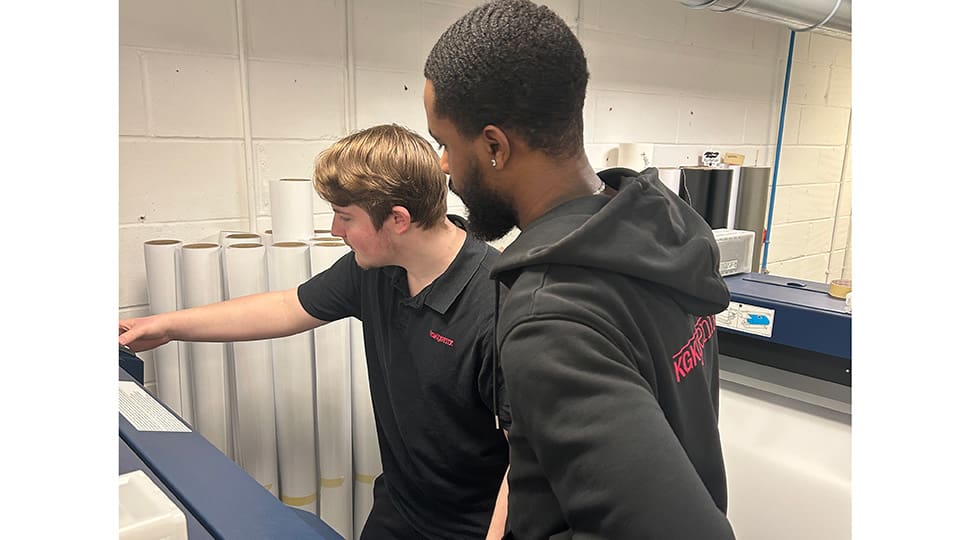
Brazier [L] with Jhevaughn Burford [R] print finisher and mentor at KGK Genix
In industries where teamwork is essential, learning how to work effectively with others is as important as mastering machinery. “One skill that surprised me,” he adds, “is learning how to work full time and work with a team.”
For many young people, the transition from education to full time employment can be a shock. An apprenticeship eases that shift by providing structure, mentorship, and gradual responsibility.
Learning from Experience
No apprenticeship succeeds without strong mentorship. For Brazier, learning from experienced colleagues has been vital.
“Learning from the experienced team has been invaluable,” he says. In print, much knowledge is built over years. Subtle adjustments, instinctive troubleshooting, and an understanding of materials often come from experience rather than textbooks alone.
Being able to observe and ask questions accelerates development. It also preserves skills within the business. As experienced professionals pass on their knowledge, the industry retains its expertise. This transfer of skills is especially important in print and signage, where many businesses face an ageing workforce.
What Completion Will Mean
Although Brazier is still completing his training, he is already thinking about what finishing his apprenticeship will represent.
“It will mean a qualification,” he says. “It will open up opportunities within the industry.”
That qualification is more than a certificate, it is proof of competence, commitment, and capability. It signals that Brazier can operate within a professional print environment and meet industry standards. Personally, it marks a journey from uncertainty to confidence. Professionally, it provides a platform for progression, whether that means specialising further, moving into leadership, or exploring different areas of print production.
Advice to Young People
For those considering their next step, Brazier offers honest advice. “It is hard work,” he says, “but it is a great alternative if you are not vibing with school or college.”
Apprenticeships are not an easy option. They require commitment, punctuality, and a willingness to learn. But for practical learners who prefer hands-on work over sitting in a classroom, an apprenticeship can be the right fit.
In print and signage, it offers the chance to develop a tangible skill. You can see the results of your work. You can hold them in your hands. For young people unsure about traditional academic routes, this pathway provides purpose and direction.
Why Apprenticeships Matter for Print
The print and signage industries have long relied on skilled craftspeople, yet they also face challenges. “In an industry that is typically middle aged and male, it is good to see things through different eyes,” Brazier says. Encouraging more young people to join the industries is essential for long term sustainability.
Apprenticeships create structured entry points into the sector. They widen access and build diversity. They also ensure that knowledge is not lost as experienced professionals retire.
By investing in apprentices, print businesses invest in continuity, innovation, and growth. Brazier’s journey is still ongoing, and he is not yet at the end of his apprenticeship, but his reflection offers a clear message; Apprenticeships provide more than training. They build confidence, character, and career prospects.
For an industry built on precision and pride, that hands on pathway remains as relevant as ever.
Following the success of the FESPA Next Generation initiative, we hear from Molly Jackson, head of content and marketing at FESPA UK, who gives her perspective on entering the industry, standing out to employers, and embracing the team you work with
In this fresh perspective, Verity Fox, managing director of large-format print specialist Dominion, reflects on how speed, quality, and service have become baseline expectations in print – and why price now exerts growing pressure on every part of the process