How Can Print Really Deliver on Speed, Quality, Service, and Price?
In this fresh perspective, Verity Fox, managing director of large-format print specialist Dominion, reflects on how speed, quality, and service have become baseline expectations in print – and why price now exerts growing pressure on every part of the process
Guest Writer
June 29, 2026
For much of my career in print, the industry has been guided by a familiar model of speed, quality, and service. Historically, if you got those three aspects right consistently, you were doing a good job. Today, this model – often referred to as a ‘triangle’ – no longer reflects reality.
Customer requirements have evolved, competitive pressures have intensified, and pricing has progressed from a commercial consideration to a constant operational force. The fourth increasingly dominant pressure is now price, and I’d argue, therefore, that the commonly known triangle has become a square, with each side constantly pushing against the others.
A lot of this expectation has been shaped by the world outside print. Platforms like Amazon Prime and other major retailers have normalised next-day delivery, instant purchasing, and seamless service, leading people to believe all industries can and should work at the same pace. The world is moving faster than ever before, and this pace inevitably filters into how print is bought and sold.
Furthermore, print has become more commoditised over the last 20 years. In some cases, the expert element has been lost from the buying process, which can make print appear deceptively simple. While some projects move quickly through automated workflows, many don’t. Large-format and bespoke print still rely heavily on skill, experience, and judgement, particularly when expectations around speed, quality, service, and price are in play at once.
Where the Square Begins to Strain
It’s when these four elements collide that the real challenges emerge, and it’s something I’ve witnessed increasingly over the last few years. Referring to the model as a square, rather than a triangle, feels accurate to me because it’s rarely one expectation in isolation that causes tension. More often, one side of the square pushes against another, bringing about trade-offs that aren’t always visible to the customer.
One of the most common pressures we’re seeing right now is speed versus quality. Fast turnarounds inevitably restrict the time available for quality control and that all-important attention to detail. When deadlines are compressed, there’s less margin to pause, check, and refine – particularly on complex or bespoke work.
Meanwhile, pricing introduces another layer of complexity. Quick turnarounds often come with additional costs that would sit outside the basic production process. Queue-jumping jobs into the schedule, shipping in non-stock substrates, arranging direct deliveries, or running overtime all add pressure to already tight margins. Looking in from the outside, these costs may not be visible, but on the production floor, they’re very real.
There’s also an ongoing tension between price and quality. Intricate, bespoke jobs demand time, precision, and expertise – but when pricing is pushed too hard, something has to give. Nobody wants to see a squeeze on price reflected in a downturn in quality, yet, sadly, this is a risk when high-quality work is expected to move through a process designed for speed.
Why Automation Hasn’t Replaced the Human Element
There’s a long-held assumption that automation and faster machinery have removed much of the risk and complexity from print production. Yes, automation should eliminate bottlenecks, reduce errors, and compress turnaround times – but, in reality, it cannot replace skill and experience. Despite the advances we’ve seen, machines can only run so fast. Media still misbehaves. Finishing processes still have physical limits.
Breakdowns, as luck would have it, tend to happen during the busiest periods. Automation may streamline workflows, but it doesn’t remove the need for people – experts – to make decisions when conditions are less than perfect.
In my experience, the real time savings come from expertise rather than speed alone. Experienced teams assess a job long before it reaches the press, considering artwork choices, ink allowances, and finishing timings. A flood colour that looks simple on screen, for example, may need to run slower to avoid downstream issues that, ultimately, cost more time than they save. This is particularly the case in large-format and bespoke print, where standardised workflows don’t always apply. Colour matching, substrate behaviour, and finishing tolerances rely heavily on human input – and, while automation supports this process, it certainly doesn’t replace it.
Print businesses succeeding today are investing in people and their expertise, as well as upgrading equipment. You could have the best kit in the industry, but without skilled operators, planners, and finishers, it simply won’t deliver on the expectations placed upon it.
Decision Making Where Trade-Offs Are Unavoidable
For all the advancements in print we’ve seen and taken advantage of, there are still instances where something has to give. I’m sometimes guilty of saying ‘yes’ to jobs that require the square to perform at full force, particularly during busy periods. There’s an ingrained instinct to want to help – to ‘make hay while the sun shines’ and avoid disappointing the customer. Often, these jobs run smoothly, reinforcing the belief it’s always possible. But when they don’t, the pressure lands firmly on the team, whether that’s through overtime, stress, or a lack of breathing space between jobs. The challenge is recognising those moments early and making decisions that protect the outcome, rather than simply chasing the deadline.
There are projects where all four sides of the square are fixed from the outset – turnaround is tight, the quality is non-negotiable, the delivery deadline is fixed, and the price expectation leaves little room for contingency. In these situations, even small changes (a late artwork approval, a challenging colour, or an unexpected production issue, for example) can have a significant knock-on effect. While some additional costs can be recovered, the truth is margins are under constant pressure and tolerance for error is extremely low. These are the moments where leadership on the production floor matters most.
I’m sometimes guilty of saying ‘yes’ to jobs that require the square to perform at full force, particularly during busy periods
If there are no workarounds and a deadline genuinely can’t be met, it’s far better to have an honest conversation early on. Experience has taught me that trade-offs aren’t a failure of the process – they’re inevitable in bespoke print. The key is understanding where flexibility exists and where it doesn’t, and making those calls with professionalism and transparency.
In the long run, honesty will always strengthen customer relationships rather than undermine them.
Why Price Matters
Of all four sides of the square, pricing is often the most difficult to navigate. There will always be cheap print and businesses willing to lead a race to the bottom. What has changed is the pressure to deliver ever-higher levels of speed, quality, and service alongside pricing that leaves very little room for error.
In the long run, honesty will always strengthen customer relationships rather than undermine them
Margins are already tight and external pressures outside our control continue to grow. Sustainable pricing isn’t about being uncompetitive. It’s about recognising that quality, service, and innovation all require investment – in people, equipment, and processes. Automation and technology play an important role, but they’re only effective when supported by skilled teams.
I often think of a phrase my dad, from whom I’ve taken the Dominion reins, used to repeat: “Turnover is vanity, profit is sanity, and cash is king,” it’s a simple sentiment, but it remains incredibly relevant. Turnover alone doesn’t build resilient businesses. Sustainable profit allows print companies to invest, but, more than this, it enables them to improve and support the people who ultimately deliver the work.
People, Partnership, and Perspective
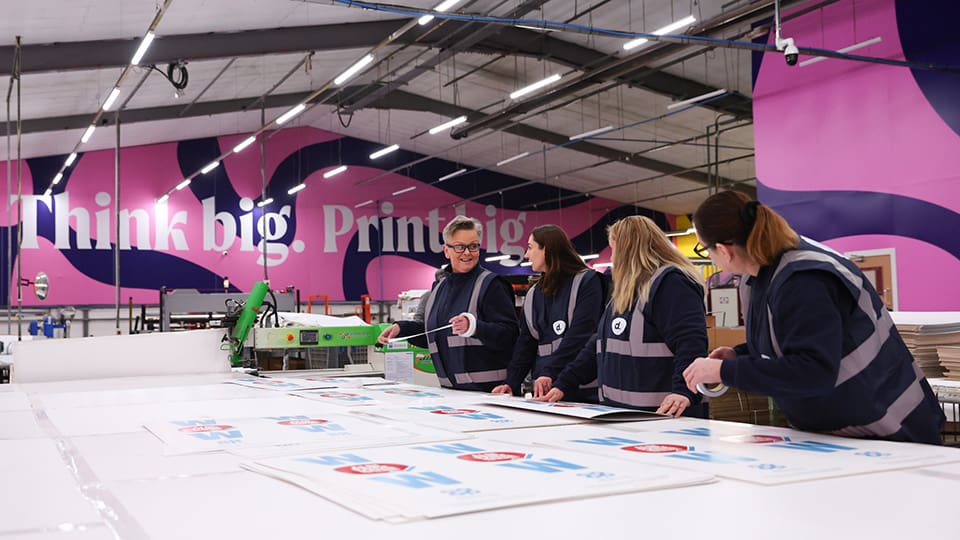
While it’s easy to talk about speed, quality, service, and price in abstract terms, behind each element are people. Behind the printers, finishing tables, and delivery schedules are expert teams making decisions, solving problems, and taking responsibility under increased pressure.
In print, we’re often the last to be briefed, yet expectations remain that everything will be delivered urgently and without compromise. This isn’t a criticism – it’s the way we’re used to working and will continue to do so for as long as projects land on the production floor in this way. Honest conversations, accurate briefs, and realistic timelines make a tangible difference to the final result.
At Dominion, we encourage customers to see us as a full-circle print partner, rather than simply a supplier. We aim to be involved in the process from the outset to implement know-how early in the briefing stage. We welcome challenges, unusual projects, and difficult briefs, and it’s our responsibility to help customers envisage the bold and go beyond what they thought possible in terms of impact. But we also believe in being upfront when something isn’t achievable within the constraints given.
Ultimately, I don’t believe the shift from triangle to square needs to be a negative one. If it’s approached thoughtfully, it can lead to better planning and briefing, stronger relationships, and more sustainable businesses. Speed, quality, service, and price will always pull against one another to some degree, but with the right perspective, I really think balance is possible and everyone can be kept happy.
Following the success of the FESPA Next Generation initiative, we hear from Molly Jackson, head of content and marketing at FESPA UK, who gives her perspective on entering the industry, standing out to employers, and embracing the team you work with
In this edition of Fresh Perspectives, KGK Genix, a provider of wide-format print solutions, highlights the experience of one of its print apprentices, Tom Brazier