Barcelona’s ‘Rotulistas’:Keeping the Craft Alive in Catalonia
With FESPA Global Print Expo and co-locating European Sign Expo set to descend on Barcelona, we meet some of the craftspeople whose work can be found on the streets of this famous city
Guest Writer
April 22, 2026
Barcelona has a strong heritage of signs and lettering, much of which survives to this day — from gilded fascias to mosaic frontages and ornate carved frames, it’s something of a sign spotter’s paradise. Of particular note is work in the ‘Modernisme’ (Catalan Art Nouveau) style. This art and design movement flourished in the growing Catalan capital during the late nineteenth and early twentieth centuries, and endures as an important aspect of the city’s visual and architectural identity.
The Modernisme movement coincided with a renaissance in Catalan culture, and now, over 100 years later, there is a rediscovery and revival of many of the craft skills from that earlier era. Their contemporary application is taking hand-painted and gilded signs in new stylistic directions, drawing on influences from a range of lettering and decorative cultures.
While the number of contemporary sign painters in Barcelona is relatively small, they are undoubtedly making a visual impact, one sign at a time. Here are four of the craftspeople currently plying their trade in the city, and whose creations now compliment the historic signs that they sit alongside.
Adrián Perez rotulostradicionales.com
Adrián Perez, also known as El Deletrista, works out of a studio in the Barcelona suburb of L’Hospitalet de Llobregat. He started his sign painting journey at a time when there was no formal training in Spain, driven by his passion for traditional lettering. He learned by working alongside others, practising
onstantly, and taking jobs for very little pay to build his experience. He is now one of the few people teaching gilding and sign painting skills to others in Spain, helping the craft’s wider revival in the country. While Adrián’s early clients mainly consisted of tattoo parlours, his work now comes predominantly from bars and restaurants along with traditional businesses that value “hand-painted signage [that] is inherently unique and clearly sets them apart from the competition”. He believes that these customers embrace the hand-crafted aesthetic for its “personality” and because it makes their businesses “feel established and authentic — like places that have always been there”.
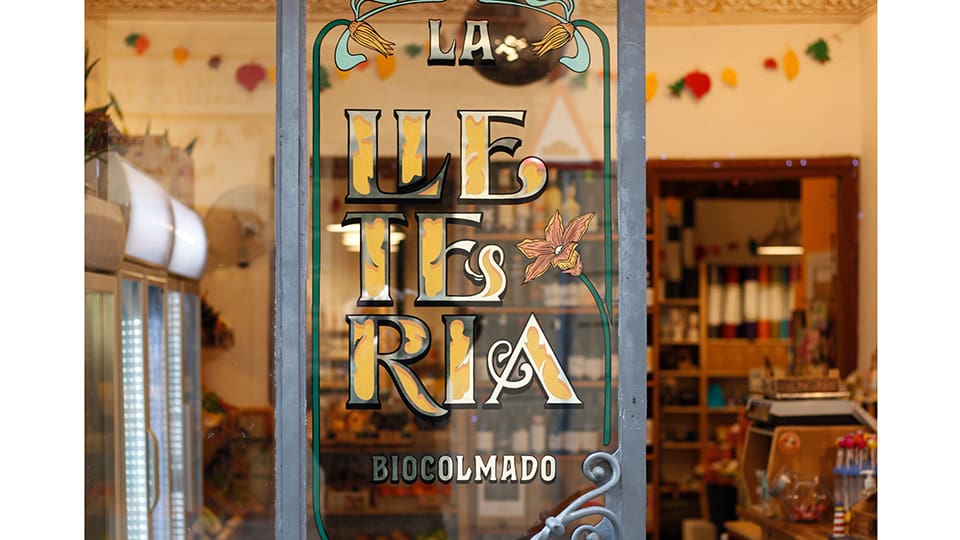
In this work for the Biocolmado organic grocer, Adrián Perez echoed the organic Art Nouveau features of the original door’s design
To deliver this authenticity Adrián offers a ‘full service’ that allows him to work through the entire creative process with his clients. This starts with visual identity and graphic design work, right through to the final execution where he’ll take on carpentry and illumination where required, in addition to the gilding and painting of signs. And it is this end-to-end process that he feels is important for those starting out to understand: “Don’t focus only on painting. Painting is the final step but everything that leads up to that moment — design, preparation, materials, installation — is just as important, if not more.”
Daniel Esteve Carbonell instagram.com/insertdaniels
Daniel Esteve Carbonell is a native of Sant Pere de Ribes, a small town in the wider province of Barcelona. Painting graffiti in his youth set him on the path to studying calligraphy and graphic design before eventually discovering lettering and traditional sign painting. These crafts fascinated him and led to the realisation that he could develop a career “combining my passions of working with letters and painting walls”.
While Daniel’s signs can be found in the city of Barcelona, most of his clients are local, consisting of bars, restaurants, music shops, and other retailers. He also takes on projects for councils and local schools, which has extended to facilitating workshops for young people. Word-of-mouth is his biggest marketing asset in what is a tight-knit community where everyone knows everyone. His customers come to him because they “value unique hand-crafted work” that brings “warmth and something special to their business”.
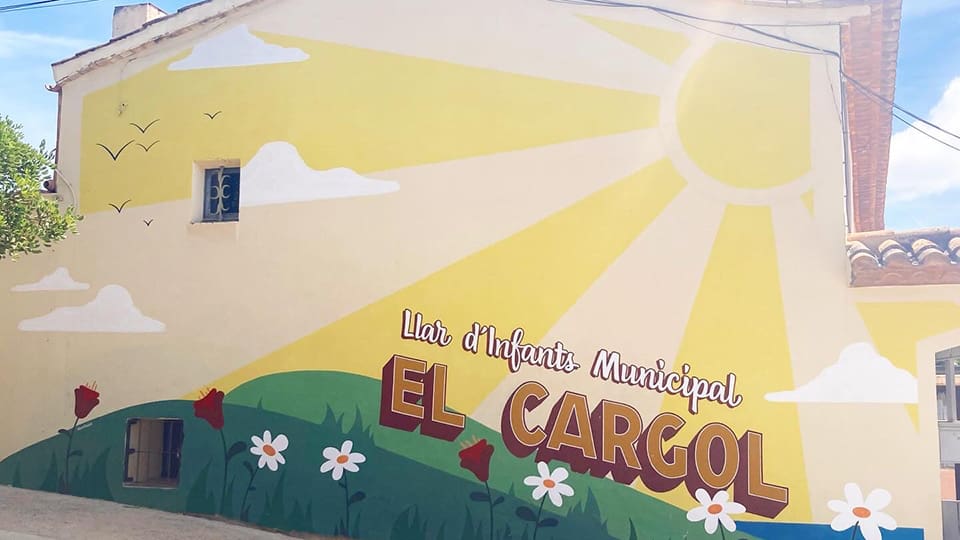
El Cargol (the snail) is a nursery in Sant Pere de Ribes where the vast majority of the town’s hand-painted signs are from the hand of Daniel Esteve Carbonell
Daniel is comfortable working in a variety of media — digital and physical — where “hand-drawn lettering plays a significant role”. Depending on the client’s requirements he’ll use tools ranging from regular sign painting brushes to spraypaints, markers, and other pens. And it is these tools that form the foundation of his practice, which is grounded in the study of calligraphy and the formation of letters. He believes that these fundamentals are important for anyone that wants to pursue a career in sign painting: “Only by controlling and practising different calligraphy styles with nibs and brushes can we develop the necessary skills to apply to our lettering and traditional sign painting.”
Leonel Fernández leonelsigns.com
Leonel Fernández, trading as Leonel Signs, started his sign painting journey in Buenos Aires, in his native Argentina. This was originally in that city’s distinctive ‘Fileteado Porteño’ decorative style, which he learned by attending classes with a number of different master painters. However, as his experience grew, learning as much from his mistakes as his successes, he sought out his own style and direction.
After a period of splitting his time between Argentina and Spain, he finally relocated to Barcelona in 2005 and now has a studio in the city’s Raval district.
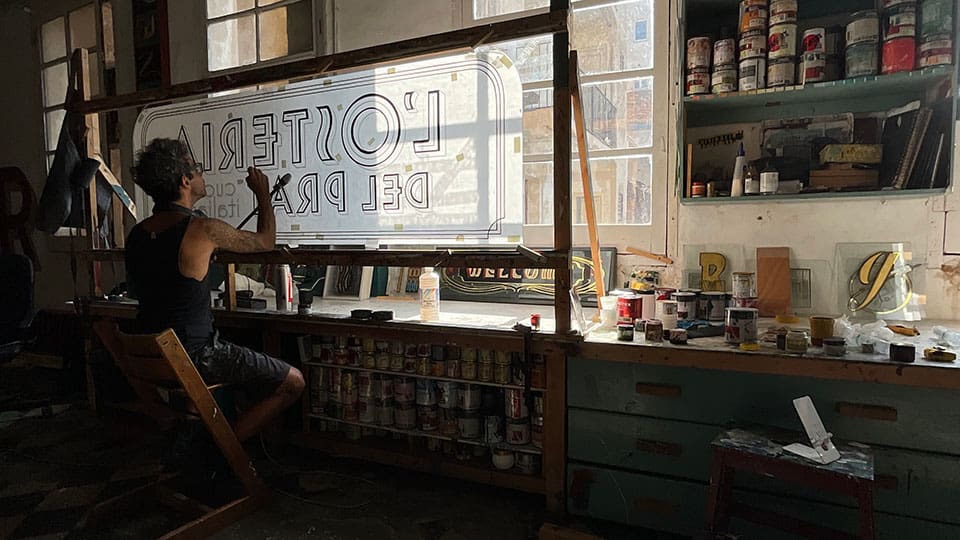
Leonel Fernández in his studio working on an Art Deco-infused fascia sign for L’Osteria del Prat. The Italian restaurant is located in the Barcelona suburb of El Prat
Businesses from various sectors, including hospitality and tattoo parlours, form Leonel’s clientele, which includes those overseas as well as in Barcelona. He believes that his customers choose hand-crafted signs over vinyl and other media because they can see the difference and “are prepared to pay a bit more for that refined aesthetic”. And his own aesthetic is infused with Art Deco and Art Nouveau influences, plus the occasional dash of Argentinian Fileteado when the job calls for it.
Leonel feels grateful to have found a trade that he is “passionate about, and which also puts food on the table”. For those that might follow in his footsteps, he recommends honing observational skills before developing one’s own style and direction. Also, when things don’t go as planned, such as spelling something wrong, it’s important to “resolve the issue properly without losing your ability to see the funny side”.
Martín Gabriel Oubiña instagram.com/filetes_martinou
Martín Gabriel Oubiña originally hails from Buenos Aires, Argentina, where, from a young age, he displayed an aptitude for drawing and painting. He went on to study at the University of Fine Arts in La Plata before specialising in painting at the Institute of Visual Arts in Lomas de Zamora. From there, his training continued under Guido de Setta, a master in the vernacular Argentine artform of Fileteado Porteño, before deepening his practice with José Espinosa, another influential ‘flieteador’ (painter of Fileteado Porteño).
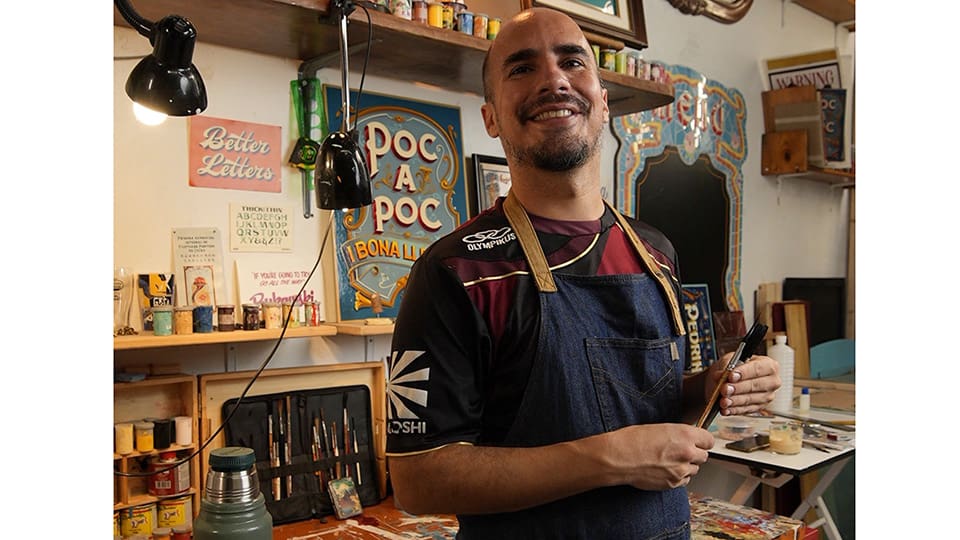
Martín Gabriel Oubiña originally hails from Argentina but has now made home, and studio, in Barcelona
In 2007, Martín started working professionally, initially painting percussion instruments for carnivals and performing arts events. These allowed him to explore unconventional approaches, blending Fileteado Porteño motifs with illustrations and characters from outside that art form's traditions. In 2019 he relocated to Barcelona where he now works with a variety of clients including tattoo and piercing studios, barbers, bars, restaurants, and milongas (Argentine Tango dance venues). They come to him for his collaborative approach, and the “personalised, unique, and warm” projects that he delivers. His new home has also seen him “incorporating influences from Catalan Modernism” into his output, once again blending different traditions in new and unexpected ways.
Martín is passionate about “reconnecting with traditional crafts that offer a more conscious and slower approach that can positively transform our surroundings”. For those seeking out this reconnection, he advises patience and “beginning with the technical foundations of the craft, supported by consistent practise”. Further, he emphasises the importance of meeting with other craftspeople, as he did in his formative years, because “exchange often leads to valuable insights”.
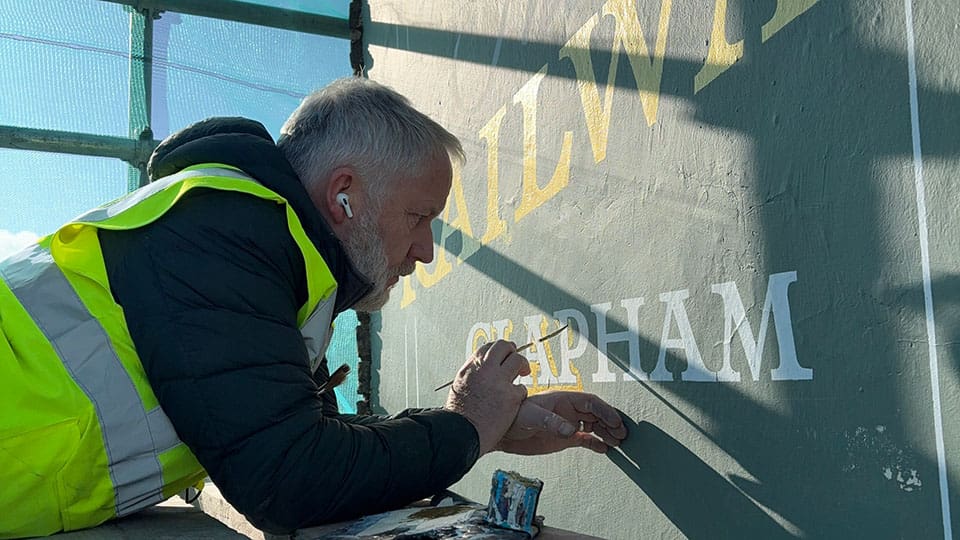
With a career spanning many facets of sign-making, Signmode has taken David Mearns back to where it all started with no regrets. Ahead of Mearns’ return to The Sign Show, Sam Roberts speaks to this traditional signwriter
Following the success of the FESPA Next Generation initiative, we hear from Molly Jackson, head of content and marketing at FESPA UK, who gives her perspective on entering the industry, standing out to employers, and embracing the team you work with
In this Company Spotlight, we speak to Andrew Ballington-James, managing director of Just AJD, about the company’s quarter-century history and how it maximises its output with a small but experienced core team
Watch our latest video of the week
SignLink gives you the latest video coverage of companies, people, and events from within the signage, graphics, and wide-format print industries.