Canon: Understanding the Cost of Roll-to-Roll Printers
In this guest feature from Canon, the company explores all the cost considerations related to buying a roll-to-roll printer
Guest Writer
December 16, 2024
In this guest feature from Canon, the company explores all the cost considerations related to buying a roll-to-roll printer, including what ink to choose, the advantages of modular devices, and the potential hidden surprises that can push up monthly outgoings.
Costs and Considerations
While volumes in the roll-to-roll market continue to grow, print service providers (PSPs) face a number of challenges created by customer demand for ever-shorter turnaround times for orders.
In fact, recent research from Keypoint Intelligence shows demand for large format print jobs that need to be turned around within 24 hours has grown exponentially over the last decade. Investing in the right roll-to-roll printer is therefore a crucial decision for print businesses.
Purchasing a new roll-to-roll printer can be a time-consuming process – buying the right device to fit the business's specific needs. If it’s to be a long-term investment, making the wrong choice could be an expensive mistake. And with so many options available, it can be tricky to know where to start.
Although the initial cost will always be a factor in the decision-making process of any business, checking the specifications to ensure the printer will be capable of delivering the right speeds, volumes, quality, and media types holds equal weight.
Only considering the upfront price when two printers offer similar features can therefore be misleading. PSPs have to decide which device will provide the best solution for the business by weighing up cost versus its capabilities and considering the total cost of ownership (TCO) of the printer.
The TCO calculation should include energy usage, which is especially important because of the increased uncertainty around utility costs, running and maintenance costs, the cost of peripherals, and any other hidden costs over time.
Selecting the Right Technology Fit
Businesses might find a good deal on a roll-to-roll printer, but then discover it has hidden costs such as high running and maintenance costs and high ink consumption, therefore drastically increasing monthly outgoings.
For example, when choosing the right device, businesses should consider not only the cost of the ink but just as importantly how much ink the machine consumes and whether any extra consumables are needed. It’s easy to be wowed with low upfront ink costs, but that’s only part of the picture – looking at the ink consumption per square metre will help to make a better comparison with other printers.
With so many different inks available on the market, how can PSPs decide which is right for their business? Similarly to selecting the right device, it will depend on the business’s needs. PSPs can choose from a number of different inks including latex, eco-solvent, UV and UVgel technology.
Canon’s wide-format offerings include its Colorado roll-to-roll and Arizona flatbed printers
Latex is water-based with good stretchability, and prints come out fully dry and odourless, ready to be finished straight away. However, due to the translucency of the ink, more ink is required to achieve a given colour, making ink usage costs higher than a UV-curable ink.
Whereas eco-solvent inks are affordable and are suitable for most indoor uses and some outdoor signs (for roughly three to five years), they take time to dry and give off an odour.
With normal UV ink technology, the ink is cured and dries quickly, so it is often used to print on vinyl as they also produce a high-quality finish on vinyl material. However, they do have an odour, meaning they aren’t suitable for all applications.
Standard UV printing also isn’t recommended for some substrates such as silicone, which tends to have adhesion issues. It also results in higher energy usage due to the heating process used for curing.
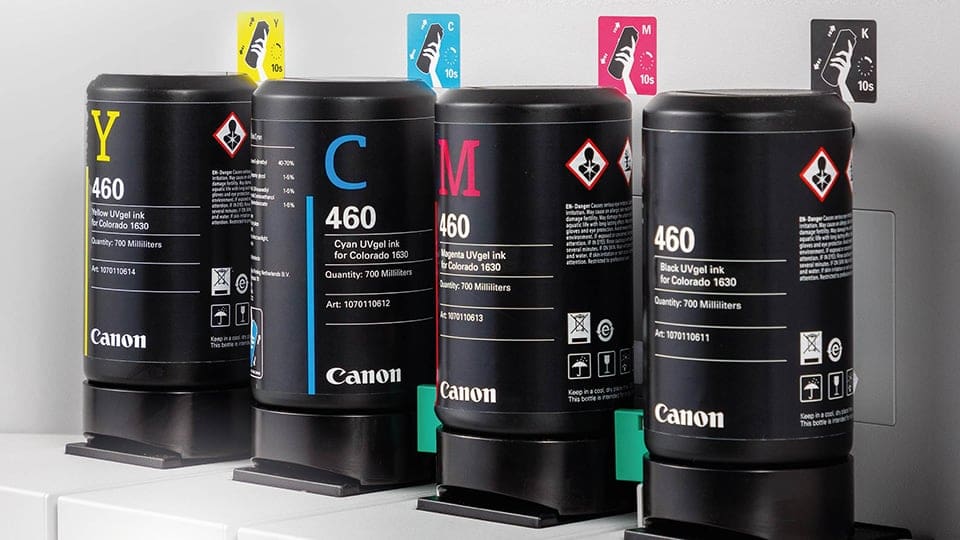
Turning to UVgel, it’s a gel-based ink that solidifies under UV light with the same principles as a UV ink - the prints dry instantly, eliminating smudging or sticking concerns.
The gel properties also reduce the amount of ink required to produce the same level of density and colour as other inks, while also creating a robust ink surface and micro-textured print for special surface effects.
UVgel is durable, resulting in little need for lamination, and UVgel prints are odourless making them suitable for indoor environments including for wallpapers and signage. The gel properties of UVgel ink also prevents ink coalescence and ensures more optimal dot control, resulting in precise and vibrant prints.
All in all, UVgel technology is a good all-rounder, delivering the benefits of other ink types without their downsides and providing the flexibility to print on a wider range of substrates.
A Holistic View of Other Key Features
After determining which ink will best suit the business’s needs, what other features should PSPs be looking to invest in to help them save money in the long run?
Sustainability is no longer just a ‘nice to have’, and is increasingly important within a print industry driven by government guidelines and customer values. By opting for modular devices, PSPs will be able to find a printer that will stand the test of time.
Choosing a roll-to-roll printer that’s upgradable, for example, with extra ink channels, with roll media options, and even to a higher speed version, will allow businesses to stay on top of the latest technology so they can deliver the right quality and the latest trends to keep up with customer demand.
Having a modular device that can be easily upgraded without being replaced will also prevent unnecessary waste, resulting in using fewer materials and saving considerably on costs.
Canon's UVgel inks are designed to dry quickly, so that the curing process does not limit print speed
Businesses can also be savvy and save on costs and floor space by comparing the productivity levels of printers and opting for a single printer that can deliver the same results as two or more alternative models.
With a robust, long-lasting and high-volume device, businesses could cut back to just one roll-to-roll printer, therefore saving not just on purchase price, but also overall running and maintenance costs.
It also pays in the longer term to ensure their technology is covered by the right warranty and servicing contracts. Selecting the right technology partner that can offer a good level of cover will help to ensure a printer remains operational with high uptime for years to come.
Another area that’s worth investing in is automation. A streamlined, efficient workflow and automated maintenance concept will not only create a fast production line but will also help to save on operator time and bring further cost savings helping to futureproof a business.
This is again where a modular, long-lasting printer that can be updated with the latest software to stay on top of those increasingly tight customer lead times, is vital. By investing in the right areas, businesses will be set up for the future with a sturdy roll-to-roll printer that should stand the test of time and provide years of use.
On a Roll with Roll-to-Roll
When choosing a roll-to-roll printer it’s important PSPs look at all the associated costs to prevent any hidden surprises that will push up monthly outgoings. Upfront costs, such as the price of the device and ink costs, can be misleading.
PSPs can start by looking at all the associated costs to see the complete picture and to understand the true investment cost they face and, by investing in the right technology and software, they will achieve a greater return on their investment.
By opting for a long-lasting device that will stand the test of time and can grow with a business, PSPs can also prevent unnecessary waste by having to needlessly replace their roll-to-roll printer prematurely.
With a career spanning many facets of sign-making, Signmode has taken David Mearns back to where it all started with no regrets. Ahead of Mearns’ return to The Sign Show, Sam Roberts speaks to this traditional signwriter
Following the success of the FESPA Next Generation initiative, we hear from Molly Jackson, head of content and marketing at FESPA UK, who gives her perspective on entering the industry, standing out to employers, and embracing the team you work with
In this Company Spotlight, we speak to Andrew Ballington-James, managing director of Just AJD, about the company’s quarter-century history and how it maximises its output with a small but experienced core team
Watch our latest video of the week
SignLink gives you the latest video coverage of companies, people, and events from within the signage, graphics, and wide-format print industries.