Two of the oldest and most respected crafts within the signage industry, Rob Fletcher takes a look at etching and engraving, speaking with suppliers and manufacturers about how these timeless techniques continue to evolve
Rob Fletcher
November 3, 2025
When speaking about etching and engraving, minds are often drawn to images of old-style public signs swaying in the wind outside historic drinking establishments, or even wooden wayfinding signage directing walkers during their weekend jaunt across the English countryside.
While it is true that etching and engraving are among the most historic crafts in the signage industry, they remain a key part of the modern market, with the technology having evolved over time and now allowing sign-makers to take on all manner of work, without the need to produce work by hand.
With this in mind, SignLink recently caught up with several specialist companies across both the etching and engraving markets to learn more about the latest developments in this line of work and how they are responding to the changing demands of the modern customer.
Higher Quality
One specialist company within this sector is Brunel Engraving Company, which offers both etching and engraving to customers. Technical director, Phil Wright says the business invests in the latest engraving and etching technology to deliver sharper detail, faster turnaround, and a wider choice of finishes.
“Upgrading our machinery means higher quality, more sustainable processes, and innovative solutions that keep us and our customers ahead of the competition,” Wright says, adding: “Sign-makers should look for engraving and etching solutions that combine precision, durability, versatility, speed, and sustainability all backed by modern technology and expert craftsmanship.
Upgrading our machinery means higher quality, more sustainable processes, and innovative solutions that keep us and our customers ahead of the competition
“At Brunel Engraving, our most popular services reflect what our customers value most: precision, quality, and style. Our industrial engraving delivers durable control panels, machine plates, and labels built to exacting standards, while our nameplates and plaques remain a timeless choice for businesses, homes, and memorials.
“We craft office and hospitality signage that makes a lasting impression, from professional door plates to elegant and functional table numbers and QR code markers. With our investment in the latest laser and etching technology, we provide sharp detail and versatile finishes across a wide range of materials.”
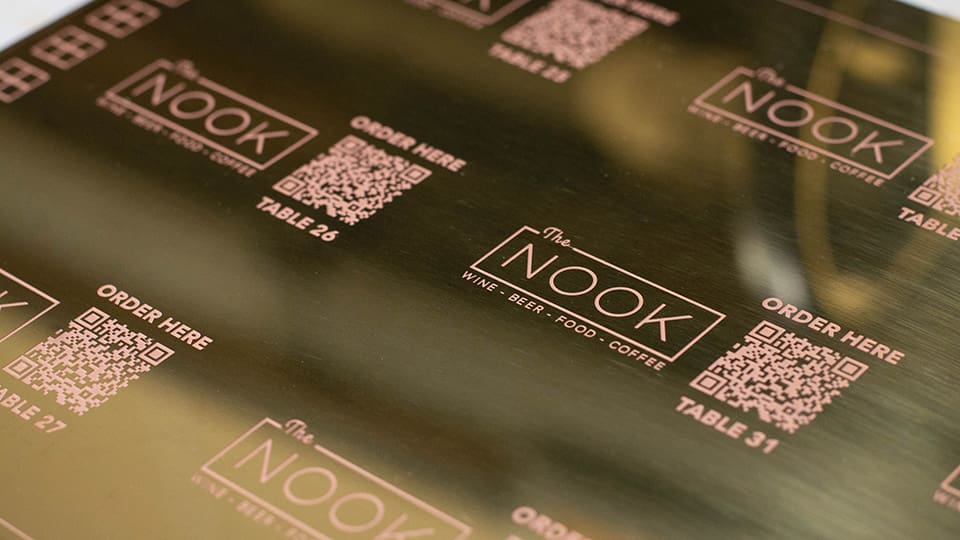
So, what applications are proving popular with Brunel Engraving customers? Wright says QR codes remain a hot area, whether this is for the local pub, a museum, or airport, these are used across a range of environments with great success. With this in mind, Brunel has taken on new equipment and software to provide materials and designs to suit every need.
Brunel Engineering Company says QR codes are still proving popular with customers
Wright also offers up an alternative to sign-makers investing in their own equipment. He says there is the option for sign companies to work directly in partnership with Brunel, allowing them to offer engraving and etching to their customers, safe in the knowledge that the work will be carried out by experts.
“Sign-makers choose Brunel because we deliver precision, durability, and reliability,” Wright says, continuing: “With decades of expertise and the latest engraving technology, we provide high-quality results across a wide range of materials, always on time. Think of us as an extension of your business, a trusted partner that helps you deliver signage your customers can count on.”
Maximise Your Machinery
Considering the technical options available to signage companies, Trotec Laser has a range of solutions within its portfolio. Sales director, Bryan Jater says that as technology constantly evolves, to ensure your business is receiving the benefits of this, it is important to at least look at what the latest models of machine can do.
“It’s often hard to find the time to step back and look at production processes and, of course, the old ‘if it isn’t broke, don’t fix it’ adage is still relevant to many customers,” Jater says, continuing: “However, keeping up to date with what is available cannot be a bad thing, even if it may not be important to your business right this minute.”
For those on the lookout for new machines within this area, Jater offers some word of expert guidance as to what they should be considering. Firstly, he says that how well a machine will integrate into a business is as important as the device itself.
It is very easy to look at the specification sheet of machines and compare the headline statistics, but what is really important is how you want to use a machine
“It is very easy to look at the specification sheet of machines and compare the headline statistics, but what is really important is how you want to use a machine,” Jater advises, adding: “How will it interact with my other production processes? Is there any webshop compatibility? What management tools are available? How will it handle my files/variable data? What management tools are available?
“Of course, support is always important. Once you own a machine, it is taking up valuable space in the production area, so it needs to be running and well supported by the supplier.”
Jater continues: “In the sign market, the majority of lasers are mainly used as a cutting tool for acrylic. With the benefit of cutting material which already has an adhesive backing, I am sure this trend will continue, but we see many customers branch off to provide industrial labels, ID badges, gaskets, and personalised gifts. Once you have a laser, then the options for expanding into different markets are endless.”
Trotec offers a range of laser engraving solutions to the market
So, what does Jater recommend from the Trotec range of solutions? The manufacturer has recently launched the Speedy 100 Cross, the first industrial grade diode laser on the market, which Jater says fits nicely in the metal marking world.
“Historically, most metal marking lasers are galvo style machines, so they have a very small marking field but very high-speed marking,” he says, continuing: “The Speedy 100 Cross has a 609mm x 305mm marking area and much lower price tag, so has proved very popular since its launch a few months ago.” For further insight into metallic signage, see page 51 for a dedicated feature on this market.
Accuracy and Rigidity
Another company in this segment is LKH Tools, which recently showcased its new solutions to visitors at the first-ever edition of The Sign Show in September. Liam Hodson, tooling and machine consultant at LKH Tools, explains engraving fine details will always require good machine accuracy and rigidity, and therefore ensuring your equipment is up to scratch should be of paramount importance to signage companies operating in this market.
“Machines which are worn will not only give poor results but also shorten the tool life,” Hodson explains, continuing: “Upgrading and maintaining the machine is just as important as the correct tool choice.
“The harder the material is, the more rigid the machine needs to be. Vibration or excessive machine movement can damage the cutting edge and produce poor results. Attention should be paid to the correct settings and ensuring the correct engraving tool geometry is chosen. Engraving laminates such as Rowmark are of course much easier to engrave successfully than hardened steel for example and will require a machine suitable for the work along with the correct tool.”
The harder the material is, the more rigid the machine needs to be
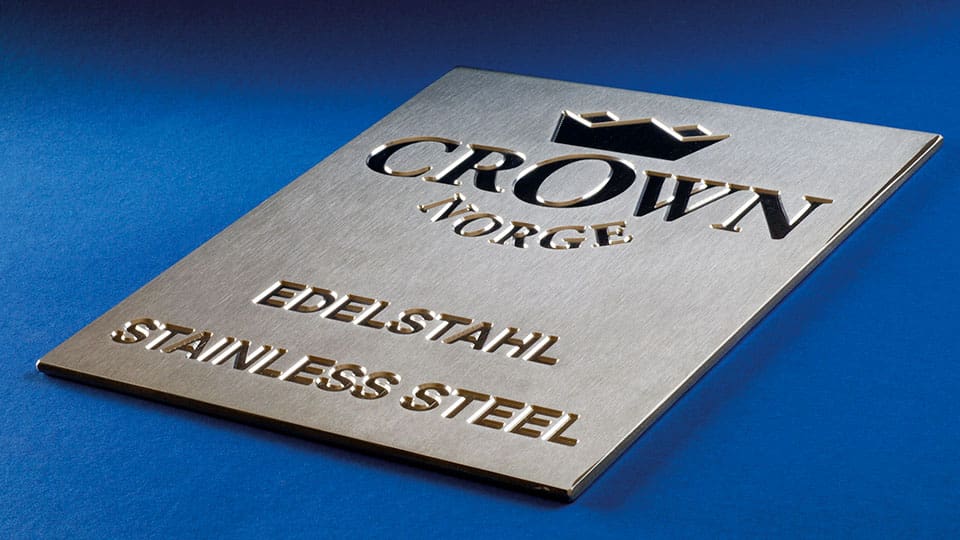
Hodson goes on to say how special coatings on the tool will also reduce heat and assist with a clean cut in metals. With this, he draws attention to engraving tools from Crown Norge, which have a super thin coating – only 0.5 micron thick – and will assist with extending the tool life in hard materials.
Hodson expands: “These should be used in conjunction with coolant or lubricant especially on aluminium and stainless steel to ensure any heat is dissipated during the cutting process. The combination of the cutting angle, tip angle, and tip relief angle all play a crucial role in obtaining the best finish and tool life.
“Crown Norge engraving tools have been developed over many years and are used in a variety of materials on many different machine types, from large heavy industrial engraving machines to lightweight desktop systems. This could be producing a stamp for The Royal Mint, an engraved plaque on the side of building, or a technical sign for oil rig applications.”
Crown Norge engraving tools are used in a variety of materials across different machine types
On the subject of application type, Hodson opens up on the type of demand that LKH Tools has been seeing for its solutions in recent months. He says customers have been making use of its larger V-Tools for deeper engraving and carving of thicker materials. This, he says, could be in natural woods or plastics for larger carving effects. In addition, LKH Tools has witnessed more customers using its Micro Graver range for brass, aluminium, and composite materials for labelling or product identification purposes.
As for future development within the engraving sector, Hodson says while engraving tool geometry has not really changed, coating technology has moved on quite some way from the gold-coloured TiN (Titanium Nitride) coating that was added to engraving tools several decades ago “Crown Norge changed from TiN coating more than 20 years ago after a new development in coating technology and superseding the TiN coating,” he says, concluding: “This was a huge improvement which gave a much better surface finish and extended the tool life further.”
Protect and Serve
As for other advice for sign-makers working in this area, the aptly named National Engravers recently published some handy hints and tips on protecting engraved signs from UV damage.
“Whether installed outdoors on a building wall or next to equipment in a light-filled factory, signs that get constant sunlight often experience visible wear,” National Engravers says, adding: “The lettering may start to fade, colours can look washed out, and over time the material itself may weaken or crack.
“This kind of damage doesn’t just affect how the sign looks – it can make information harder to read. That’s a problem when the sign carries important instructions, safety warnings, or labels that keep things running smoothly.”
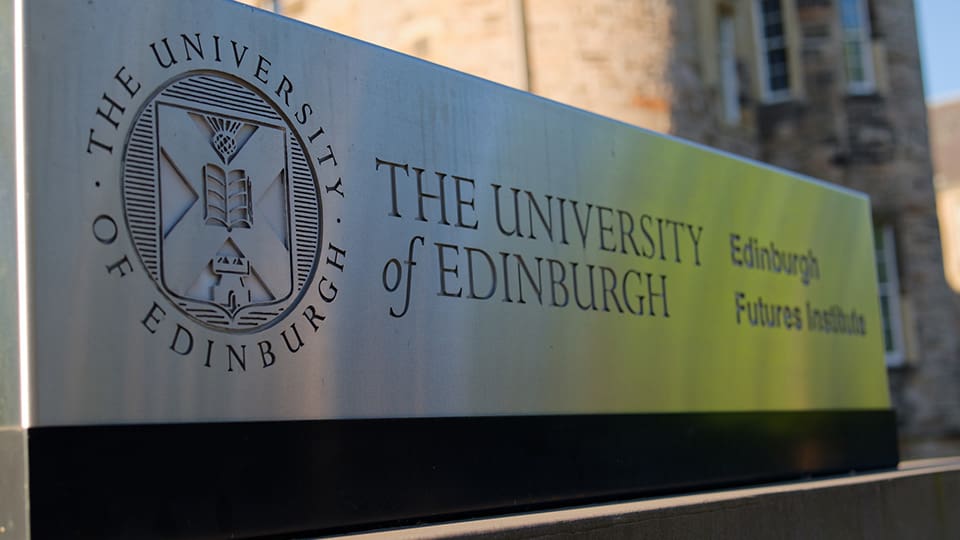
Many businesses and associations have seen the desire for engraved metallic signage rise in the past few years
So, how can you avoid this? National Engravers offers five steps that could avoid the need for a full replacement. First up, work with high- quality UV-resistant materials that are designed to hold their colour and integrity even under frequent sun exposure, and avoid options such as anodised aluminium, UV-stable plastics, and certain treated metals.
Next, applying a clear layer on top of the sign, such as varnish, laminate, or a UV-filtering coat, can help reduce sunlight’s impact, almost acting like a barrier to limit how much of the harmful rays actually reach the engraved surface. On top of this is a recommendation to carry out regular inspections and maintenance of signage to stop issues such as yellowing and surface cracks from worsening.
Factoid: Etching uses chemicals, lasers, or abrasive blasting to remove surface layers, while engraving uses a cutting tool or laser to carve into the material
National Engravers also says installing signs under eaves, next to shaded areas, or using UV-resistant barriers nearby can protect them from full sun exposure, while simply shifting the sign just a metre or two having a marked improvement. Finally, consider professional restoration services, even to help save those signs that have already been damaged.
“Specialists in restoration can re-engrave worn plates, clean up faded graphics, or restore finishes with the right equipment,” National Engravers says, adding: “This can be particularly helpful for legacy assets or signage that’s part of a safety or information system.”
With the advice of several experts ringing in your ears, this should give you enough to go on not only in terms of investing in new equipment but how to ensure engraved, and indeed etched signs, are successful in the long run.
Working with other businesses can open doors to new markets, services, and expertise. Here, SignLink examines how building the right partnerships can strengthen day-to-day operations and long-term success.
What is the best approach and strategy for your business: investing in a
new management information system or upgrading your current setup?
Rob Fletcher speaks to a range of suppliers, and finds out more
Architectural wrapping is opening up new revenue opportunities for sign-makers, offering a cost-effective alternative to refurbishment and replacement. SignLink explores the rapid rise of this growing market
Watch our latest video of the week
SignLink gives you the latest video coverage of companies, people, and events from within the signage, graphics, and wide-format print industries.