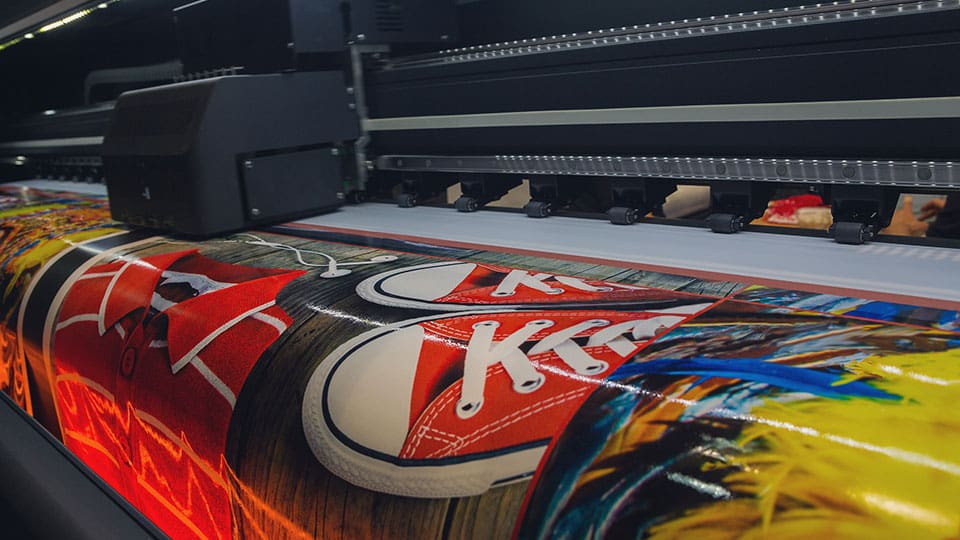
With attention to detail of paramount importance in large-format print, we take a closer look at colour management software and find out how updating your systems can help ensure accuracy in printed work
Rob Fletcher
July 31, 2024
Colour management software is a key tool in ensuring accurate output in wide-format print
When it comes to working with leading brands on major marketing campaigns, ensuring you are able to produce printed materials that match their colours is critical. For example, you cannot afford to print the wrong red on Coca-Cola posters or get the famous yellow of the McDonald’s arches wrong in a billboard campaign.
For this reason, sign-makers and those working in the large-format print market are advised to invest in quality colour management software. Working with such solutions helps cut out colour inaccuracies at an early stage and prevent issues further down the line.
Here, SignLink considers the importance of colour management software to the modern sign-maker and wide-format print business, looking at some of the latest solutions and how ensuring your systems are up to date can help to further improve the quality of larger printed applications.
Unpredictable Results
X-Rite specialises in colour management, measurement, and control, working with clients across both the commercial print and wide-format markets. Application specialist Liane May says it is a fact that the right colour has an essential influence on a purchasing decision, with the importance of getting this right being critical.
“This is one of the reasons why brand manufacturers attach great importance to accurate colour reproduction across the entire range of printed products,” May says adding: “The share of digital printing, especially inkjet printing, on a wide variety of materials – paper, cardboard, foils, plastics, textiles, backlighted materials, metal plates, and ceramics – is always increasing.
“From digitisation to editing to final printing, colour data passes through various system components, all of which capture and reproduce colour differently. Scanners, cameras, monitors, and printing technologies with their various printing materials all behave differently and unpredictably in terms of colour.”
As a starting point, May highlights ICC colour management, a standardised framework for communicating colour consistently and predictably throughout the entire reproduction workflow.
“It is not just an option but is the only way to get colour under control,” May explains, adding: “It enables to reproduce colour data as faithfully as possible on the one hand, but on the other hand to be able to communicate with clients at an early stage how the colour output will change on specific materials and what is achievable.”
X-Rite says the right colour has an essential influence on a purchasing decision
ICC profiles for input systems, monitors, and printers make it possible to see colour correctly on monitors, how digitised colour looks, and how colour will look on a desired printing process and material. Colour can then be edited in output preview mode, and errors can be detected and corrected in good time, reducing processing times and costs.
“By simply switching back and forth between ICC profiles, the colour output of various printing conditions or materials can be simulated on a monitor in just a few seconds,” May explains, continuing: “In addition, ICC profiles make it possible to stabilise the colour print output over time and keep it repeatable, as well as to create cost-effective proof prints in advance for a cost-intensive printing process.
Don’t Neglect Management
May goes on to say ICC printer profiles are also essential when integrating custom or spot colours, such as Pantone, into the colour management process.
In digital printing, spot colours cannot be printed with an additional ink. However, they can be translated into best-possible matching printing system-specific colour values using the ICC profiles, so that time-consuming manual bending of a spot colour for each specific printing condition is no longer necessary. “These advantages of colour consistency, predictability, error, time, and cost minimisation are crucial for production in sign-making and large-format printing,” May adds.
For this reason, May says updating colour management software and systems is critical to ensure the user benefits from the latest advancements and developments with this sort of technology.
“This ecosystem should be kept up to date and regularly maintained, otherwise the risk of losing colour control, consistency, and quality, as well as producing unexpected colour output is high and the cost of colour reproduction can increase,” May comments.
“High colour fidelity makes the difference for production partners, brand owners, as well as for customers who choose you. In addition, ISO production standards, ISO standards for measurement and colour assessment conditions and measurement technologies, and the quality of profiling software are constantly evolving in the graphic industry.”
Brand manufacturers attach great importance to accurate colour reproduction across the entire range of printed products
With this, May flags some of the latest offerings from X-Rite. The new i1Publish Pro 3 and i1Publish Pro 3 PLUS products offer most up-to-date measurement instruments including a profiling software in i1Profile, which enables users to profile all input devices such as a scanner, camera, monitors, and virtually any kind of printing system and material, across conventional and digital, with RGB, CMYK, or CMYK plus up to four additional colours.
i1Pro 3 features the classic 4.5mm aperture and is suitable for common paper and other smooth substrates. i1Pro 3 Plus has an 8mm aperture size plus an additional polarisation filter (M3), which May says is designed to measure on challenging substrates like textured papers, textiles, high-glossy substrates or inking systems like UV inks, foils, and rough materials such as ceramics.
“The large aperture improves the measurement data quality and the included Pol filter improves measurement data on substrates with specular highlights by filtering out the gloss, which helps to cover a larger dynamic range and better detail drawing especially in the dark areas of a colour profile,” May adds.
Future Developments
Given the recent advancements in this sector, we can look forward to more developments and new solutions to make life even easier for sign-makers and wide-format printers. This could be boosted further with more collaboration between developers and equipment manufacturers.
Screen Graphic Solutions took this a step further in April, adding Germany’s CGS ORIS to its own group of companies. CGS is primarily engaged in the development and sales of colour technology products, working on colour management and digital proofing solutions since its establishment in 1985.
Screen, then Dainippon Screen, began to build a business partnership with CGS in 1991 when the two companies cooperated on the development of colour technologies for scanner and recorder systems. Acquiring CGS takes this to the next level and could open doors to new advancements with colour management technologies.
The core message here for sign-makers and wide-format print businesses is to ensure their systems are up to date. Only by investing in and upgrading to the latest solutions in colour management can you take advantage of the latest advancements and enhancements, and produce higher quality work as a result.
With a career spanning many facets of sign-making, Signmode has taken David Mearns back to where it all started with no regrets. Ahead of Mearns’ return to The Sign Show, Sam Roberts speaks to this traditional signwriter
Following the success of the FESPA Next Generation initiative, we hear from Molly Jackson, head of content and marketing at FESPA UK, who gives her perspective on entering the industry, standing out to employers, and embracing the team you work with
In this Company Spotlight, we speak to Andrew Ballington-James, managing director of Just AJD, about the company’s quarter-century history and how it maximises its output with a small but experienced core team
Watch our latest video of the week
SignLink gives you the latest video coverage of companies, people, and events from within the signage, graphics, and wide-format print industries.