FESPA Global Print Expo has continued to show the ebbs and flows of the speciality print and signage industries as a range of printers, sign-makers, suppliers, and manufacturers all descended on Berlin to share in the latest products and solutions available on the market
David Osgar
June 16, 2025
For the past decade, FESPA Global Print Expo has taken place in either Germany or the Netherlands, showing the clear strength and power of speciality and wide-format print in central/Western Europe.
This year was no different, as FESPA returned to Berlin after previously hosting its vast exhibition at the city in 2018 and 2022. Previous years of the show have dealt with several global issues as well as clashes with other industry events which has meant FESPA has taking place at different times within the year.
One challenge at this year’s event was certainly the medley of bank holidays taking place across Europe which some said created a sense that “lots of people were in holiday mode”. Despite that, FESPA continued to fill many of its halls with visitors and business owners who all seemed to be attending the show with purpose and queries as opposed to window shopping.
While the combination of drupa and FESPA last year meant a range of different machines launched in 2024, this year still saw a strong presence from manufacturers, especially those who supply solutions for wide-format and textile printing.
Many manufacturers showcased and discussed themes such as near-shoring in response to global tariffs and sustainability, as well as creating solutions to cater to customers who are providing more services ever than before.
Many of the stands at FESPA showed the creative uses of print, as exhibitors have done before, however this year’s edition seem to focus far more on creating large and explorative environments, rather than overloading or simplifying stands too much.
Examples of this were Agfa, HP, Mimaki, STAHLS, Fujifilm, and swissQprint, all of which carefully laid out presses, materials, and software solutions for visitors to navigate. So, while this year’s show may not have had the momentum or headlines of previous shows, the atmosphere and volume of conversations taking place certainly made FESPA feel like the wide-format industry in particular was still in good stead. But what exactly were exhibitors showcasing at this year’s exhibition?
Going Big
One manufacturer which had perhaps the most printer debuts at the show was Agfa which showcased all its 2025 releases at the show.
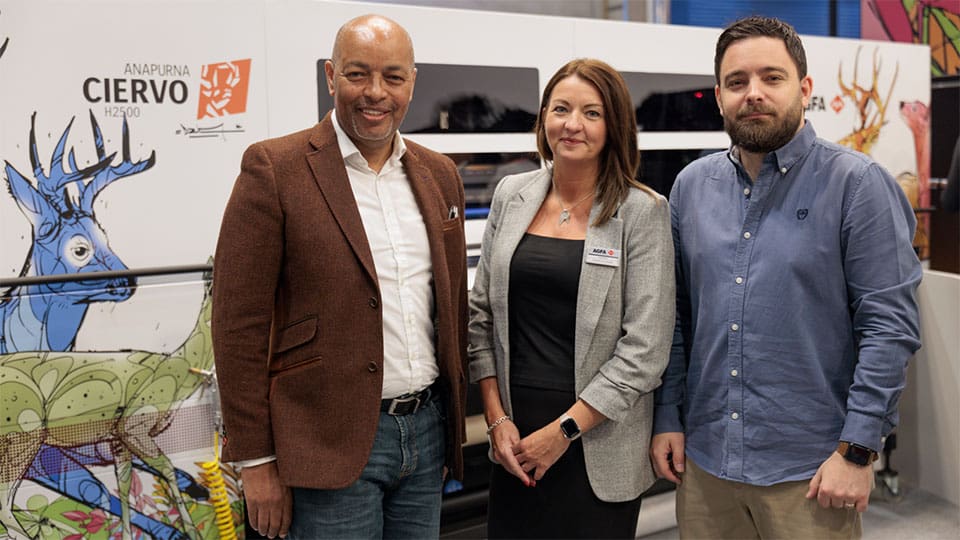
One of the standouts of the Agfa stand was its special edition Ciervo which marked 20 years of Anapurna inkjet printing technology. The printer featured a one-of-a-kind artistic design by Belgian street artist DZIA and was actually hand signed by the artist himself. Ten versions of this press were available on a first-come first-serve basis.
Digital Plus, were one of the first companies to purchase the limited edition Ciervo. [L to R] Owen Russell, director at Digital Plus; Emma Plant, Agfa sales manager (North) – Inkjet, UK; and David Brisk, sales director, Digital Plus
DZIA is well-known for his striking murals depicting wildlife in bold, geometric lines, making him a great fit for Agfa as it utilises its “beasts” theme into its range of printers. Speaking to SignLink at the show, Mike Horsten, senior press and PR manager for Agfa, said that the company has been revitalising its total line up in the last three years so that everything is revamped and improved, something which was evident on the stand at FESPA.
“What we offer today is a beast for every need, we try to give our partners what they need, where we talk to them about what they require in the next four to five years and how we can work together to make their plans work. This is an area in which I think we are very strong,” says Horsten.
At the stand the company showcased its latest launches including the Jet Tauro H3300 XUHS and Onset Panthera FB3216 as well as the Jet Bronco H3300 and the recently expanded Anapurn Ciervo range. The Ciervo range includes the recently released H3200 and the follow-up H2050 and H2500. Classed as “the smallest in the herd” the H2050 is a 2.05m model with a top speed of 133m2/h whereas the H2500 is considered the workhorse of the group as it can produce banners and coated textiles with speeds of up to 169m2/h.
The new Onset Panthera is made with quick speed, advanced LED curing, and smart automation all in mind. Meanwhile the new Tauro XUHS is made for versatility with award-winning quality and minimal maintenance in multi-shift operations.
FESPA 2025 is not just about new products for us, it’s about showcasing our technological ambition
Speaking about the Tauro’s ability to produce up to 1,280m2/h, Horsten said: “Your average customer may not know what to do with that speed, but there’s a lot of big companies which are happy to buy this machine (which we’ve sold a lot of on the booth) because they know that they can now use one machine instead of two.
“This then saves on operator cost, gives you the integrated robots, and allows everything to work in the customer's benefit. Our dedication to the customer can also be seen in the Tauro XUHS’s colour offering, which gives seven colours in order to achieve finer details, which was achieved after a request from one of our partners.”
Another manufacturer that showcased its wide range of solutions was Durst Group which exhibited under the motto “Made in Durst”. The manufacturer ensured that it covered the breadth of its digital printing and production technologies with an open stand focused on applications, live demonstrations, and customer interactions.
Products on the stand included the P5 500 TEX iSUB superwide-format solution, the P5 X flatbed printer, the LF430 GF textile printer, and the P5 350 HS D4, which is made for “high-intensity production environments.”
Speaking ahead of the show, Christoph Gamper, chief executive officer and co-owner of the Durst Group, said: “FESPA 2025 is not just about new products for us, it’s about showcasing our technological ambition.
“We are rethinking professional print production with the most reliable printing systems on the market, a connected software architecture, a clear focus on automation, true efficiency, and resource-saving processes. ‘Made in Durst’ stands for integrated solutions with responsibility: for our customers, their competitiveness, and our environment.”
New Markets
A big part of this year’s event, which was evident across multiple stands, was the focus on diversification, especially within spaces not typically considered in the past by wide-format printers and sign makers.
Fujifilm used the show to demonstrate the range of new technologies and solutions it has amassed over the last few years with the launch of its HS3000 inkjet press and the new Acuity Triton with AQUAFUZE ink technology.
AQUAFUZE combines the benefits of UV LED and water-based inkjet printing, which according to Fujifilm, offers strong adhesion to various media without a pre-coat primer of optimiser.
The HS3000 represents a unique look at the market as it is part of Fujifilm and Barberan’s continued partnership which has seen the release of the HS3000 and the HS6000 which have been developed for the “ultra-high production” end of the market. The two machines are meant to open up the possibilities of single pass inkjet to a broader audience, with the HS3000 being a smaller and lower investment option than the high-end HS6000.
Fujifilm’s wide-format division used FESPA to showcase its new HS3000 press which is made in collaboration with Barberan
Neither the HS3000 nor HS6000 are off-the-shelf products but can be configured in numerous ways depending on the needs of the interested business. The machines offer stack-to-stack printing with litho-style top feeing, manual feeding, or continuous bottom feeding all available.
The highlighting of the HS series as well as the Acuity Ultra Hybrid Pro and the new AQUAFUZE technology demonstrates Fujifilm and the industry’s commitment to catering several different markets with a range of different possibilities for corrugated, packaging, signage, commercial print, and textile applications.
This focus on diversification and different markets was also evident in the increased presence of manufacturers of finishing equipment such as Plockmatic, Zünd, and Kongsberg, all of which showed solutions for packaging and point-of-sale (POS).
A manufacturer which also focused on the bridge into packaging was Electronics For Imaging (EFI) which demonstrated a range of its hybrid, flatbed, and roll-to-roll printers on its stand. On the Smarthub section of FESPA, Kerry Sanders, vice president of market development at EFI, presented “The Power of Personalisation: Transforming Corrugated Packaging with Right-Sized, On-Demand Digital Printing”.
In a presentation to the media, EFI highlighted its single pass technology such as the EFI Nozomi 1400 range which has been used to great success by UK company – Caps Cases, a multi-site manufacturer of corrugated cardboard packaging.
EFI sees the EFI Nozomi as representing a “convergence” of packaging and sign and display solutions with LED, water-based, and digital inkjet systems made for the corrugated, display, and metal packaging sectors.
Also showcasing new solutions with its new Generation 5 models, swissQprint also focused on quality, applications, and potential new markets with its stand at FESPA. Speaking on the stand to Erskine Stewart, managing director of swissQprint UK, Stewart highlighted the global audience of FESPA as well as the many UK visitors that made their way to Berlin.
This has been the first time we have been able to show our Gen 5 platform to a larger audience which has been really exciting
“This has been the first time we have been able to show our Gen 5 platform to a larger audience which has been really exciting but also the many applications and benefits that swissQprint offer.”
Stewart also emphasised a lot of conversations around sustainability which swissQprint was able to answer with the energy efficiency of its presses. More standouts of the swissQprint stand were the creative uses of swissQprint technology such as the company’s unique neon room and its haptic and visual effects including colour shifts and pyramid shapes.
The company’s commitment to innovation was rewarded in Berlin as it took home two EDP Awards which recognised the company’s 5th generation Nyala flatbed printer as well as its pyramid printing technique.
Celebrations in the Industry
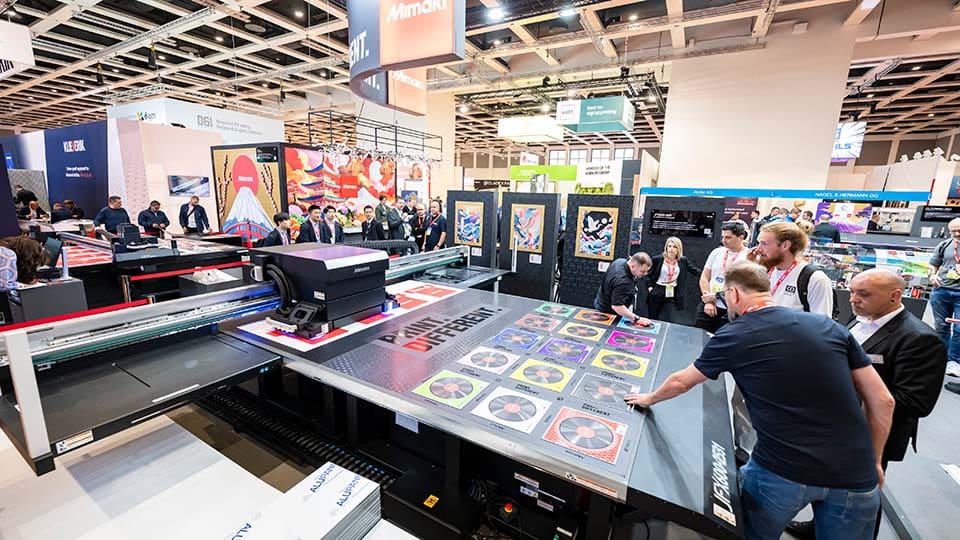
Elsewhere at Messe Berlin, Mimaki Europe was celebrating 50 years of Mimaki with a stand that celebrated the company’s Japanese roots. The company also celebrated Arjen Evertse’s promotion to director sales along with his appointment to the Mimaki Europe Board of Directors, making him the first ever locally appointed member of the board.
Speaking of the appointment, Evertse says: “This new role coincides with an exciting phase of Mimaki’s evolution, where the regional Mimaki businesses will be even more aligned with the global sales strategy and implement new team structures to support changing market demands.
“After over 20 years with Mimaki, I have witnessed the business lead and inspire change across the industries we serve. Now, in our 50th year, it’s the ideal time to look to the future and adapt our strategy to meet the new demands of the market – many of which we have been instrumental in creating. Our vision now is to support the needs of a more diverse, flexible print industry.”
Solutions on the Mimaki stand included the new Mimaki UJV300DTF-75, the JV200-160, the Tx330-1800, and Mimaki’s recently launched ELH and ELS inks.
Mimaki had an impactful stand at the front of Hall 1.2 which celebrated the company’s Japanese heritage
The JV200-160 uses eco-solvent inks and is said to offer reliable signage production and “outstanding” print quality. The Tx330-1800, which is equipped for the textile and apparel markets, is equipped with a dual ink set capability in order to switch between textile pigment inks and dye sublimation inks.
On the second night of FESPA, Mimaki held a 50th anniversary celebration at Spindler & Klatt riverside venue in Berlin, where Mimaki staff, resellers, and the media were invited to celebrate the company’s milestone as well as witness a selection of awards handed out to the company’s most successful partners.
Mimaki Europe says it has now implemented a new strategy that enables further “horizontal growth” with the opening up of new markets for customers, as well as “vertical growth” for entry-level and industrial scale print production.
The manufacturer also used the event to talk about its new ‘print different’ ethos which has been created in order to encapsulate Mimaki’s legacy of new technologies, but also its commitment to driving creativity, differentiation, and sustainability.
Speaking on the stand, general manager of marketing and product management at Mimaki Europe, Danna Drion, said: “When I look at back our fifty years as a company I think we’ve really grown into a global player. Originally we were a Japanese technology company, but in the last 25 years we have restructured to reach people around the world with our innovations, offering something new and different for everyone.
“Just as important now is our commitment to sustainability and social responsibility which we are showing in our products and the way we work. When I first joined the company, Mimaki really had the urge to move forward and that is reflected in our global sales alignment, business development departments, and e-learning programmes.”
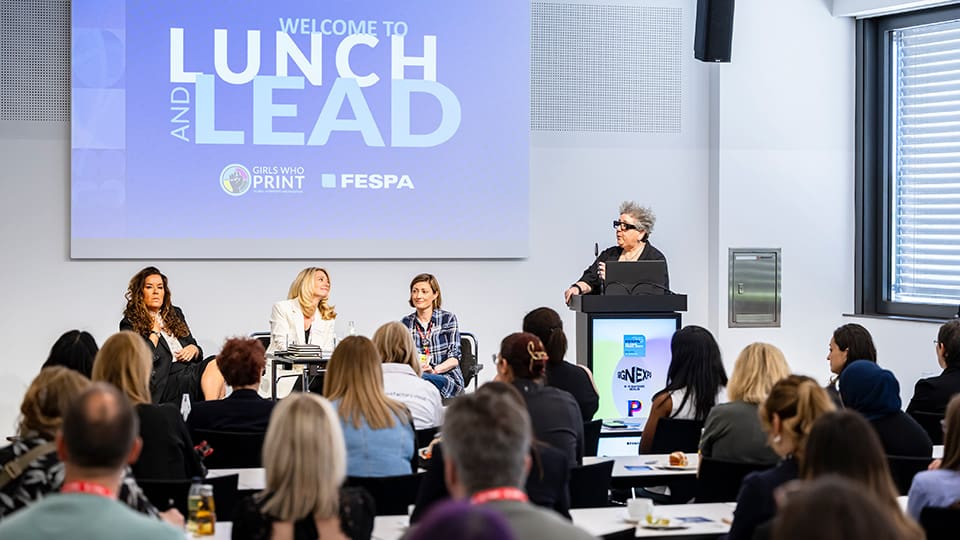
Drion recently gave herself the personal commitment to ensure she drove diversity within the industry and in Mimaki. Two big initiatives that were highlighted at this year’s FESPA was the FESPA Foundation and Girls Who Print, the latter of which Drion is a board member of, for the EMEA region.
Another company that used FESPA to highlight success within the print and signage industry was Kavalan, a producer of PVC-free materials for indoor and outdoor use. On the Wednesday of FESPA, Kavalan hosted its Green Leader Awards in a Champagne reception on its stand.
The winners were chosen by industry experts: Marcus Timson, co-founder of FuturePrint; Nick Widdowson, founder of ShopperFIRST; and Steve Lister, a global sustainability consultant named one of RETHINK Retail’s Top Retail Experts 2025. Winners of awards were Embrace Building Wraps, Blue Rhine, Groupe Mediagraphic, and CMYUK which won the Kavalan Champion award for its ongoing advocacy for PVC-free alternatives.
Nova Abbott, head of marketing at Kavalan, says: “With the Kavalan brand launching at FESPA in 2017, it seemed fitting that we use the event as an opportunity to champion and recognise the incredible applications and projects brought to life using Kavalan’s PVC-free material. The awards are a great opportunity to highlight the fantastic projects being produced with Kavalan materials and to celebrate the strong partnerships we have built with our valuable distributors. Congratulations to all the winners!”
Wrapping Up
From the various interactive experiences, the Personalisation Experience, World Wrap Masters, and the SmartHub, FESPA provided plenty of innovations and networking opportunities for visitors.
Interaction and collaboration continued to be prevalent as many manufacturers and exhibitors could be seen amongst various stands. Manufacturers like Canon highlighted collaborations with software companies like OneVision as well as businesses like Fotoba, Neolt, and Lamina, showcasing the increased prevalence of textile and packaging in wide-format print.
Similarly, companies like Inkcups and Roland worked with Antigro Designer to make fun personalised products like latte mugs and golf balls, which all added to the fun and shareable experiences of FESPA. Antigro also returned with its popular sticker wall which the company hosted at drupa 2024. The installation allowed visitors to design and print stickers of themselves to place on the “FESPAVERSE” wall which was run in partnership with FESPA.
[On stage L to R] Danna Drion, Mimaki; Jennifer Kolloczek, Canon; Nicole Spencer; RMC Digital Print; and Deborah Corn, who hosted the Girls Who Print Lunch and Lead at FESPA 2025
While positioning appeared to be successful last year, European Sign Expo seemed to be the area of the exhibition which struggled in regard to traffic as a lot of attention was focused towards Halls 27 and 25 to the left of the Messe and then the surrounding areas including 1.2 and 2.2 at the front of the show. The offering of a large signage exhibition in Europe seems to continue to be a tough nut to crack as the majority of exhibitors are region specific, or offering such a variety of solutions, it’s hard to see a clear trend amongst the products.
Despite the challenges a trade exhibition like this can face, FESPA continued to show the strength of the industry in Europe, and its prevalence as a meeting place for a variety of manufacturers and wide-format printers.
Deborah Corn, a well-known face in the print industry and executive director of Girls Who Print, was visiting the show for the first time along with Kelly Mallozzi, vice president and program director of Girls Who Print and a sales coach and consultant for the industry.
Corn and Mallozzi’s reaction and experience with the show was very interesting as it not only showed the difference in the European and US markets but also demonstrated how FESPA comes across to new international visitors, something that happens on a daily basis throughout the four-day show.
Speaking to SignLink at the show, Mallozzi said: “It’s an incredibly engaged community where there is real conversations happening and real urgent decisions being made, which is really exciting.
“The biggest takeaway for me is that issues and experiences are universal, such as workforce development, something that we are struggling with in both the states and here in Europe.”
Corn adds: “There’s definitely a way of operating you get used to in the states, and I don’t want to say there’s no pressure on the stands here, but I think the pressure is more on the business owners to map out their day so they can see everything they want to see, organise appointments, and answer questions.”
For Corn and Mallozzi, sustainability and the community atmosphere were two of the biggest takeaways from FESPA, and considering the collaborations, networking, and innovation that has been discussed in this recap, it’s hard to disagree.
For now, it’s time for everyone to reset and follow up all the meetings, sales, and opportunities that were made at the show and start planning for FESPA 2026 in Barcelona.
Working with other businesses can open doors to new markets, services, and expertise. Here, SignLink examines how building the right partnerships can strengthen day-to-day operations and long-term success.
What is the best approach and strategy for your business: investing in a
new management information system or upgrading your current setup?
Rob Fletcher speaks to a range of suppliers, and finds out more
Architectural wrapping is opening up new revenue opportunities for sign-makers, offering a cost-effective alternative to refurbishment and replacement. SignLink explores the rapid rise of this growing market
Watch our latest video of the week
SignLink gives you the latest video coverage of companies, people, and events from within the signage, graphics, and wide-format print industries.