The Power of Partnerships in Sign-Making
Working with other businesses can open doors to new markets, services, and expertise. Here, SignLink examines how building the right partnerships can strengthen day-to-day operations and long-term success.

We take a look at the ‘silent partner’ of the modern print and signage provider, discovering how integrated workflow software can reduce pain points, and increase efficiencies for businesses

In the modern signage industry, the digital thread connecting a customer’s initial inquiry to the final installation can define a shop’s success. It’s no longer just about how fast your printer can run, but how little time your jobs spend sitting idle between stations.
This is where robust workflow platforms can become the silent engine room of the industry. By centralising everything from substrate stock levels to live installation calendars, these systems aim to eliminate those ‘where is that file?’ moments that can eat into both margins and sanity.
In this feature, we’re looking at how some of the latest workflow solutions on the market aim to streamline processes and eliminate costly bottlenecks, and how a robust, invisible workflow infrastructure can be a critical tool in a sign-maker’s arsenal.
Clarity Software offers a comprehensive MIS solution for the print and signage market, designed to combine a range of essential functions into a single, robust workflow. Explaining the company’s core offerings, Samantha Yarnall, sales and marketing director at Clarity, says: “We provide both our established on-premises solution, Clarity Pro, and our rapidly evolving cloud-based platform, Clarity Go.
“These solutions encompass the entire workflow, from initial customer relationship management (CRM) and swift, accurate quoting to production scheduling and final invoicing. This dual method enables us to cater to the specific needs of the entire market, from small print providers to large-scale signage manufacturers with complex production settings.”
In Yarnall’s opinion, signage professionals tend to prioritise speed and financial accuracy in their workflows, as they operate in a competitive market with narrow margins. She explains: “Customers value the ability to automate admin-heavy processes, such as generating complex quotes in seconds using template-based workflows, which prevents them from losing bids due to delays.”
Equally important, in her view, is the assurance of profit offered by automatic pricing features. By standardising calculations for labour, materials, and wastage, businesses can safeguard their margins and avoid the sometimes-costly guesswork linked to manual estimating.
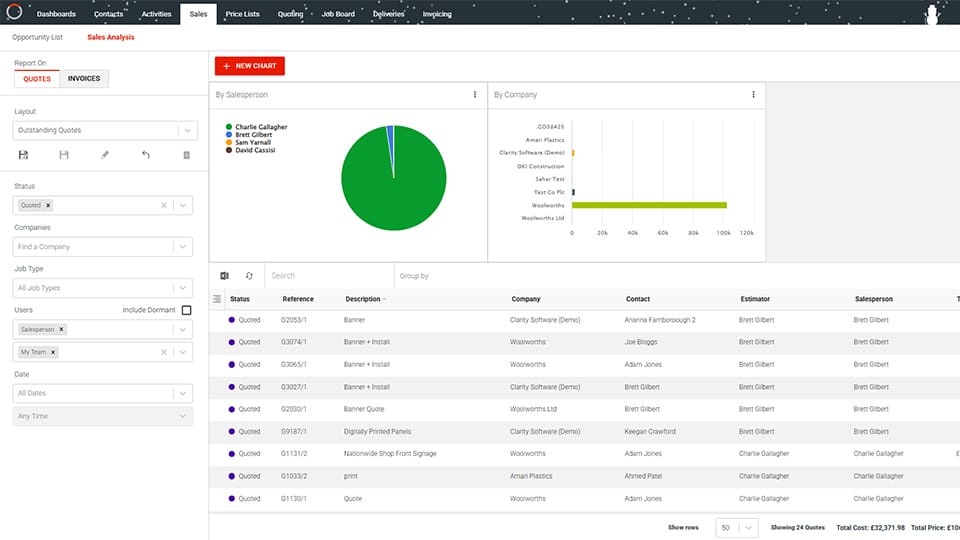
Yarnall asserts that Clarity customers have seen “transformative results” with workflow solutions such as Clarity Go, giving the example of Pembrokeshire-based signage company, Signspeed. As she comments: “Clarity Go has helped Signspeed cut non-conformances by 50% through clearer, process-driven workflows.
“Co-owner, Sam Morgan, says that the introduction of a live Jobs Board has provided the team with comprehensive visibility into the entire production process, significantly reducing the need for manual intervention and error correction.”
Clarity’s focus on cloud-based tech comes from a desire to create solutions that are fully integrated, allowing designers, production staff, and sales teams to access the same centralised records. This unity and transparency can prevent what Yarnall calls “the silo effect where departments work in isolation,” ensuring that the finished product aligns with the client's vision.
It can also empower staff to deliver better customer service, as anyone can respond to a client query immediately without needing to sift through emails or physical files. As Yarnall puts it: “Effective collaboration depends on a single source of truth, which is why integrating MIS and CRM into one platform is so beneficial.”
Clarity has continued driving significant investment into its cloud-based Clarity Go product, in order to target what it sees as the forefront of future workflow technology. In Yarnall’s view, as projects become more complex, systems must support remote access, and integrate seamlessly with other business tools, from accounting packages to web-to-print platforms.
Our focus is on delivering a system that supports complex, multi-departmental production environments
“Following our acquisition by Inktavo in 2024,” she explains, “we are accelerating our product roadmap to ensure we can handle these evolving demands. Our focus is on delivering a system that supports complex, multi-departmental production environments while offering the agility that modern, hybrid teams require.”
Another company putting particular focus on the benefits of integrated workflows is print press manufacturer, DPI Laboratory. While its core offering is its range of Catalyst UV printers, the company has since launched KFLOW, a workflow software designed to give users full control over their data and processes while working with standard equipment.
Lon Riley, founder and chief executive officer of DPI Laboratory, says: “I have spent more than 30 years in UV printing, engineering, and high-volume production, mostly in environments where the printer has to run all day and the shop cannot afford surprises. I’m an engineer by nature, so I obsess over reliability, repeatability, and making the process easier for the people running the equipment.
“My focus at DPI is to make sure the hardware, software, and support work as one system, so customers can produce sellable output day after day with confidence”
DPI designs its hardware to support a range of workflow automation, with a focus on staying predictable and operating as part of a production line rather than a standalone machine. In Riley’s words: “That is where the money shows up.” Explaining the impact of that focus, he adds: “Every extra touch, every reprint, and every minute of downtime eats margin. When the printer behaves the same way all day, systems like KFLOW can standardise setup and routing, cut operator guesswork, reduce waste, and keep throughput steady so profit stays where it should.”
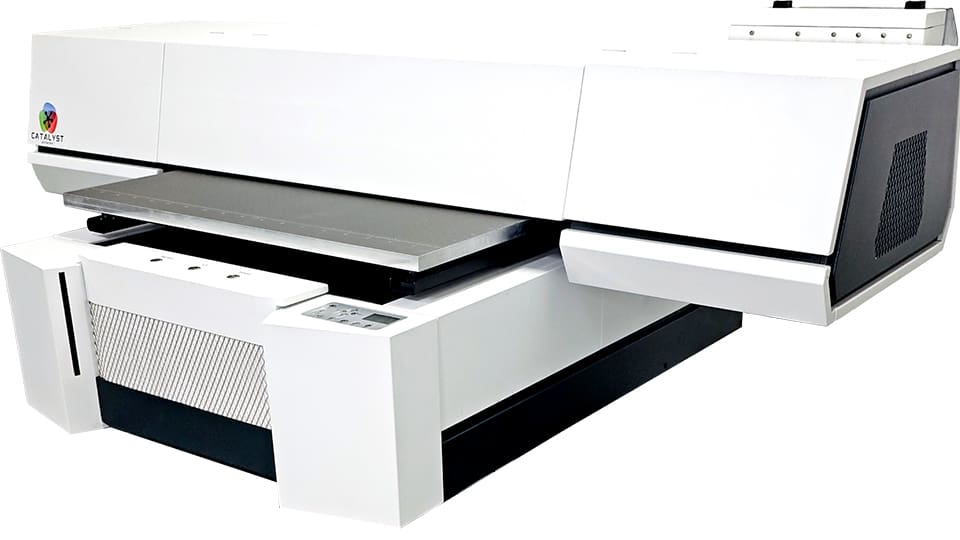
KFLOW is designed to be adaptable rather than prescriptive, keeping in mind that every shop has a different mix of products, materials, and equipment. The software uses configurable building blocks like presets, templates, and job paths with the aim of matching what users actually sell. As Riley says: “The goal is to connect the full journey from order intake to shipment, whether that order comes from ecommerce, email, or a sales rep, and then guide the job through print, finishing, and QC without constant attention.”
The workflow software can run on standard on-premises hardware, integrate with the tools a shop already uses, and support different print and embellishment equipment as needs change. “When the workflow is modular, you can add a new product line or a new market without rebuilding your process from scratch,” Riley comments.
Factoid: According to PRNTING United Alliance's 'Production Digital Printing 2025' report, nearly 80% of print providers have automated at least part of their workflows
Many users may be looking for a ‘one stop shop’ workflow solution that encompasses all possible operations. However, Riley believes that this is not always helpful.
“A one stop shop can sound convenient,” he says, “but it often turns into a rigid system that is hard to train and harder to change. Most shops already have tools they trust like design software, MIS, and shipping. What they need is a workflow layer that connects those tools and removes friction. The best systems do the critical pieces well and integrate cleanly, instead of trying to replace everything.”
We will see more financial visibility built into production, so teams can track the real drivers of profit
Riley believes that over the next few years, workflow innovation will be less about chasing speed, and more about protecting margins. Explaining his vision for the future of workflow technology, he says: “First, we will see predictive systems that catch more problems before a job becomes scrap and before a small issue turns into a long downtime day. Second, we will see more template driven automation that makes short runs and mixed job queues feel easy instead of chaotic. Finally, we will see more financial visibility built into production, so teams can track the real drivers of profit, not just whether the printer is running.”

DPI Labs has more updates and solutions planned for 2026, both in terms of hardware and software, though as of time of writing these are yet to be formerly announced. Riley hints that the company is “planning to debut something new at an upcoming trade show in February.” While he cannot share the details yet, he does disclose that the new solution is “focused on reducing steps, improving consistency, and protecting margin.” Time will tell.
Workflow solutions from companies like Clarity and DPI can help to provide the oversight needed to allow printers and sign-makers to move beyond reactive ‘fire-fighting’. By establishing a consistent flow of information from the first quote through to the final install, these platforms help identify hidden logjams that eat into profits, ensuring your team’s core technical expertise is spent on their core craft.
In 2026, many would argue that the businesses maintaining the healthiest margins are those that have traded in the ‘controlled chaos’ of yesteryear for a structured digital framework, ensuring that production remains predictable even when the job queue gets full.