The Power of Partnerships in Sign-Making
Working with other businesses can open doors to new markets, services, and expertise. Here, SignLink examines how building the right partnerships can strengthen day-to-day operations and long-term success.

As we enter 2026, Jonathan Pert looks ‘beyond the hype’ at the still-growing role of AI in signage, speaking to a range of professionals to understand AI’s recent developments, and how it affects sign-makers

As we enter 2026, artificial intelligence (AI) has permeated almost every corner of the signage industry – from automated job request scanners dealing with customer requests, AI-enhanced programmes aiding design teams, to the increasingly intelligent hardware in our print shops.
During my recent chat on the Print Island podcast, I highlighted that while the technology is more prevalent than ever, there is still a gap in knowledge and adoption for many of the signage professionals on the ground. The collective patience for AI as a ‘buzzword’ might also be wearing thin. We’ve moved past the initial shock and awe, and many are now looking critically at how these tools can help in everyday operations, without losing the human touch which is so important to signage output.
In this feature, we delve deeper into the tangible reality behind the hype, exploring the latest AI software and hardware technology, as well as speaking to seasoned signage professionals who are already embedding these tools into their daily operations. From this analysis, we aim to offer advice on where AI can provide a genuine competitive edge in 2026.
While there is a lot of AI-enhanced hardware and software on the market, it is first important to explore how signage and print providers are using AI technology in their daily operations.
Scottish wide-format printer, Graphic Warehouse, utilises AI in one form another across its entire enterprise. As Robert McCombe, operations director at Graphic Warehouse, explains: “Currently all our directors use ChatGPT for general day to day data analysis, email drafting, and problem workflowing. It's a great easy access way of using AI (specifically LLMs) to do very quick analysis of data. Personally, I've also found it a great way of just adding a bit of formality to my emails.”
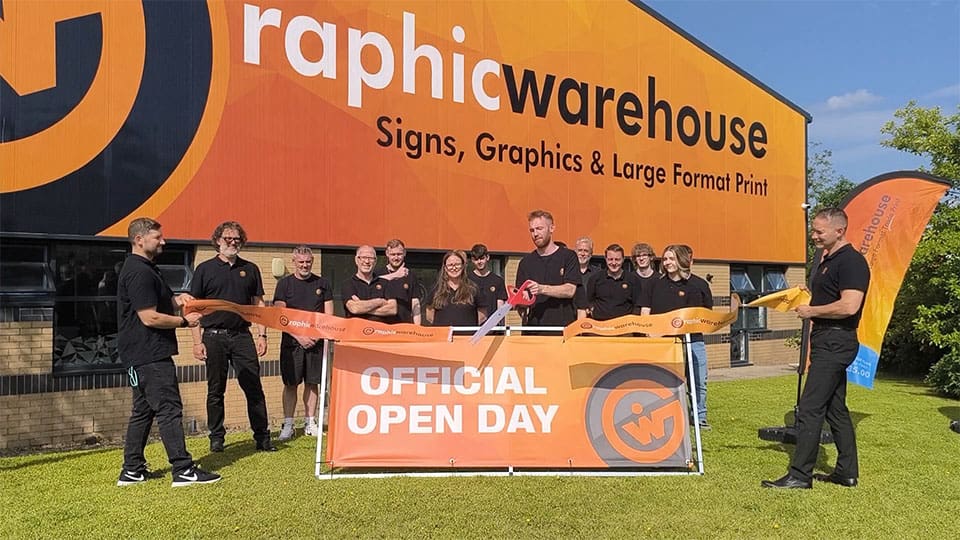
Operationally, Graphic Warehouse uses AI agents in its in-house chat platform, which is designed to allow for quick interaction with the company’s CRM software, updating jobs, and tracking waste. In McCombe’s words: “Traditionally you'd have to go log into the specific system, navigate to what you want, and update the system. Now it's as simple as ‘Hey Graphy, track wastage for job ABC1234 – got scuffed when getting laminated.’ The AI agent automatically knows it's wastage, what system to talk to, how to log it, and then gives you a helpful message back if you've been a bit vague.”
According to McCombe, the company has seen wastage tracking improve by 400% since implementing the AI agent. However, while this demonstrates the benefits of AI tools, he warns users to be mindful about how they use them if they are less bespoke.
“ChatGPT was straight out of the box, dump your data in, and start asking questions,” he explains. “You have to be a bit specific with what you are looking for and watch out for it hallucinating – AI chatbots tend to make things up when things get complicated.
“However, once you identify what you have to look out for and how to create prompts you are absolutely flying. I would say it takes about a week or two to generally get fairly good at using them.”
The company’s in-house AI agents took more time to implement by comparison. McCombe compares it to building a piece of software for a specific solution, in that you still have to scope out the exact issue and how you want that issue solved. “The beauty with AI agent development is it's a bit like the old Wild West of software development,” he posits. “You build quickly and change quickly, so the development speed is rapid. Fortunately, with visual code builders this is now very easy to test and develop, you can ‘vibe code’ it without the need to have experience in software development.”
McCombe stresses that Graphic Warehouse don't use AI for anything creative, primarily keeping it as a tool to drive efficiency in already existing systems either through automation, identification, clarification, or quick access.
Speaking about the advice he would give to new adopters of the tech, he stresses: “Don’t start with ‘we need AI’ – this seems to be the popular idea right now, but it is not helpful. Start with ‘what’s annoying us every day, what’s getting missed, or what are people avoiding because it’s a pain to log or update?’ That’s where AI actually earns its keep.”
So, what are some of the examples of how software providers are utilising AI in their solutions?
Throughout its over three-decade history providing digital front ends (DFEs) for digital print, Fiery has implemented one form or another of automation processes designed to streamline and enhance the print process.
It is no surprise, therefore, that Fiery’s latest technology innovations incorporate AI tech, which represents the latest wave in the history of computational automation. Kerry Moloney, senior product marketing manager at Fiery, explains: “Many of Fiery’s products incorporate AI to some degree – whether for efficiency, greater automation, image recognition, or more.”
Fiery have a range of new products launching in 2026 that incorporate AI as a foundational element, namely JobFlow Pro, Fiery Scribe, and Fiery InkWise.

The JobFlow Pro workflow automation platform is designed to intelligently adapt to the variety of job types, formats, and operational contexts. In its initial release, JobFlow Pro is focused on the cutsheet market, but there is a planned expansion to Fiery Large Format coming in the version 1.1 release.
Moloney comments: “What makes JobFlow Pro adaptable is its use of AI-driven content analysis and job intelligence. It doesn't just rely on metadata – it uses an AI large language model (LLM) to look at the actual file content to identify whether a job is a brochure, postcard, business card, or something more complex.
“Based on this classification, it automatically applies the appropriate print presets, imposition templates, and finishing settings, routing the job to the correct destination.”
Beyond job content, JobFlow Pro is also designed to adapt in real time to production conditions, receiving sensor data including tray status, environmental conditions, or time-of-day rules, and responding accordingly. As Moloney puts it: “This situational awareness allows it to optimise performance dynamically and prevent disruptions. For operators, it simplifies technical preflight reports into easy-to-understand language tailored to the user’s experience level.”
The other new solutions previously mentioned also use AI features to enhance their effectiveness. Fiery Scribe uses LLMs to intelligently scan incoming job request emails, converting it into a job ticket to eliminate the time it takes to manually input job requests. Fiery InkWise, by comparison, uses AI to analyse a print business’s historical ink usage over time, from which it creates an optimised ink purchasing schedule.
Speaking of these new solutions, Moloney says: “These are very much in line with our core mentality: specific, pragmatic, and designed to use their AI intelligence to solve concrete pain points in the daily lives of PSPs.”
Factoid: The 2025 ‘EU AI Act’ requires organisations in the European market to ensure that staff possess a sufficient level of ‘AI literacy’
2026 has also seen the launch of Fiery XF 9, the latest version of the company’s RIP software for wide-format and specialty printing. XF 9 aims to bridge the gap with some its other technologies and markets, offering the power of Fiery’s DFEs and technical solutions in commercial printing to wide-format applications.
In terms of AI tech, XF 9 comes with new AI-powered capabilities which allow print bleed to cover canvas edges with extra image or colour, aiming to avoid trimming issues where bleed is missing.
Other new features in XF 9 include compatibility with FreeForm Create 2.0, a variable data printing (VDP) tool already in use by Fiery’s commercial, cutsheet, and high-speed printing users. The tool aims to eliminate the need for external VDP software, providing a ‘one-stop shop’ of solutions.
XF 9 is also compatible with Fiery ColorGuard, a cloud-based colour control solution designed to ensure more consistent colour on a wide range of printers and substrates.
We don’t incorporate AI just for its own sake, or throw it around as a buzzword; rather, we focus on solving concrete, tangible, real-world problems
Fiery views AI as not just a useful tool, but a vital component of its core vision for what digital printing can accomplish. As Moloney explains: “We don’t incorporate AI just for its own sake, or throw it around as a buzzword; rather, we focus on solving concrete, tangible, real-world problems print businesses face by utilising the power of AI to deliver smoother, stronger, more intuitive automation capabilities.
“Intelligent AI tools will reduce operator intervention and deliver the most automated solutions possible, where the DFE can do a deep, intelligent inspection and make the right decision for the customer – just like how phones these days automatically pull up the optimal camera settings when you take a picture.”
For wide-format hardware distributor, China Print Supplies (CPS), its primary AI offering consists of advanced visual positioning cameras, which are designed as a strategic upgrade for its flatbed printers. The technology employs high-resolution optical recognition and AI analysis tools to precisely identify the placement and orientation of media on the print bed, thereby removing the need for manual alignment.
The new AI-improved system from Chinese manufacturer, Dlican, is now capable of working effectively on clear materials, which has traditionally been a challenge for optical systems, widening the scope of substrates it can handle automatically.
As Scott Clutton, managing director of CPS, explains: “Manufacturers like Dlican have evolved from basic mechanical automation to advanced visual intelligence.
“Although features such as auto media-height detecting and anti-collision systems have always been essential, recent developments include the integration of AI vision into the workflow. This evolution means the machinery can now actively see the print bed, enabling capabilities where fixtures can be placed anywhere on the platform and the machine intelligently directs the print to the correct location without rigid templates.”
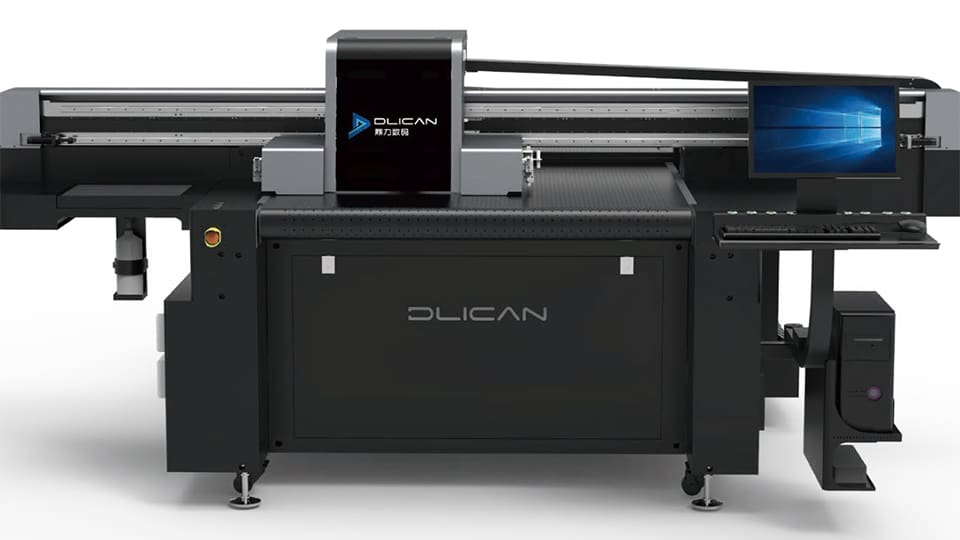
For higher-volume workflows, CPS offers a belt scanner that uses AI to provide a continuous ‘scan-and-print’ solution. This has been developed to enable seamless, uninterrupted production rather than stopping to reset for each bed. Cylindrical printing solutions like the Dlican DLI-360 also come with Auto Shape Mapping tools, enabling the machine to scan and adapt to the specific contours of the object being printed to ensure accurate registration even on complex shapes.
In Clutton’s opinion: “Basic automation is now the industry standard. Features like automatic media alignment pins and anti-collision systems are expected by buyers to protect their printheads and expedite job changeovers.” By contrast, he believes that authentic AI features like the aforementioned visual positioning camera are “presently regarded as high-value options for businesses with specific, complex production requirements.”
Clutton regards AI as a tool that eases tedious tasks like setup processes, rather than completely replacing the operator. He gives the example of CPS’ AI Visual Positioning system, which allows operators to “randomly position multiple items, such as bottles or promotional gifts, on the bed, and the machine will handle the complex registration.” According to Clutton: “This flexibility allows the human team to focus on quality control and creative design instead of spending hours measuring distances or building physical jigs. It essentially safeguards the print process, enabling the operator to concentrate on the commercial outcome.”
We expect systems that can autonomously detect print errors in real-time and adjust parameters without human intervention
A number of further innovations in AI-powered print hardware will come in the near future, according to Clutton. Among these updates, he believes that “the drop-and-print concept, currently used in our rotary options, will expand to larger formats.”
He continues: “As features like the Auto Shape Mapping feature on our DLI-360 rotary printer mature, we expect systems that can autonomously detect print errors in real-time and adjust parameters without human intervention. This will make 24/7 unattended printing a practical reality for more businesses.”
As McCombe earlier emphasised, while AI can help with many repetitive or time-consuming tasks, its use in more creative spheres can be more of a sticking point, with the jury still out on where it can align with human originality and imagination. In the view of Karis Copp, owner of B2B PR agency, KC Media: “Print and signage’s core value comes from creativity, craft, and connection with an audience, and the role humans play in that value isn’t replaceable.”
Copp believes that AI is great at automating repetitive tasks, reducing time working on administrative tasks, and improving operational accuracy, but emphasises that: “This in turn gives people the time and capacity to focus on higher value activity such as strategic thinking, creative ideation, and nurturing customer relationships.” As Copp stresses: “When you view AI’s role through that lens, I think it actually makes human creativity more important, not less.”

She also believes that human oversight is still critical in all systems, especially for something like signage which “is a physical medium with physical consequences.” Copp continues: “Our judgement as professionals is key to setting parameters for AI and is essential for making the final calls. Let’s not forget that AI can make mistakes and even hallucinate after all.”
As more print and signage businesses move from experimentation to implementation, we should start to see clearer evidence of what works
Asked what further AI innovations we will see in the future, Copp hypothesises: “AI will continue to move beyond individual tools into more systemic implementation, and more connected workflows.” She believes that while there is a great deal of buzz around AI in print and signage, as with almost every industry, there are not yet enough in-depth case studies that demonstrate the long-term impact of AI in practice. She comments: “It’s fantastic to see so much experimentation and innovation, but it will be interesting to follow company insights on things like efficiency gains, revenue growth, reduced waste, improved customer experience, and sales/marketing performance.
“As more print and signage businesses move from experimentation to implementation, we should start to see clearer evidence of what works, what doesn’t, and where AI delivers the most value.”
In my AI feature for Print Monthly last year, I spoke to print-focused software company, Antigro Designer, about its various generative and machine-learning AI tools and how they aim to streamline workflows and operations. Checking in on the company in 2026 is therefore a great case study of where the companies innovating new AI tech are setting their sights.
Antigro Designer develops personalisation and customisation tools to enable users to provide personalised print products. Alongside tools such as automated cropping, positioning, and layout adjustments, its software also utilises AI for features including background removal, photo enhancement for low-resolution images, and creative tools such as image ‘cartoonising’.
Speaking about Antigro’s more recent focus, Waclaw Mostowski, chief revenue officer and co-founder of Antigro Designer, says: “Over the past year, we have been working on refining these tools to be faster, more accurate, and more accessible across devices, particularly when it comes to mobile.”

Antigro has also introduced a new generative AI feature for its Sticker Builder tool in the last year, which allows users to design custom stickers through prompting, which Mostowski says “further reduces barriers to creativity for non-designers.” This evolution reflects what Antigro sees as a growing demand for more complex personalisation without added complexity for either the customer or the print provider.
Mostowski believes that AI will continue to play an increasingly pivotal role in end-to-end print workflows. In his opinion: “This includes smarter prepress automation, improved error detection, greater consistency in colour management, and more intelligent optimisation of ink and material usage.”
He also highlights the still-growing use of AI in the personalisation space. As he explains: “AI will continue to make mass customisation more accessible for all design abilities, as well as more scalable and commercially viable, including for signage and on-demand print where run lengths are shrinking and expectations around speed and accuracy are rising.”
While Mostowski keeps his cards close to his chest in terms of revealing upcoming releases and innovations from Antigro, he emphasises that the company’s focus will remain on integrating more complex and intelligent automation, while simultaneously making the process ever more intuitive for the end user. As he concludes: “Our focus remains on creating tools that make advanced personalisation achievable for businesses of all sizes. Innovation is an ongoing process at Antigro Designer, and while we can’t share specific details yet, we certainly have some exciting developments in the pipeline.”