Adventures in Sign Painting: A Ceiling Mural in Panama City
Sam Roberts takes a look at Panama’s answer to the Sistine Chapel which has people looking up at a mural that provided a steep learning curve, and sore necks, to sign painters Camila Borrero and Damiano Damianovich.
Guest Writer
June 12, 2023
Lettering above at Innova 109 in Panama City
Panama’s “City of Knowledge”
Camila (known as Cami to her friends) was born in Colombia, but moved to Panama as a child shortly after America handed over control of the Panama Canal at the end of 1999. The result was a large area of the city left vacant where the Clayton military base had been located. Cami’s family settled there, running a bakery and café that’s still serving coffee and cake today.
Prior to the handover, this part of the city had been earmarked for development as a centre of research and innovation. Under the banner of Ciudad del Saber (City of Knowledge), the 120-hectare area has since emerged as a hub for science and creativity in Panama. One small part of this is the co-working space and ‘incubator’ Innova 109, housed in a former church.
Do Something Crazy
After studying in Buenos Aires, Cami returned to Panama City and started taking on sign painting jobs. Her café was the obvious first client and joining her in this endeavour was Damiano Damianovich, who she met in Argentina. The managers of Innova 109 saw Cami painting signs nearby and approached her about decorating their flexible events space.
Cami recalls the brief being extremely loose—essentially “do something crazy”.
Since she was already part of the wider Ciudad del Saber community, the project was close to her heart, and she had a good understanding of the organisation, and the space. During the project’s development, further themes emerged, including the importance of ideas and the hard work required to make them happen. The client wanted to inspire the Innova 109 community and promote their entrepreneurial and supportive culture.
From Sketching to Ceiling
Cami and Damiano started by developing a colour palette and some broad graphic themes for the work. This was all done on an iPad using ProCreate. At this stage, the exact nature of the final piece wasn’t known, and things were complicated by the planned installation of noise-reduction panels on the walls. This led to the idea of working on the ceiling, which determined the final direction for the project.
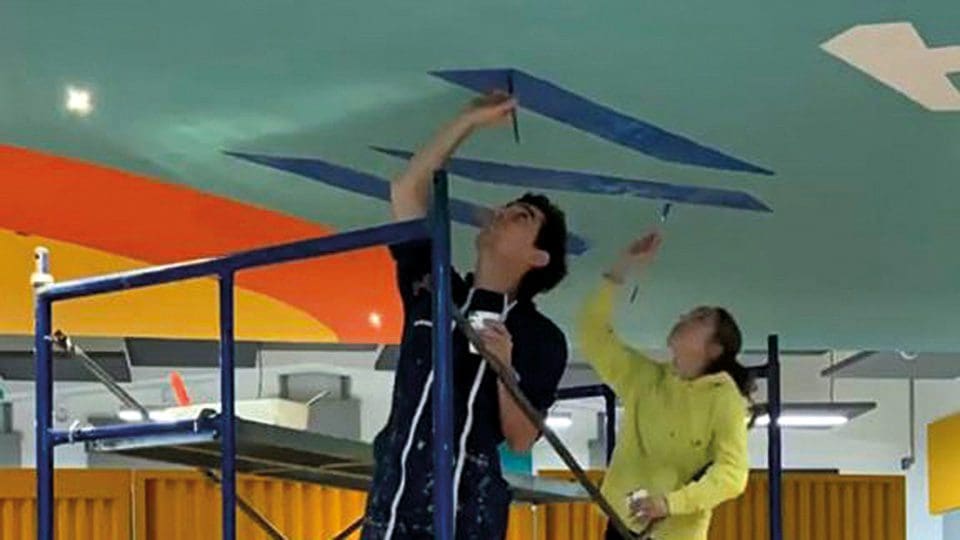
Damiano Damianovich and Camila Borrero found that working above oneself requires various adjustments to manage dripping paint and avoid excessive neck strain
Cami recalls this being hard to visualise at first, but they continued to brainstorm ideas and develop sketches. Damiano remembers their moment of clarity when seeing a ceiling-mounted poster on a bus—it was upside down! Reflecting on this gave them the insight needed to tackle their project.
One of the big lessons they learned across the whole project was that ceiling work should be charged at two to three times the rate for an equivalent wall mural—not only is the design process more complex, the installation itself is much slower due to the need to take more breaks to rest your neck.
An Idea About Ideas
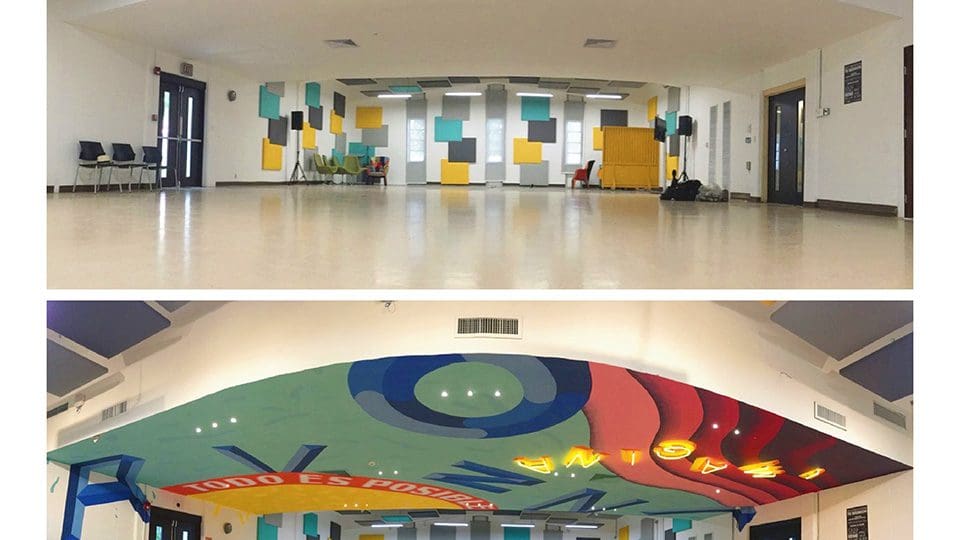
The broad concept of the final piece is the process of abstract ideas becoming reality—in short, a “World of Ideas”. This consists of three stages in the life of an idea: emerging from a black hole; evolving in a sea of innovation; and, finally, becoming concrete things in the real world. These are represented by the corresponding texts: Imagina (Imagine); Innova (Innovate); and Todo es Posible (Anything is Possible).
Ultimately, there was no stretching of the letters to correct perspective from any given viewpoint. The mural was instead designed to work from the multiple angles it would be seen from. Cami and Damiano carried out multiple tests on site before finalising the design. These consisted of mounting drawings to the ceiling to check how distinct elements would work together, and how they would look from different perspectives.
They also played with different scales of lettering, and avoided too much detail so that colour blocks could be done with rollers—much easier to work with on a ceiling versus brushes.
Additional visual elements were added through the use of mounted neon letters for the Imagina part, representing the light-bulb moment associated with good ideas.
Cami and Damiano also decided to straddle some of the letters across the ceiling and the walls, along with other graphic elements from the mural. This again supported the notion of ideas moving from mental abstractions into the real world.
Different elements from the final ceiling mural, including the addition of neon laid over the hand-painted lettering
The final installation took two weeks on site. Ahead of this, Cami and Damiano trained at the gym to get themselves physically ready for working on the ceiling—they don’t think it helped much as the sore necks were ultimately unavoidable! After painting the block Imagina lettering, the Stamps Neon firm installed the illuminated elements.
For anyone attempting to pull off something similar, Cami and Damiano advise ensuring the floor is well covered as there are sure to be lots of drips. These will also inevitably run down the length of your brush and onto your hands, making this type of work much messier than usual. Finally, it’s important to work in front of your head and body. This requires more care, as you’re not looking square-on at your work, but helps to prevent paint getting into your eyes and hair, and reduces the strain on your neck.
The mural was completed just before the pandemic which resulted in a delay to the events space opening. However, it is now up and running, and helping to inspire those at Innova 109 to make their ideas reality, just as Cami and Damiano did with their rollers and brushes on the ceiling.
This article is adapted from the version that first appeared in Issue 01 of BLAG (Better Letters Magazine). Camila and Damiano can be found on Instagram via @camitype and @damianodamianovich respectively.
Sam Roberts is the editor and publisher of BLAG (Better Letters Magazine), the world's only print and online publication dedicated to sign painting.
He has written numerous books and articles on the craft and its history, and first became interested in the topic via the fading ‘ghost’ signs around London.
SignLink subscribers can sign up with a special discount to the publication via bl.ag/signlink.
With a career spanning many facets of sign-making, Signmode has taken David Mearns back to where it all started with no regrets. Ahead of Mearns’ return to The Sign Show, Sam Roberts speaks to this traditional signwriter
As 2025 comes to an end, we look ahead to the new year with advice from several voices from across the print and signage industries, who give their thoughts and advice on what to keep in mind for your business in 2026
SignLink speaks to Linda Edwards from the BSGA following the launch of the new SICCS Provisional Card for commercial signage installers, which is designed to provide compliant site access
Watch our latest video of the week
SignLink gives you the latest video coverage of companies, people, and events from within the signage, graphics, and wide-format print industries.