Back to His Roots: David Mearns Gets Back on the Brush at 50
With a career spanning many facets of sign-making, Signmode has taken David Mearns back to where it all started with no regrets. Ahead of Mearns’ return to The Sign Show, Sam Roberts speaks to this traditional signwriter
Guest Writer
August 17, 2026
When David Mearns picks up the phone for our conversation, he’s in the middle of paying bills and other bookkeeping tasks. These now come naturally to him after more than 40 years in the business of signs, but it wasn’t always so; in his teenage years he “was awful at maths” and finished school with just two O Levels in Art and Technical Drawing. However, his success in those subjects was perhaps inevitable for someone that “always had a pencil in [his] hand and was constantly drawing”. He’s now wielding a pencil once again, alongside the brush that is the main tool of his trade – traditional signwriter.
Seeking (and Finding) Direction
Although he was born in The Wirral, Merseyside, David grew up in Surrey and after getting those O Levels as a 16-year-old, he had no idea what he was going to do next. One day while walking in Guildford with his dad they happened upon a signwriter lettering a shop fascia. As they paused to watch him work, David’s dad casually remarked: “You could do that”
A seed had been sown and, not long afterwards, a school friend mentioned that the local Guildford Signs firm was looking for an apprentice. David’s mum drove him to their shop, where she was also invited inside and given a cup of tea in the waiting room while he got interviewed. Up against 20 other hopefuls, he got the position and started work in July 1985.
Formative Years
Guildford Signs provided David with a traditional apprenticeship, an opportunity that is largely closed to today’s aspiring signwriters. The vast majority of the firm’s work was hand-painted, and he was quickly making himself useful around the shop. His early responsibilities included coating out boards before they were lettered by the signwriters, and later he progressed onto double coating larger letters, gradually developing his skills, even though he didn’t feel like he was making progress.
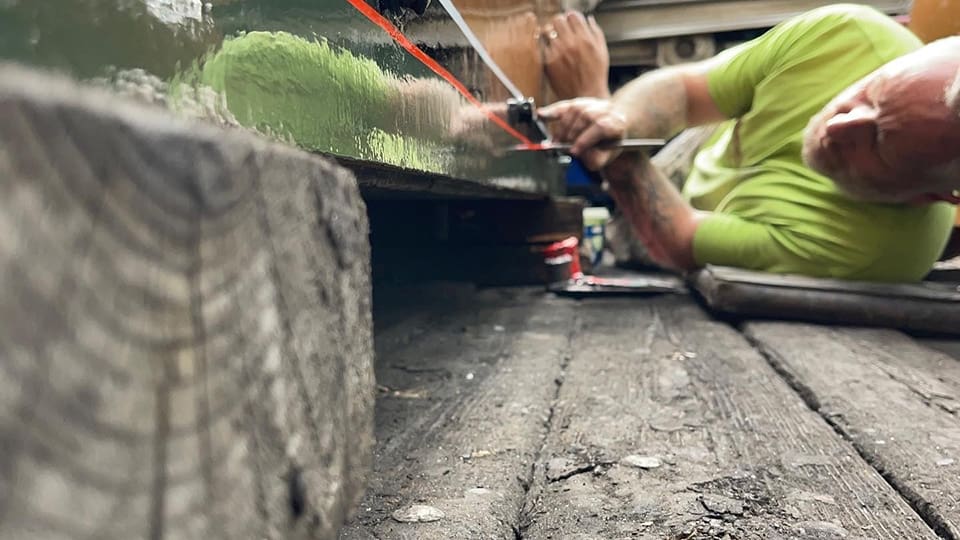
Hand lining train buffers, the only way to do this while making sure you don’t fall in the pit – Fenchurch Steam Engine, The Bluebell Railway April, 2022
Despite having only one working eye, the boss, Mark Allen, was a fine signwriter, and nothing like the grumpy taskmaster stereotype of shop foremen. One day he saw David admiring some skilful lettering work in progress and offered up some encouraging words: “One day with practise, you’ll be doing this”, and, sure enough, it came to pass.
David worked at Guildford Signs for the best part of eight years, with most of this in the era when everything was done by hand. From fascia signs to vehicles, the shop covered all the traditional aspects of signwriting and gilding, and he emerged as a well-rounded ‘sign man’.
Embracing Technology
One of David’s mottos is “never stop learning” and, while traditionally trained, he spent the next 25 years or so working across a range of different sign-making disciplines and technologies. From extra-large dimensional letters and illuminated signs to vinyl and vitreous enamel, he continued to add new skills and techniques to his repertoire. Rather than resisting new technologies like large-format printing, he was driven to learn how they worked and which applications they were best suited to.
In addition to design, fabrication, and installation work, David also spent time in project and production management roles, developing his understanding of pricing, scheduling, and customer services. He was often working with blue chip clients, learning how they operate and what they need from the sign shops that serve them. Throughout all of this, his curiosity was a driving force, consistently seeking new experiences that built the knowledge required to solve problems and recommend the best approaches for different customer requirements.
Back to the Future
After an extended period of time commuting from the mainland to the isle of Wight for his last employer, David began to feel an overwhelming desire to go it alone and, in doing so, return to his signwriting roots. This came to a head in early 2020 and, although unconnected to the onset of the Covid-19 pandemic, he set up his current business, Signmode, in February of that year. Based in Worthing, West Sussex, Signmode is a full-service shop, but the vast majority of its output is 100% hand painted. Most of this is subcontracted from larger sign firms, with a smaller portion comprising local, private clients.
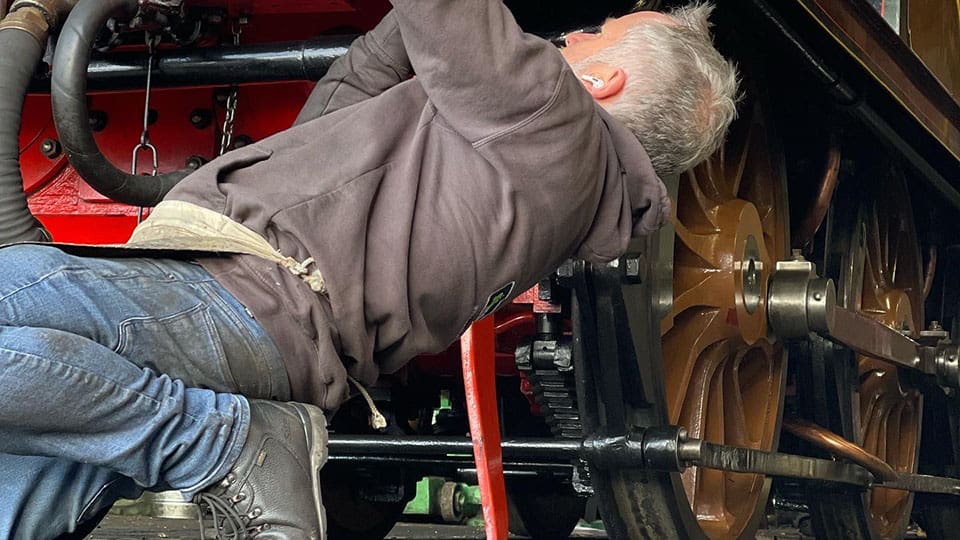
Hand lining the water tanks, "much easier and cleaner when they are on the train!" – Fenchurch Steam Engine, The Bluebell Railway May, 2022
David has relished this new direction and his passion for the craft is felt by his loyal and growing clientele. He has been able to draw on his decades of industry experience to quickly build a thriving business doing what he loves. He credits another technology – LinkedIn – as a solid marketing platform, alongside his existing network and word-of-mouth recommendations.
His work now takes him all over the country, with pre-dawn starts not uncommon, but doing it for himself, which makes it all worthwhile. While speaking with him, he was in the middle of a project that required renting temporary space at Brighton City Airport to accommodate a series of hand-painted safety screens for a 140m-tall student accommodation building in Canary Wharf. Some of these measure 14 × 7m, with their efficient production facilitated by the use of mask and spray techniques – “It’s all about finding the best way to deliver what the client needs, not forcing a brush into situations where it isn’t necessary,” says David.
Passing It On
After the 2020 shift in his career direction, David had another epiphany in 2022. This came after attending a four-day reverse glass gilding course in Torquay, Devon, taught by master craftsperson David Adrian Smith MBE. Driving back to Worthing, with his head full of the possibilities emerging from this intensive learning experience, he decided that he wanted to add teaching to his own activities. The result is The Sign Painter and its monthly workshop for those that want to learn some signwriting basics. With groups capped at four people, the hands-on day takes them through the basics, including tools and materials, brush control, and transfer techniques, with each participant taking home a finished personal project.
The workshop is a long way from the years-long apprenticeship that David served, but most of his students are essentially hobbyists or those looking to get off their screens and do something with their hands. However, there are often some that have a degree of natural talent and David is actively considering taking on an apprentice of his own one day. And the lucky person will likely pick up a lot more than the technical skills needed to be a signwriter, including that all-important number crunching that makes it pay.
As 2025 comes to an end, we look ahead to the new year with advice from several voices from across the print and signage industries, who give their thoughts and advice on what to keep in mind for your business in 2026
SignLink speaks to Linda Edwards from the BSGA following the launch of the new SICCS Provisional Card for commercial signage installers, which is designed to provide compliant site access
As customers across different age demographics all embrace various forms of social media, David Osgar looks at the best ways for signage and print companies to use different platforms to strengthen their brand and reach new customers
Watch our latest video of the week
SignLink gives you the latest video coverage of companies, people, and events from within the signage, graphics, and wide-format print industries.